Ai Best in category 1 results Programming AI Tool

Popular AI tools in the Programming field of Ai include Aider, etc., helping you quickly improve efficiency.

Free
Aider

Aider

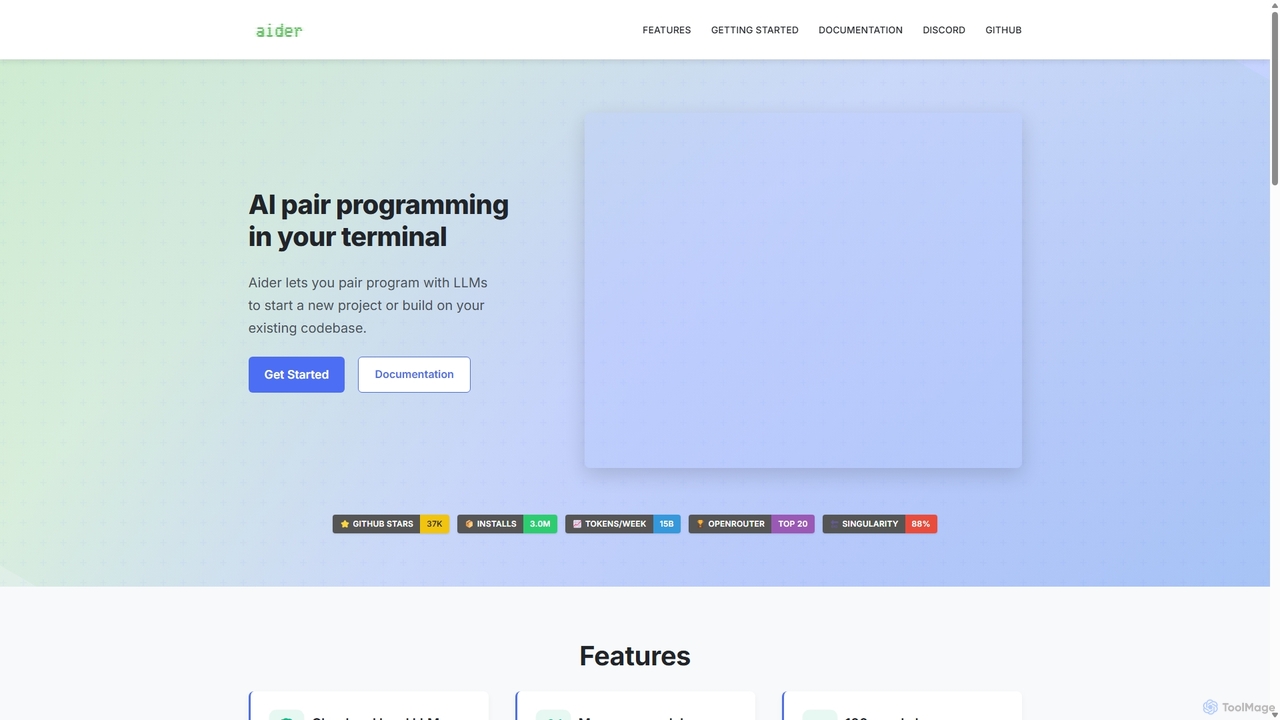
Aider is an AI-powered pair programmer that operates directly in your terminal. It intelligently maps your entire codebase, …

404.1K

About Programming

AI Programming tools are AI-powered applications designed to assist and automate various stages of software development. Leveraging advanced machine learning and natural language processing, these tools can generate code, debug, refactor, and optimize programming tasks. They significantly enhance developer productivity, reduce errors, and accelerate the overall software development lifecycle, making coding more accessible and efficient for both seasoned professionals and new learners.

Core Features

  • Code Generation: Automatically generates code snippets, functions, or entire components from natural language descriptions or design specifications.
  • Intelligent Code Completion: Provides context-aware suggestions and completions, learning from user patterns and common coding practices.
  • Debugging & Error Detection: Identifies potential bugs, syntax errors, and logical flaws, often suggesting fixes or improvements.
  • Code Refactoring & Optimization: Analyzes existing code to suggest improvements for readability, performance, and maintainability.
  • Test Case Generation: Automatically creates unit tests and integration tests based on code logic and requirements.
  • Documentation Assistance: Helps generate comments, docstrings, and API documentation from code.

Applicable Scenarios

AI Programming tools are invaluable for software engineers, data scientists, and even non-technical users looking to automate tasks. They are widely used in rapid prototyping, where developers need to quickly build out new features or applications. These tools also excel in automating repetitive coding tasks, freeing up developers to focus on complex problem-solving and architectural design. Furthermore, they can assist in understanding and modernizing legacy codebases, making maintenance more efficient.

How to Choose

When selecting an AI Programming tool, consider its compatibility with your primary programming languages and development environments (IDEs). Evaluate the accuracy and quality of the generated code, as well as its ability to integrate seamlessly into your existing workflow. Look for features like customization options, security protocols for code handling, and the level of support for specific frameworks or libraries. Finally, assess the pricing model and community support to ensure it aligns with your team's needs and budget.

ProgrammingUse Cases

1

Accelerating Web Development with AI

A web developer needs to quickly build a new user interface component or a backend API endpoint. Instead of writing boilerplate code from scratch, they use an AI programming tool. By providing a natural language description like "create a responsive navigation bar with a logo and three menu items" or "generate a Python Flask endpoint for user registration," the AI tool rapidly produces the initial code structure. This significantly reduces the time spent on repetitive coding, allowing the developer to focus on custom logic and unique features, thereby accelerating project delivery.

2

Automating Data Science Scripting

A data scientist frequently writes Python or R scripts for data cleaning, analysis, and visualization. Manually writing complex data manipulation or statistical modeling code can be time-consuming and prone to errors. With an AI programming tool, the data scientist can describe their data processing needs in plain English, such as "clean missing values in 'age' column using mean imputation" or "generate a scatter plot of 'sales' vs 'marketing_spend' with a regression line." The AI then generates the corresponding code, allowing the data scientist to focus more on interpreting results and extracting insights rather than on syntax and boilerplate.

3

Generating Unit Tests Automatically

A software engineer is responsible for maintaining code quality and ensuring robust functionality through comprehensive unit testing. Manually writing unit tests for every function and edge case can be tedious and time-consuming, especially in large codebases. An AI programming tool can analyze the existing code, understand its logic, and automatically generate relevant unit test cases. For instance, given a function, the AI can create tests for valid inputs, invalid inputs, boundary conditions, and error handling, significantly reducing the manual effort and improving test coverage and code reliability.

4

Modernizing Legacy Codebases

An enterprise architect faces the challenge of updating an outdated, monolithic application written in an older language to a modern, microservices-based architecture using current technologies. Manually refactoring and rewriting large portions of legacy code is a monumental task. An AI programming tool can assist by analyzing the legacy codebase, identifying patterns, suggesting refactoring opportunities, and even generating modern equivalents for specific modules or functions. This helps in gradually migrating the application, reducing technical debt, and extending the lifespan of critical business systems without a complete, risky overhaul.

5

Assisting New Developers in Learning

A junior developer or a student is learning a new programming language or trying to understand a complex codebase. They often struggle with syntax, best practices, or grasping the overall architecture. An AI programming tool can act as an intelligent tutor. When presented with a code snippet, the AI can provide clear explanations of its functionality, suggest improvements, or generate example usage scenarios. This accelerates the learning curve, helps new developers quickly become proficient, and fosters a deeper understanding of programming concepts and existing projects.

6

Creating Custom Scripts for Automation

An IT administrator or a power user needs to automate repetitive system administration tasks, such as file backups, log analysis, or user management, but lacks deep programming expertise. Instead of spending hours learning a scripting language or searching for existing solutions, they can use an AI programming tool. By describing the desired automation in natural language, like "write a Python script to delete files older than 30 days in the 'temp' folder," the AI generates a functional script. This empowers non-programmers to create custom automation solutions, saving significant time and reducing manual errors in routine operations.

ProgrammingFrequently Asked Questions