ToolMage
Sign in

Best 1 Text Generation AI tools for Ai

Popular Text Generation AI tools in Ai include ApyHub, helping you work more efficiently.

ApyHub
Freemium

ApyHub

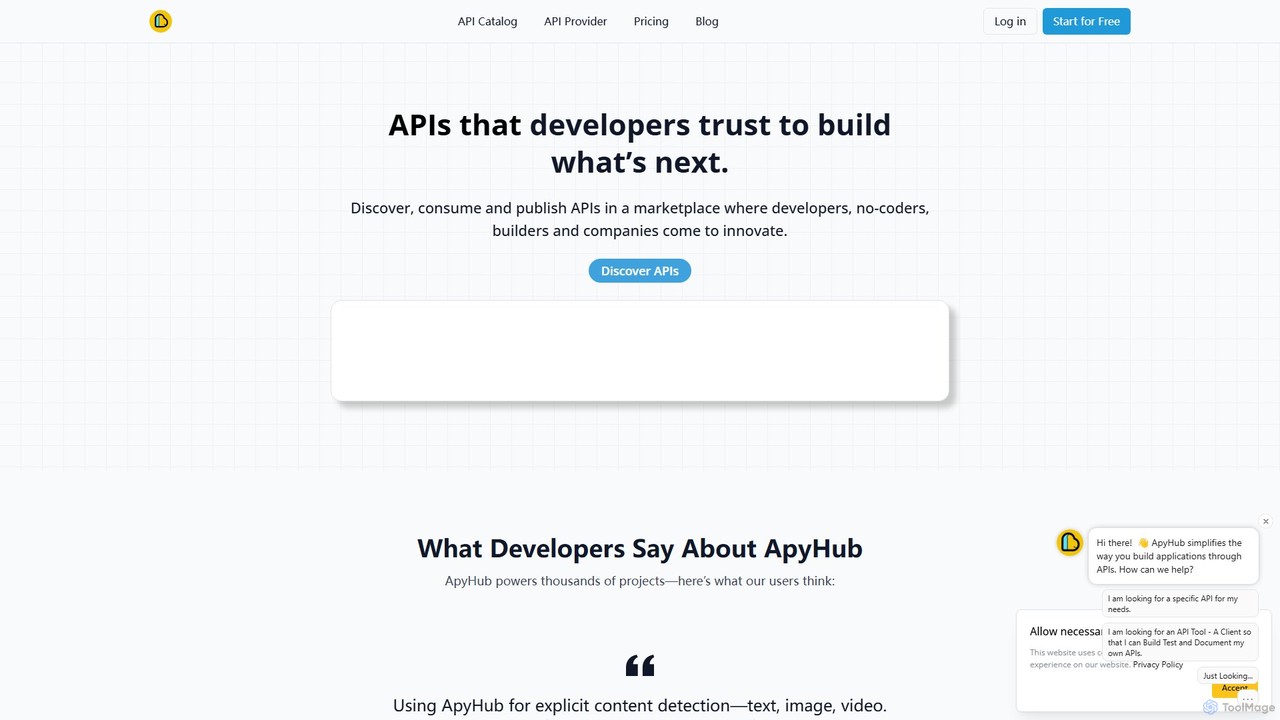
ApyHub is a comprehensive developer platform offering over 150 production-ready APIs. It's designed to accelerate application development by providing a vast catalog of utility and AI-powered APIs for tasks like data extraction, file manipulation, marketing automation, and e-commerce. It enables developers, no-coders, and teams to innovate faster by integrating trusted, pre-built functionalities, reducing boilerplate code and infrastructure management.

Text Generation
Visits 56.6KFavorites 120Likes 120

About Text Generation

Text Generation tools are AI-powered applications that automatically produce human-like written content from various inputs. Leveraging advanced natural language processing (NLP) and large language models (LLMs), these tools can create diverse text formats, from short social media posts to extensive articles and code. They significantly enhance productivity for content creators, marketers, and developers by automating routine writing tasks and accelerating content creation workflows within the broader AI landscape.

Core Features

  • Content Creation: Generates articles, blog posts, marketing copy, and creative narratives based on prompts.
  • Summarization: Condenses long documents or web pages into concise summaries.
  • Paraphrasing & Rewriting: Rephrases existing text to improve clarity, tone, or avoid plagiarism.
  • Code Generation: Assists developers by generating code snippets, functions, or entire scripts.
  • Multilingual Output: Produces text in multiple languages, facilitating global communication.

Applicable Scenarios

Content marketing teams use text generation for drafting social media updates, ad copy, and email newsletters. Journalists and bloggers leverage these tools to quickly generate article outlines or first drafts. Developers utilize them for boilerplate code, documentation, and script creation, streamlining their development cycles.

How to Choose

When selecting a text generation tool, consider its output quality and coherence, the variety of content types it supports, and its integration capabilities with existing platforms. Evaluate the pricing model, the ease of use, and the level of customization offered for tone and style to ensure it aligns with your specific needs and budget.

Featured tool rankings

Text Generation use cases

1

Crafting Engaging Marketing Copy

Marketing professionals can use text generation tools to quickly produce multiple variations of ad headlines, product descriptions, and social media posts. By inputting key product features and target audience, the AI generates compelling copy that resonates, saving hours of manual brainstorming and drafting, and enabling rapid A/B testing for optimal campaign performance.

2

Accelerating Blog Post Creation

Content creators and bloggers can leverage text generation to overcome writer's block and accelerate their workflow. By providing a topic and a few keywords, the AI can generate outlines, introductory paragraphs, or even full draft articles. This allows creators to focus on refining content, adding unique insights, and optimizing for SEO, significantly reducing the time to publish.

3

Automating Customer Service Responses

Customer support teams can integrate text generation tools to automate responses to common customer inquiries. Based on predefined FAQs or past interactions, the AI can draft personalized and accurate replies, ensuring consistent communication and reducing response times. This frees up agents to handle more complex issues, improving overall customer satisfaction.

4

Generating Code Snippets for Developers

Software developers can utilize text generation tools to quickly generate boilerplate code, functions, or even entire scripts based on natural language descriptions. This accelerates the coding process, reduces repetitive tasks, and helps in exploring different implementation approaches. It's particularly useful for generating unit tests, documentation, or converting pseudo-code into functional code.

5

Personalizing Email Campaigns at Scale

Sales and marketing teams can employ text generation to create highly personalized email campaigns for large audiences. By feeding customer data and campaign goals, the AI can craft unique subject lines, body paragraphs, and calls-to-action tailored to individual recipients. This boosts engagement rates and improves conversion by making each email feel personally addressed.

6

Summarizing Research Papers and Reports

Researchers, analysts, and students can use text generation tools to efficiently summarize lengthy documents, academic papers, or business reports. By inputting the full text, the AI extracts key information and condenses it into a coherent, concise summary. This saves significant time in information gathering and helps in quickly grasping the core arguments or findings without reading the entire document.

Text Generation FAQ

What are Text Generation tools?

Text Generation tools are AI-powered applications that automatically produce written content. They utilize advanced natural language processing (NLP) and large language models (LLMs) to understand prompts and generate human-like text across various formats, from marketing copy to code. Their core purpose is to automate and accelerate the creation of diverse written materials.

How do Text Generation tools work?

Text Generation tools primarily work by employing large language models (LLMs) that have been trained on vast datasets of text and code. When a user provides a prompt or input, the LLM analyzes it to understand the context and intent. It then predicts the most probable sequence of words to generate a coherent and relevant response, often using deep learning architectures like transformers to produce human-like output.

What are the main benefits of using Text Generation tools?

The main benefits of using Text Generation tools include significant time savings in content creation, overcoming writer's block, and generating diverse content variations quickly. They can enhance productivity for marketers, writers, and developers, ensure content consistency, and facilitate personalization at scale. These tools also help in automating routine writing tasks, allowing users to focus on more strategic work.

How do Text Generation tools differ from AI writing assistants?

While often overlapping, Text Generation tools primarily focus on creating new content from scratch or minimal input, such as generating a full article or a new ad copy. AI writing assistants, on the other hand, often assist in the writing process by offering grammar checks, style suggestions, sentence rephrasing, or completing sentences. Text generation is about creation, while writing assistants are more about refinement and enhancement of existing text.

Who can benefit most from Text Generation tools?

A wide range of professionals can benefit from Text Generation tools. This includes content creators, bloggers, and journalists for drafting articles and stories; marketing and sales teams for generating ad copy, emails, and social media posts; software developers for code generation and documentation; and customer service teams for automating responses. Essentially, anyone who regularly produces written content can find value in these tools.