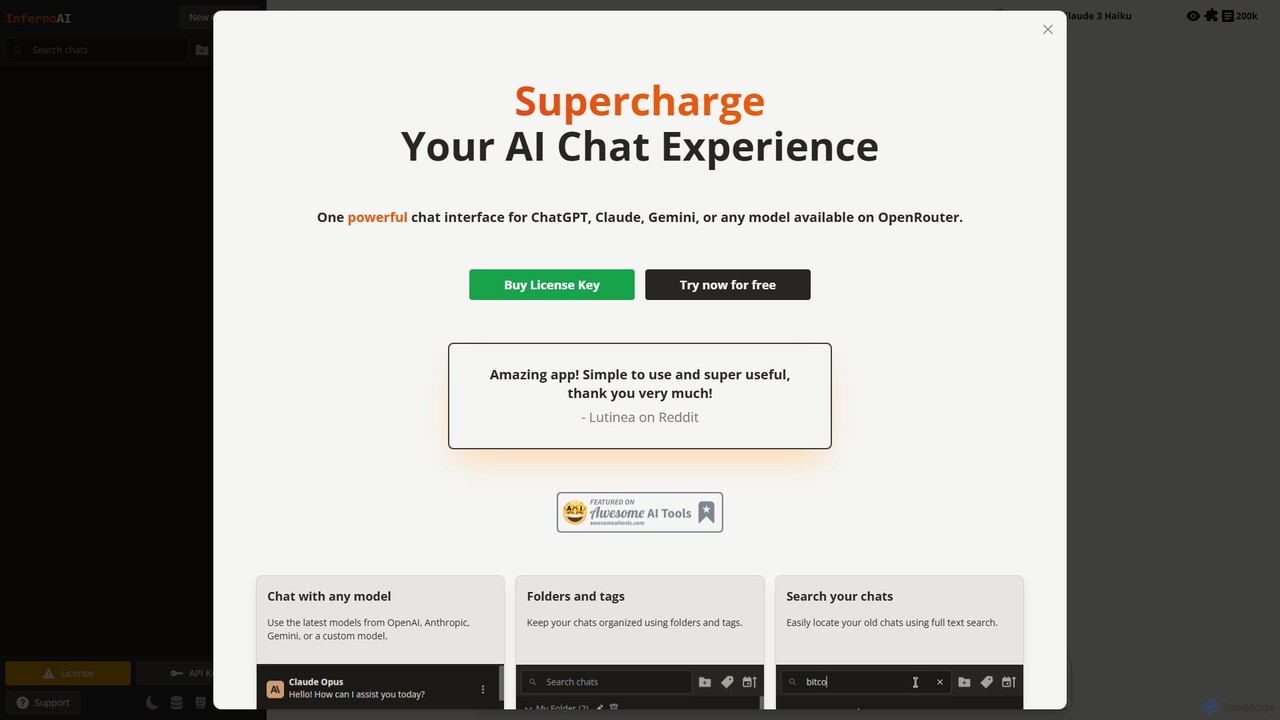
An AI Chat Interface is the user-facing front-end that enables seamless interaction with artificial intelligence models, particularly conversational AI. These interfaces provide a structured and intuitive environment for users to input prompts, receive AI-generated responses, and manage ongoing dialogues. They act as a crucial bridge, simplifying complex AI functionalities and making advanced AI capabilities accessible for various applications, from customer service to creative content generation.
Core Features
- Intuitive Prompt Input: Offers clear text fields and often supports multi-modal inputs like voice or image for diverse queries.
- Conversation History Management: Stores and organizes past interactions, allowing users to revisit, continue, or reference previous dialogues.
- Customizable AI Personas: Enables users to define or select specific AI personalities, tones, or knowledge bases for tailored interactions.
- Response Formatting & Editing: Presents AI outputs in readable formats and sometimes allows users to refine or edit the generated content directly within the interface.
- Integration Capabilities: Connects with various AI models (e.g., GPT, Claude) and third-party applications for extended functionality.
Use Cases
AI Chat Interfaces are vital in scenarios where direct and efficient human-AI communication is paramount. They are extensively used in customer support for agents to quickly retrieve information or draft responses, in content creation for brainstorming and generating text, and in educational settings for interactive learning. These interfaces empower users across industries to leverage AI's power without needing deep technical expertise.
How to Choose
When selecting an AI Chat Interface, prioritize ease of use, ensuring it offers a clean and intuitive design. Evaluate its compatibility with your preferred AI models and existing workflows, looking for robust integration options. Consider customization features, such as persona settings and response formatting, to tailor the AI experience. Finally, assess security protocols and data privacy policies, especially for sensitive information, to ensure a trustworthy interaction environment.