100 School
100 School is an online learning platform designed to make AI and tech skills accessible to everyone. It …
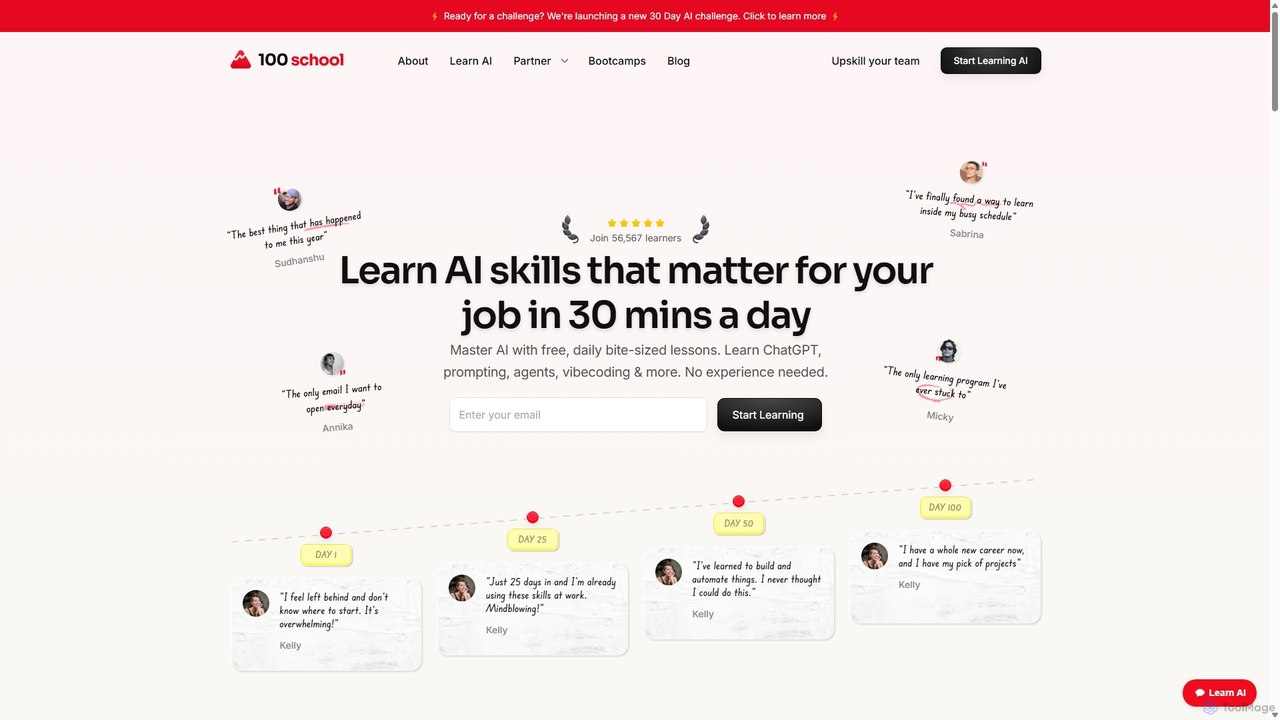
100 School is an online learning platform designed to make AI and tech skills accessible to everyone. It offers free, daily, bite-sized lessons (30 minutes) that help professionals, career switchers, and lifelong learners master practical skills like ChatGPT, prompting, no-code, and automation without needing prior experience. The focus is on building real-world skills and forming a consistent learning habit.
About Ai Learning
AI Learning tools are specialized educational platforms designed to teach artificial intelligence concepts and skills. These platforms provide structured courses, interactive coding environments, and real-world projects to facilitate hands-on learning. They are crucial for aspiring developers, data scientists, and professionals seeking to upskill in areas like machine learning, deep learning, and natural language processing. Unlike generic online courses, AI Learning tools often integrate cloud computing resources and pre-configured environments, removing technical barriers for beginners.
Core Features
- Interactive Coding Environments: Write and execute AI code directly in the browser without complex local setup.
- Guided Learning Paths: Follow structured curricula from fundamental concepts to advanced specializations.
- Project-Based Learning: Apply knowledge by building real-world AI applications and models for a portfolio.
- Algorithm Visualization: Understand complex models like neural networks through interactive diagrams and simulations.
- Skill Assessments & Certification: Validate your knowledge through quizzes, assignments, and earn shareable certificates.
Applicable Scenarios
These tools are widely used in academic settings for computer science courses and by tech companies for internal training and upskilling programs. Individuals use them for career transitions into AI roles or to learn specific frameworks like TensorFlow or PyTorch. Business leaders also leverage non-technical courses on these platforms to grasp AI's strategic implications.
Selection Criteria
When choosing an AI Learning tool, consider your current skill level and learning objectives (e.g., career change, skill enhancement). Evaluate the depth and breadth of the curriculum, the programming languages supported (Python is key), and the quality of project-based assignments. Also, check the platform's community support, mentorship options, and whether it offers recognized certifications.

Ai LearningUse Cases
Building a First Machine Learning Model
A university student with basic programming knowledge wants to enter the field of AI. They use an AI Learning platform's guided path for beginners. The platform provides interactive notebooks where they learn Python for data science, key concepts of machine learning like regression and classification, and how to use libraries like Scikit-learn. For their final project, they follow a step-by-step tutorial to build an image classifier that can distinguish between cats and dogs, deploying it as a simple web app within the platform's environment. This provides a tangible portfolio piece and solidifies their foundational knowledge.
Developer Upskilling in Natural Language Processing (NLP)
A software developer with experience in web applications needs to learn NLP for a new project involving a chatbot. They enroll in an advanced NLP specialization on an AI Learning platform. The course covers topics from text preprocessing and sentiment analysis to modern transformer models like BERT. Using the platform's integrated GPU resources, they fine-tune a pre-trained language model on a custom dataset for a specific business task. The hands-on labs and projects allow them to quickly gain practical skills that are directly applicable to their new role, reducing the time needed for on-the-job training.
AI Literacy for Business Leaders
A product manager needs to understand the capabilities and limitations of AI to make informed strategic decisions. They take a non-technical course titled 'AI for Business Leaders' on a learning platform. The curriculum avoids deep coding and focuses on conceptual understanding. Through case studies and interactive simulations, they learn about different types of AI, project lifecycles, data requirements, and ethical considerations. This knowledge helps them communicate more effectively with the technical team, identify viable AI opportunities for their product, and set realistic project timelines and expectations.
Mastering Advanced Deep Learning Techniques
A data scientist aims to deepen their expertise in computer vision. They enroll in an advanced deep learning course that focuses on convolutional neural networks (CNNs), object detection, and image segmentation. The learning platform provides access to powerful GPUs, which are essential for training these complex models efficiently. They work on a capstone project to build a system that can detect and classify multiple objects in real-time video streams. The platform's pre-configured environment with all necessary libraries saves them hours of setup time, allowing them to focus solely on model architecture and experimentation.
Portfolio Building for a Career Change
An individual from a non-tech background is aiming to switch careers and become a data analyst. They use an AI Learning platform that emphasizes project-based learning. Over several months, they complete a series of projects with increasing complexity: cleaning and analyzing a sales dataset, building a predictive model for customer churn, and creating an interactive dashboard to visualize their findings. The platform allows them to publish these projects online as a professional portfolio. When applying for jobs, they can share this portfolio with recruiters, demonstrating practical skills and real-world problem-solving abilities beyond just a course certificate.
Using AI Learning Tools in University Courses
A university professor teaching an 'Introduction to AI' course uses an AI Learning platform as a core component of their curriculum. Instead of traditional homework, students complete interactive coding assignments and labs on the platform. The auto-grading feature provides instant feedback, saving the professor significant time. For the final project, students use the platform's datasets and computing resources to train and evaluate their own models. This approach provides a standardized, equitable learning environment for all students, regardless of their personal computer's specifications, and ensures they gain practical, hands-on experience.