ToolMage
Sign in

Best 1 Workflow Management AI tools for Ai Tools

Popular Workflow Management AI tools in Ai Tools include Yugong, helping you work more efficiently.

Yugong
Free

Yugong

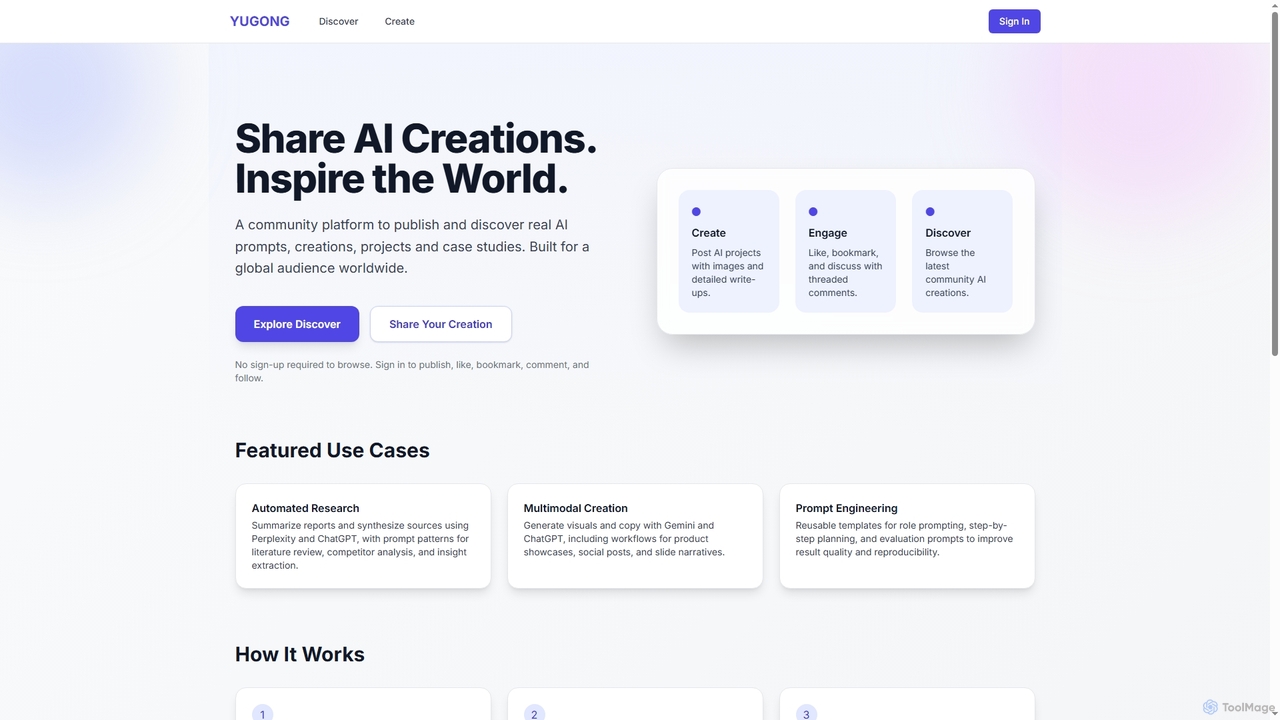
Yugong is a global community platform for discovering and sharing AI creations, prompts, projects, and case studies. It enables users to publish detailed AI workflows, engage with a worldwide audience, and explore innovative applications of AI tools like ChatGPT, Gemini, and Perplexity.

Prompt Sharing
Visits 4.7KFavorites 123Likes 119

About Workflow Management

Workflow Management tools are AI-powered solutions designed to automate, optimize, and streamline business processes and tasks. Leveraging machine learning and natural language processing, these tools intelligently manage sequences of operations, from simple approvals to complex cross-departmental projects. They enhance operational efficiency, reduce manual errors, and provide data-driven insights for continuous process improvement across various industries.

Core Features

  • Intelligent Task Routing: Automatically assigns tasks to the most suitable team members based on availability, skills, and workload.
  • Process Automation: Automates repetitive, rule-based tasks and entire multi-step workflows, reducing manual intervention.
  • Anomaly Detection: Identifies deviations from standard process flows or potential bottlenecks using predictive analytics.
  • Performance Analytics: Provides real-time dashboards and reports on workflow efficiency, task completion rates, and resource utilization.
  • Adaptive Learning: Learns from past workflow data to suggest improvements, optimize routing, and adapt to changing business needs.

Use Cases

These tools are invaluable for organizations seeking to enhance productivity and agility. They are widely adopted in sectors like IT, finance, HR, and customer service to manage complex operations, ensure compliance, and accelerate service delivery. From automating invoice approvals to orchestrating software development pipelines, AI-driven workflow management transforms how work gets done.

How to Choose

When selecting a Workflow Management tool, consider its integration capabilities with existing systems, the level of customization offered for unique business processes, and its scalability to grow with your organization. Evaluate the AI's intelligence in task prediction and anomaly detection, as well as the clarity of its analytics and reporting features. User-friendliness and vendor support are also crucial for successful adoption.

Workflow Management use cases

1

Automating Invoice Approval Workflows

Finance departments can utilize AI workflow management tools to automatically route invoices for approval based on vendor, amount, and department. The AI can identify discrepancies, flag potential fraud, and ensure compliance with spending policies, significantly reducing manual review time and accelerating payment cycles. This frees up finance personnel for more strategic tasks.

2

Automating Invoice Processing

For finance departments, AI workflow management tools can automatically extract data from incoming invoices, validate information against purchase orders, route approvals based on predefined rules, and initiate payments. This drastically reduces manual data entry errors, accelerates payment cycles, and frees up accounting staff for more strategic tasks.

3

Streamlining Customer Support Ticket Resolution

Customer service teams can deploy these tools to intelligently categorize incoming support tickets, prioritize them based on urgency and customer impact, and automatically assign them to the most appropriate agent or department. AI can also suggest knowledge base articles or pre-written responses, drastically cutting down resolution times and improving customer satisfaction.

4

Streamlining Employee Onboarding

HR teams utilize these tools to automate the entire onboarding journey, from sending welcome emails and collecting necessary documents to setting up IT accounts and assigning initial training modules. The system ensures all compliance steps are followed and provides a personalized, efficient experience for new hires, reducing administrative burden.

5

Enhancing Customer Support Ticket Management

Customer service centers deploy AI workflow management to automatically categorize incoming support tickets, prioritize them based on urgency and customer history, and route them to the most appropriate agent or department. Some tools can even suggest responses or automate resolution for common queries, improving response times and customer satisfaction.

6

Optimizing HR Onboarding and Offboarding

HR professionals can leverage AI workflow management to automate the multi-step processes of employee onboarding and offboarding. This includes automatically sending welcome emails, provisioning access to systems, scheduling training, and managing exit checklists. The tool ensures all necessary steps are completed efficiently and compliantly, improving the employee experience.

7

Optimizing IT Incident Response

IT operations teams use these tools to automate the detection, logging, and initial triage of system incidents. Upon detecting an anomaly, the workflow can automatically create a ticket, notify relevant personnel, initiate diagnostic scripts, and even attempt self-healing actions, significantly reducing downtime and manual intervention.

8

Managing Software Development Pipelines

Development teams can use AI workflow tools to orchestrate their CI/CD pipelines, automating code reviews, testing, and deployment stages. The AI can monitor build statuses, identify bottlenecks in the development cycle, and even suggest optimal resource allocation for faster, more reliable software releases, enhancing overall development velocity.

9

Accelerating Marketing Campaign Execution

Marketing professionals leverage workflow management to automate the creation, approval, and distribution of content across multiple channels. From scheduling social media posts and email campaigns to tracking performance and generating reports, these tools ensure consistent brand messaging and timely campaign launches, improving overall marketing agility.

10

Automating Marketing Campaign Execution

Marketing teams can utilize AI workflow management to automate the execution of complex campaigns, from content creation approvals to multi-channel distribution. The AI can schedule posts, manage asset approvals, and track campaign performance, adapting future actions based on real-time engagement data. This ensures consistent brand messaging and optimized reach.

11

Enhancing Supply Chain Logistics and Inventory

Logistics and supply chain managers can implement AI workflow tools to automate order processing, inventory management, and shipment tracking. The AI can predict demand fluctuations, optimize warehouse routes, and flag potential supply disruptions, leading to reduced operational costs, minimized stockouts, and improved delivery efficiency.

12

Automating Supply Chain Order Fulfillment

In logistics and supply chain, AI workflow tools can automate the entire order-to-delivery process. This includes verifying stock availability, generating shipping labels, tracking package movements, and updating inventory levels in real-time. It minimizes delays, optimizes resource allocation, and provides greater transparency throughout the supply chain.

Workflow Management FAQ

What are AI Workflow Management tools?

AI Workflow Management tools are software solutions that use artificial intelligence to automate, optimize, and streamline business processes. They go beyond traditional automation by employing machine learning to understand patterns, predict outcomes, and make intelligent decisions, adapting workflows dynamically. These tools aim to improve efficiency, reduce manual effort, and provide actionable insights for process enhancement across an organization.

What are AI Workflow Management tools?

AI Workflow Management tools are software solutions that use artificial intelligence to automate, optimize, and manage business processes. They go beyond traditional automation by incorporating machine learning for intelligent decision-making, anomaly detection, and predictive insights, making workflows more adaptive and efficient.

How do AI Workflow Management tools differ from traditional BPM software?

While traditional Business Process Management (BPM) software focuses on defining and executing predefined processes, AI Workflow Management tools add intelligence. They can learn from data, adapt to changing conditions, make autonomous decisions, and identify process improvements, offering greater flexibility and predictive capabilities than static BPM systems.

How do AI Workflow Management tools differ from traditional workflow automation?

Traditional workflow automation typically follows predefined rules and static sequences. In contrast, AI Workflow Management tools incorporate machine learning and predictive analytics to learn from data, adapt to changing conditions, and make intelligent decisions. They can identify anomalies, suggest optimizations, and dynamically route tasks, offering greater flexibility, intelligence, and continuous improvement capabilities beyond rigid rule-based systems.

What are the key benefits of using AI for workflow management?

The key benefits include significant improvements in operational efficiency by automating repetitive tasks, reducing human error, and accelerating process completion. AI-driven insights help identify bottlenecks and areas for optimization, leading to cost savings and better resource allocation. Furthermore, these tools enhance decision-making through data analysis and improve compliance by ensuring consistent execution of processes, ultimately boosting overall productivity and agility.

What are the key benefits of implementing AI Workflow Management?

Implementing AI Workflow Management offers several key benefits, including significant reductions in operational costs, improved process efficiency and speed, enhanced data accuracy, and better compliance. It also frees human employees from repetitive tasks, allowing them to focus on more strategic and creative work, ultimately boosting productivity and innovation.

Who can benefit most from AI Workflow Management tools?

Organizations with complex, repetitive, or high-volume processes across various departments can benefit significantly. This includes finance, HR, IT, customer service, marketing, and operations teams. Businesses looking to reduce operational costs, improve efficiency, ensure compliance, and gain deeper insights into their processes will find these tools particularly valuable. Both large enterprises and growing SMEs can leverage them to scale operations intelligently.

Which departments can benefit most from AI Workflow Management?

Virtually any department with repetitive, rule-based, or data-intensive processes can benefit. Common beneficiaries include Finance (invoice processing, expense management), Human Resources (onboarding, payroll), Customer Service (ticket routing, query resolution), IT Operations (incident management, system monitoring), and Marketing (campaign execution, content distribution).

What should I consider when implementing an AI Workflow Management solution?

When implementing, consider the tool's ability to integrate with your existing IT infrastructure and applications. Evaluate its customization options to align with your specific business processes and its scalability for future growth. Assess the vendor's support, security features, and the clarity of its analytics and reporting. A clear understanding of your current workflows and desired outcomes is also crucial for successful deployment.

What should I consider when integrating AI Workflow Management with existing systems?

When integrating, prioritize tools with robust API capabilities and pre-built connectors for your existing CRM, ERP, and other business applications. Evaluate the ease of data synchronization, security protocols, and the vendor's support for custom integrations to ensure a seamless and secure flow of information across your technology stack.