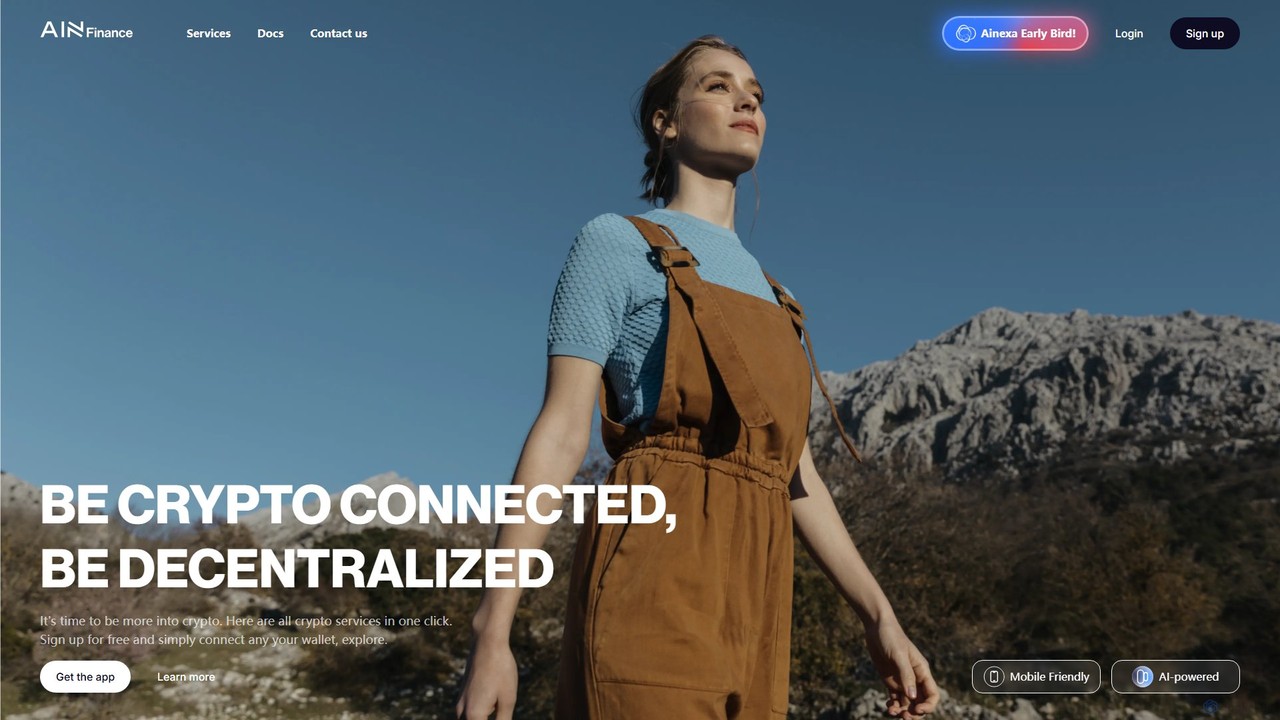
Ain Finance
Ain Finance is an AI-powered, all-in-one DeFi platform designed to simplify cryptocurrency management. It integrates services like cross-border …
Ain Finance is an AI-powered, all-in-one DeFi platform designed to simplify cryptocurrency management. It integrates services like cross-border payments, token swaps, staking, and secure wallet management across 13+ blockchains. A key feature is its professional voice AI, enabling users to execute crypto operations through voice commands, providing a unified experience for investors and traders.
About Voice Assistant
Voice Assistants are AI-powered software agents designed to understand and respond to human speech. They utilize Natural Language Processing (NLP), speech recognition, and speech synthesis to interpret voice commands and provide audible replies or perform actions. This enables users to interact with devices and services hands-free, creating a seamless conversational experience. Voice Assistants can answer questions, control smart devices, manage schedules, and execute a wide range of tasks through simple vocal instructions.
Core Features
- Speech Recognition: Accurately converts spoken language into machine-readable text to understand user commands.
- Natural Language Understanding (NLU): Interprets the user's intent and context behind the spoken words, not just keywords.
- Task Execution & Automation: Performs actions such as setting alarms, playing music, making calls, or controlling smart home devices.
- Conversational Dialogue: Engages in back-and-forth interactions, remembers context within a conversation, and asks clarifying questions.
- Information Retrieval: Accesses and retrieves information from the internet or connected databases to answer user questions in real-time.
Use Cases
Voice Assistants are widely used in consumer electronics like smartphones and smart speakers for personal productivity and home automation. In business, they are integrated into customer service phone systems for call routing and automated support. The automotive industry uses them for hands-free navigation and in-car controls, while they also serve as critical accessibility tools for users with visual or motor impairments.
How to Choose
When selecting a Voice Assistant tool or platform, consider its integration capabilities with your existing hardware and software ecosystem (e.g., iOS, Android, specific smart home brands). Evaluate the accuracy of its speech recognition and its support for different languages and accents. For developers, the availability of APIs and SDKs for custom command creation is crucial. Finally, review the provider's privacy policy to understand how voice data is collected, stored, and used.

Voice AssistantUse Cases
Hands-Free Smart Home Control
Homeowners and renters use voice assistants integrated into smart speakers or displays to manage their connected home environment. By using simple voice commands like "Turn on the living room lights" or "Set the thermostat to 22 degrees," users can control lighting, climate, entertainment systems, and security devices without touching a single button. This is particularly useful when hands are full, such as when cooking or carrying groceries, and enhances both convenience and accessibility within the home.
In-Vehicle Navigation and Communication
Drivers utilize built-in or smartphone-based voice assistants to enhance safety and convenience while on the road. They can ask for directions, find nearby points of interest, make phone calls, or dictate text messages without taking their hands off the steering wheel or their eyes off the road. The assistant provides turn-by-turn audio navigation and reads incoming messages aloud, creating a safer, less distracting driving experience while staying connected.
Automated Customer Service Routing
Businesses deploy voice assistants in their Interactive Voice Response (IVR) systems to improve customer experience. When a customer calls, the voice assistant uses NLU to understand the reason for their call in their own words, such as "I want to check my account balance" or "I have a problem with my last order." It can then either provide the information directly or intelligently route the call to the most appropriate department, bypassing complex phone menus and reducing wait times for customers.
Accessibility for Visually Impaired Users
For individuals with visual impairments, voice assistants are a transformative technology. They serve as a primary interface for interacting with smartphones, computers, and other digital devices. Users can have emails and text messages read aloud, browse the web by asking the assistant to find and read information, make calls, and manage their calendar entirely through voice. This provides a level of independence and access to the digital world that was previously much more difficult to achieve.
Hands-Free Task Management for Professionals
Professionals in various fields, such as doctors, mechanics, or lab technicians, use voice assistants to document work and manage tasks without interrupting their workflow. A surgeon could verbally log procedure notes, a mechanic could ask for repair instructions while under a car, or a scientist could record experiment results without taking off their gloves. This hands-free interaction allows for real-time data capture, improves efficiency, and maintains a sterile or safe working environment.
Interactive Language Learning and Practice
Language learners use voice assistant applications to practice pronunciation and conversational skills. These tools can present scenarios, ask questions, and evaluate the user's spoken responses for accuracy and fluency. For example, a user could practice ordering food in a restaurant or asking for directions in a new language. The assistant provides instant feedback on pronunciation and grammar, offering a patient and readily available partner for language practice anytime, anywhere.