fixa
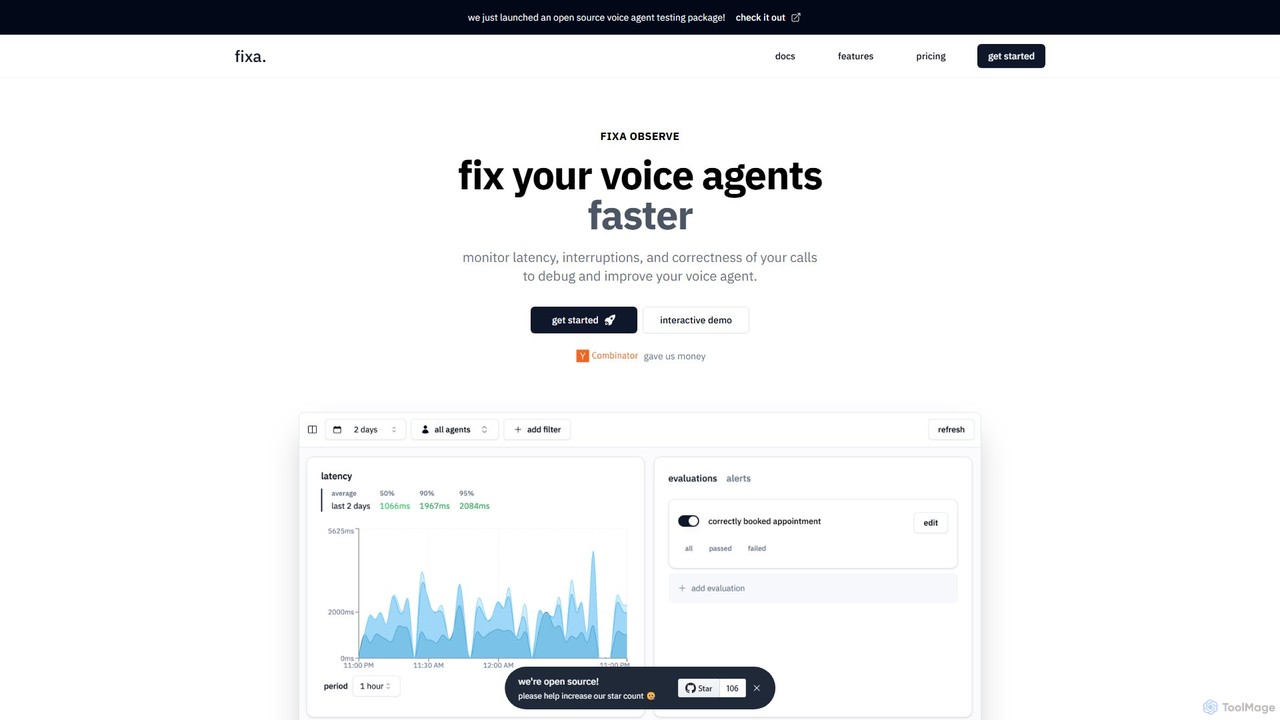
fixa is an open-source observability platform designed specifically for AI voice agents. It helps developers monitor, debug, and …
fixa is an open-source observability platform designed specifically for AI voice agents. It helps developers monitor, debug, and improve their voice AI by tracking key metrics like latency, interruptions, and conversational correctness, ensuring a high-quality user experience.
About Voice & Speech
Voice & Speech AI tools are advanced technologies designed to process, understand, and generate human language through audio. These tools leverage deep learning and natural language processing to accurately convert spoken words into text, synthesize human-like speech from text, or analyze vocal characteristics. They significantly enhance communication, automate auditory tasks, and create immersive experiences across various digital platforms, making interactions more intuitive and accessible.
Core Features
- Speech-to-Text (STT): Accurately transcribes spoken audio into written text, supporting diverse languages and accents for various applications.
- Text-to-Speech (TTS): Synthesizes natural-sounding human speech from written text, often with customizable voices, tones, and emotional nuances.
- Voice Biometrics: Identifies or verifies individuals based on unique vocal patterns, enhancing security and authentication processes.
- Emotion Detection: Analyzes speech patterns, pitch, and tone to infer emotional states, valuable for customer service and user experience analysis.
- Speech Enhancement: Filters background noise, improves audio clarity, and optimizes vocal quality for better listening and understanding.
Use Cases
These tools are indispensable for content creators, customer service centers, developers, and individuals seeking enhanced accessibility. They are widely used to automate transcription of meetings and interviews, power intelligent voice assistants in smart devices, and create engaging audio content like podcasts and audiobooks, streamlining workflows and expanding reach.
How to Choose
When selecting Voice & Speech AI tools, consider the accuracy of transcription or synthesis, the range of supported languages and accents, and the level of voice customization available. Evaluate integration capabilities with your existing platforms, data privacy policies, and the pricing model based on usage volume. Also, assess real-time processing capabilities and the quality of technical support.

Voice & SpeechUse Cases
Automated Meeting & Interview Transcription
Business professionals and researchers utilize Voice & Speech AI tools to automatically transcribe meeting recordings, interviews, and lectures. This eliminates the need for manual note-taking, ensures highly accurate records, and allows for quick keyword searches across discussions. The result is significant time savings in administrative tasks and improved efficiency in information retrieval and knowledge management.
Generating Realistic Audiobooks and Podcast Narrations
Content creators, authors, and publishers leverage Text-to-Speech (TTS) AI to convert written manuscripts into high-quality, natural-sounding audiobooks or podcast episodes. This significantly reduces the production costs and time associated with hiring professional voice actors, enabling faster content delivery and broader accessibility for audiences who prefer audio formats.
Developing Intelligent Voice Assistants and Chatbots
Developers integrate Speech-to-Text (STT) and Natural Language Understanding (NLU) AI into applications to create highly responsive voice assistants for smart devices, mobile apps, or customer service chatbots. Users can interact naturally using voice commands, enhancing user experience and streamlining task execution without the need for manual input, leading to more intuitive digital interactions.
Enhancing Customer Service with Advanced IVR Systems
Customer service departments deploy Voice & Speech AI for advanced Interactive Voice Response (IVR) systems. Speech recognition allows callers to describe their issues naturally, routing them to the correct department or providing automated solutions more efficiently than traditional touch-tone menus. This leads to improved customer satisfaction, reduced call handling times, and optimized resource allocation.
Real-time Language Learning and Pronunciation Feedback
Language learners utilize Voice & Speech AI tools to practice pronunciation and receive instant, personalized feedback. The AI analyzes their spoken words, compares them to native speaker models, and highlights specific areas for improvement, such as intonation or specific phonemes. This accelerates language acquisition and builds confidence in speaking by providing objective and consistent guidance.
Voice Biometric Authentication for Enhanced Security
Financial institutions, healthcare providers, and secure platforms implement voice biometrics for robust user authentication. Instead of traditional passwords or PINs, users verify their identity by speaking a specific phrase, which the AI analyzes for unique vocal characteristics. This provides a convenient, secure, and fraud-resistant method of access control, improving both security posture and user experience.