
Freemium
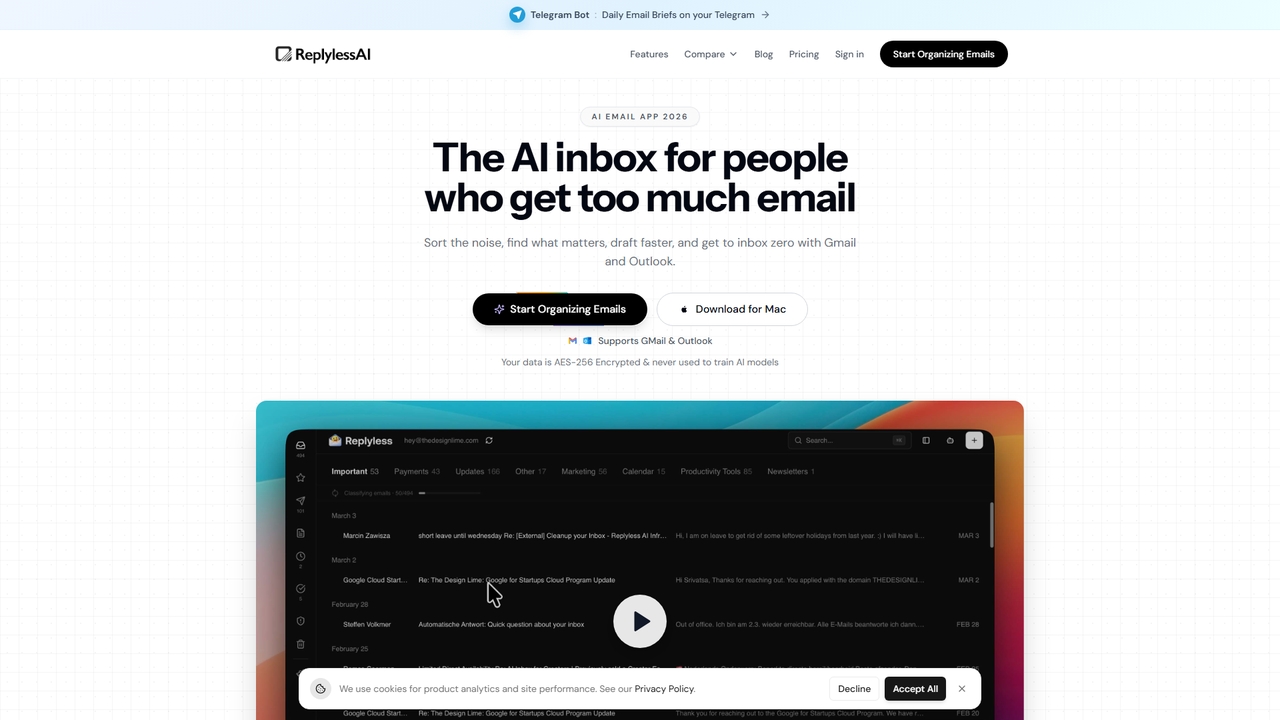
Replyless
AI-powered email inbox for founders, creators, and teams. Sort, summarize, draft, and clean up Gmail and Outlook with one intelligent workflow.
Writing AssistantVisits 10.7KFavorites 60Likes 56
Popular Writing Assistant in Ai include StoriesOnBoard and Replyless, helping you work more efficiently.
AI-powered email inbox for founders, creators, and teams. Sort, summarize, draft, and clean up Gmail and Outlook with one intelligent workflow.
Writing Assistant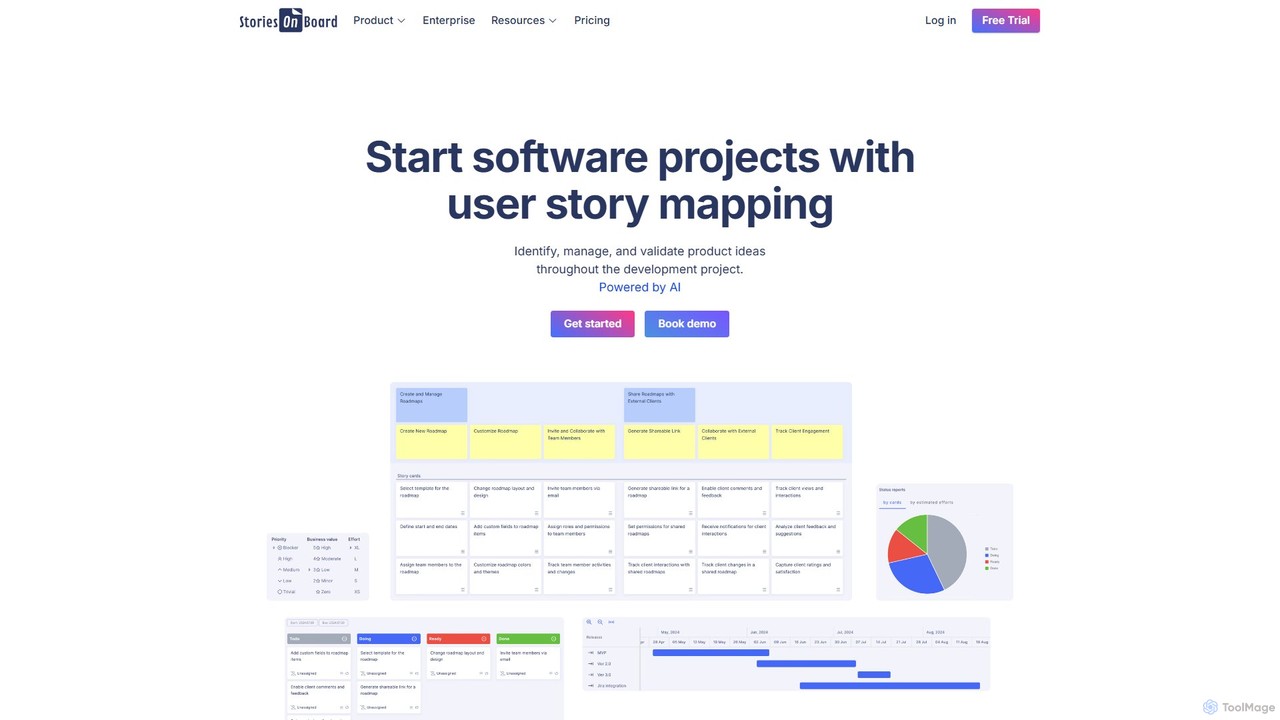
StoriesOnBoard is an end-to-end product management platform centered around user story mapping. It leverages AI to streamline workflows, from brainstorming ideas and generating user stories to creating visual backlogs and roadmaps. The tool facilitates collaboration, helps prioritize features with established frameworks, and integrates user feedback directly into the planning process, making it ideal for agile teams, product managers, and business analysts.
Writing AssistantWriting Assistant tools are a category of AI-powered applications designed to significantly enhance and streamline the writing process across various contexts. Leveraging advanced natural language processing (NLP) and sophisticated machine learning algorithms, these tools offer a comprehensive suite of features, from meticulous grammar and style correction to efficient content generation and creative idea brainstorming. They empower users to produce high-quality, engaging, and error-free text more efficiently, making complex writing tasks more accessible and less time-consuming for professionals, students, and casual writers alike. These AI writing tools act as intelligent co-pilots, improving clarity, consistency, and overall impact of written communication.
Writing Assistant tools are invaluable across a multitude of sectors, from marketing and education to journalism, technical documentation, and customer service. Content creators utilize them to quickly draft blog posts, social media updates, and marketing copy, ensuring brand voice consistency. Students leverage these AI writing assistants for proofreading essays, refining research papers, and improving academic writing quality. Businesses employ these tools to generate email campaigns, craft compelling sales pitches, and ensure clarity in internal communications, significantly reducing the time and effort spent on textual production while boosting overall communication effectiveness.
When selecting a Writing Assistant, carefully consider its core functionalities, such as advanced grammar checking, sophisticated content generation, or specialized style suggestions, to ensure alignment with your primary writing needs. Evaluate its integration capabilities with your existing writing platforms and workflows (e.g., Google Docs, Microsoft Word, CMS). Assess the accuracy, naturalness, and ethical considerations of its AI output, particularly for content generation. Finally, compare pricing models, including free tiers versus premium subscriptions, and customer support options, to find a solution that offers the best value and reliability for your specific writing demands and budget.
Marketing professionals can use Writing Assistant tools to quickly generate multiple variations of ad copy, social media posts, and email subject lines. By inputting key product features and target audience details, the AI can produce compelling, conversion-focused text, significantly reducing the time spent on initial drafting and A/B testing, leading to faster campaign launches.
A marketing specialist needs to create engaging social media posts daily for various campaigns. Using a Writing Assistant, they input a product description and target audience, and the AI generates multiple caption options with different tones and calls to action. This allows the specialist to quickly select and adapt content, saving hours of brainstorming and drafting time, and ensuring a consistent brand voice across platforms.
A university student is finalizing a complex research paper and needs to ensure it's grammatically correct, clear, and adheres to academic style guidelines. They upload their draft to a Writing Assistant, which identifies sophisticated grammatical errors, suggests improvements for sentence structure and vocabulary, and checks for academic tone consistency. This helps the student submit a polished, professional paper, improving their chances of a higher grade.
Content writers and bloggers leverage Writing Assistants to overcome writer's block and accelerate content creation. They can input a topic or outline, and the AI generates initial drafts, section expansions, or even entire articles. This allows writers to focus on refining the AI-generated content, adding unique insights, and ensuring factual accuracy, rather than starting from scratch, saving hours of effort.
A content creator is tasked with producing several blog posts weekly on diverse topics but often faces writer's block. They use a Writing Assistant by providing a topic and a few keywords. The AI then generates a detailed outline with headings and subheadings, and even a preliminary first draft for each section. This significantly accelerates the initial content creation phase, allowing the creator to focus on refining and adding unique insights.
Students and researchers utilize Writing Assistants to improve the clarity, conciseness, and grammatical correctness of their academic work. These tools can identify complex sentences, suggest more formal vocabulary, and ensure consistent citation styles (if integrated), helping to produce polished, professional-grade papers and reports that meet high academic standards.
Business professionals can use Writing Assistants to craft clear, concise, and appropriately toned emails, proposals, and internal communications. The AI can help structure messages, suggest polite yet firm language, and ensure error-free delivery, saving time and enhancing professional image in daily correspondence, ultimately improving communication effectiveness.
A technical writer is preparing user manuals and software documentation that must be precise and easy for non-technical users to understand. They run their drafts through a Writing Assistant configured for clarity and conciseness. The tool highlights jargon, suggests simpler phrasing, and identifies ambiguous sentences, ensuring the documentation is accessible and reduces potential user confusion and support requests.
A customer support agent frequently responds to similar inquiries but wants to avoid generic, templated replies. With a Writing Assistant, they can input key details of a customer's issue and a brief desired tone. The AI then generates a personalized, empathetic, and clear email response, incorporating relevant information while maintaining a professional and helpful tone, enhancing customer satisfaction and agent efficiency.
Social media managers employ Writing Assistants to generate a high volume of creative and engaging captions, hashtags, and post ideas for various platforms. By providing a theme or image description, the AI can produce diverse content options tailored to different social media channels, maintaining brand voice and audience engagement, thereby streamlining content calendars.
Analysts and knowledge workers can use Writing Assistants to quickly summarize lengthy reports, research papers, or meeting transcripts. The AI extracts key information and condenses it into concise summaries, enabling faster comprehension and efficient information sharing without needing to read every detail, thereby saving significant time in information processing.
A professional writer or researcher needs to incorporate information from various sources into their work while ensuring originality and avoiding accidental plagiarism. They use a Writing Assistant's paraphrasing feature to rephrase sentences and paragraphs from source material into unique formulations. This helps them integrate external ideas ethically and effectively, maintaining the integrity of their own writing while citing sources appropriately.
AI Writing Assistant tools are software applications that use artificial intelligence, primarily Natural Language Processing (NLP) and Natural Language Generation (NLG), to help users with various writing tasks. They can generate text, check grammar and style, paraphrase content, suggest improvements, and even brainstorm ideas, making the writing process faster and more efficient by automating repetitive or challenging aspects of text creation.
AI Writing Assistant tools are software applications that leverage artificial intelligence, specifically natural language processing (NLP) and machine learning, to help users improve and generate written content. They function as intelligent co-pilots, offering features like grammar and style correction, content generation, paraphrasing, and summarization. Their primary goal is to enhance writing quality, boost efficiency, and overcome common writing challenges for a wide range of users, from students to marketing professionals.
AI Writing Assistants go far beyond traditional spell checkers. While spell checkers only identify misspelled words, AI Writing Assistants analyze text for complex grammatical errors, punctuation mistakes, stylistic inconsistencies, and even tone. They can suggest alternative phrasing for clarity, improve sentence structure, generate new content, and detect plagiarism, offering a much more comprehensive and intelligent approach to refining written communication than basic error detection.
While traditional grammar checkers primarily focus on identifying and correcting grammatical errors, spelling, and punctuation based on predefined rules, AI Writing Assistants offer a much broader range of capabilities. They can understand context, suggest stylistic improvements, adjust tone, generate entirely new content, and even optimize text for SEO, going beyond mere error correction to actively assist in content creation and refinement.
A wide range of individuals and professionals can benefit significantly from Writing Assistants. This includes content creators, marketers, students, academics, technical writers, customer service agents, and business professionals. Anyone who regularly produces written content—from emails and reports to blog posts and academic papers—can leverage these tools to improve clarity, correct errors, save time on drafting, and ensure their message is effectively communicated to their target audience.
A wide range of users can benefit from Writing Assistants. This includes content creators, marketers, students, academics, business professionals, and anyone who regularly produces written content. They are particularly useful for those facing writer's block, needing to produce high volumes of content, or aiming to improve the clarity and impact of their communication, making writing more accessible and less time-consuming for diverse needs.
When choosing an AI Writing Assistant, look for features such as robust content generation capabilities, advanced grammar and style checking, paraphrasing and summarization tools, tone adjustment options, and seamless integration with your existing writing platforms (e.g., Google Docs, Microsoft Word). Also, consider the accuracy of its AI, ease of use, pricing model, and the availability of templates relevant to your specific writing needs.
When choosing an AI Writing Assistant, consider several key factors. First, identify your primary needs: do you need advanced grammar, content generation, or style suggestions? Second, evaluate its accuracy and the naturalness of its AI output. Third, check for integration capabilities with your preferred writing platforms (e.g., Word, Google Docs). Fourth, compare pricing models and available features across different tiers. Finally, consider data privacy policies and the tool's ability to maintain your unique writing voice.
AI Writing Assistants are powerful tools that can significantly aid and accelerate the writing process, but they are designed to assist, not replace, human writers. While they excel at generating drafts, correcting errors, and suggesting improvements, human writers bring creativity, critical thinking, nuanced understanding of audience, emotional intelligence, and unique perspectives that AI cannot fully replicate. They are best used as collaborative partners to enhance human output.
Yes, AI Writing Assistants can certainly aid creative writing, though they typically serve as a supportive tool rather than a replacement for human creativity. They can help overcome writer's block by generating ideas, plot outlines, character descriptions, or even different narrative beginnings based on prompts. While the AI can provide a foundation or inspiration, the unique voice, emotional depth, and intricate storytelling elements still largely come from the human writer, who then refines and shapes the AI's output.