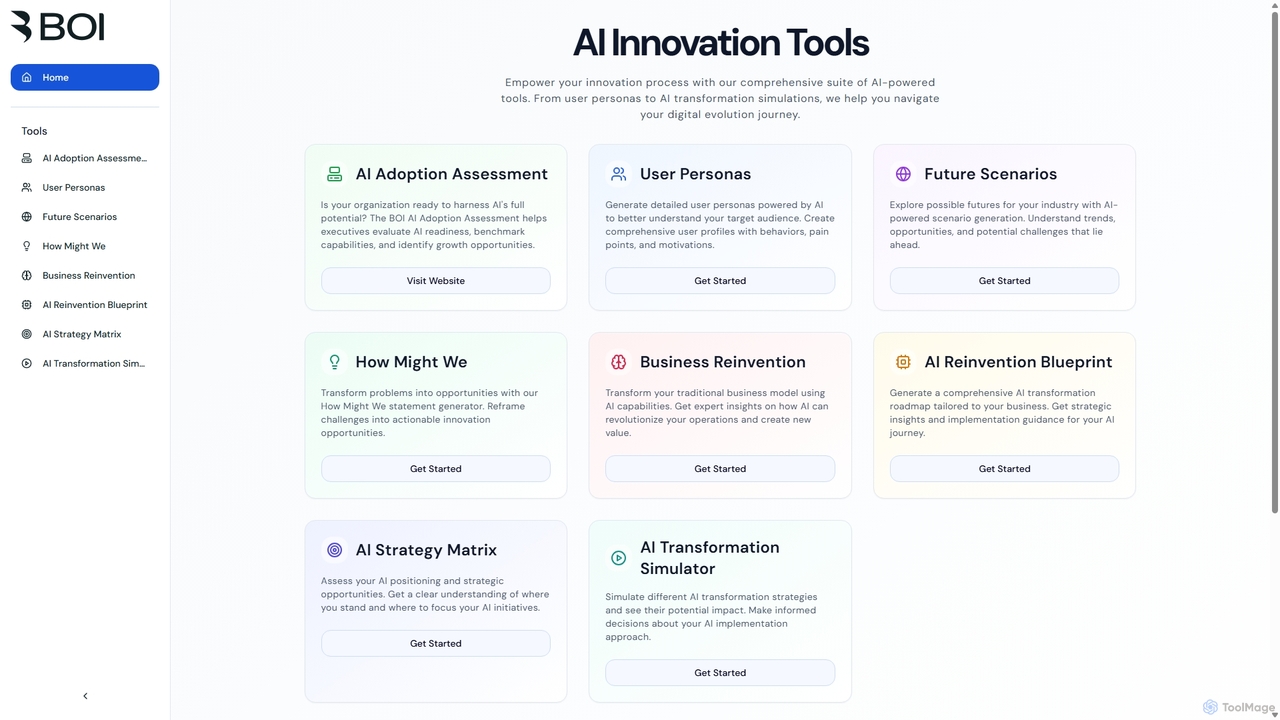
AI Innovation Platform
A comprehensive suite of AI-powered tools by Board of Innovation, designed to help businesses assess AI readiness, generate …
A comprehensive suite of AI-powered tools by Board of Innovation, designed to help businesses assess AI readiness, generate strategic insights, and simulate transformation roadmaps. It empowers executives and innovation teams to navigate their digital evolution journey with data-driven decision-making.
About Forecasting
AI Forecasting tools are a specialized category of analytics software that use machine learning to predict future outcomes based on historical data. They leverage techniques like time-series analysis, regression models, and neural networks to identify trends, seasonality, and complex patterns that traditional methods might miss. The primary value of these tools is enabling businesses to make proactive, data-driven decisions in areas like inventory management, financial planning, and resource allocation. Unlike general analytics tools that focus on past insights, forecasting tools are specifically designed to generate quantifiable future predictions.
Core Features
- Time-Series Analysis: Automatically analyzes data points over time to identify underlying trends, cycles, and seasonal variations.
- Predictive Modeling: Builds and deploys various statistical and machine learning models (e.g., ARIMA, Prophet, LSTM) to generate accurate forecasts.
- Scenario & Simulation: Allows users to model different 'what-if' scenarios by adjusting variables to understand potential future impacts.
- Multivariate Forecasting: Incorporates multiple related variables (e.g., promotions, holidays, economic indicators) to improve prediction accuracy.
- Automated Data Integration: Connects to various data sources like ERPs, CRMs, and databases to create a unified dataset for analysis.
Use Cases
AI Forecasting tools are widely used in industries such as retail, finance, manufacturing, and logistics. They are essential for roles like supply chain managers for demand planning, financial analysts for revenue prediction, and marketing strategists for estimating campaign performance. For example, a retail company can use these tools to predict product demand for the next quarter, while a utility company can forecast energy consumption to optimize grid management.
How to Choose
When selecting an AI Forecasting tool, consider the following: First, evaluate its model library and customization options—does it support the specific algorithms your business needs? Second, check its data integration capabilities to ensure it can connect seamlessly with your existing systems. Third, assess its scalability to handle your data volume and forecasting frequency. Finally, consider the user interface and technical requirements; some tools are designed for data scientists, while others offer a no-code experience for business users.

ForecastingUse Cases
Retail Demand Forecasting for Inventory Optimization
A supply chain manager for a national retail chain needs to prevent stockouts of popular items and reduce overstock of slow-moving products. Using an AI forecasting tool, they integrate historical sales data from their POS system, marketing promotion schedules, and public holiday data. The tool's time-series models automatically identify seasonal peaks (e.g., holidays) and the impact of promotions. This results in a highly accurate, SKU-level demand forecast for the next 90 days, allowing the manager to automate purchase orders and optimize inventory levels across hundreds of stores, reducing carrying costs by 15% and improving product availability.
Financial Revenue Forecasting for Strategic Planning
A CFO at a SaaS company needs to create a reliable quarterly revenue forecast for the board of directors. They use an AI forecasting tool to analyze historical subscription data, customer churn rates, new sales pipeline data from their CRM, and macroeconomic indicators. The tool's multivariate forecasting capabilities model the complex relationships between these variables. It generates a forecast with confidence intervals, showing best-case and worst-case scenarios. This allows the finance team to set realistic budgets, plan hiring, and make strategic investment decisions with a clear understanding of potential revenue outcomes.
Predicting Website Traffic for Resource Planning
A digital marketing manager for an e-commerce site needs to anticipate traffic spikes during an upcoming holiday season to ensure server capacity is sufficient. They use an AI forecasting tool connected to their Google Analytics data. The tool analyzes years of traffic history, identifying patterns related to specific holidays, marketing campaigns, and organic search trends. It predicts daily user sessions for the next quarter with over 90% accuracy. Based on this forecast, the manager collaborates with the IT team to scale server resources proactively, preventing website crashes and ensuring a smooth user experience during peak shopping periods.
Optimizing Staffing Levels in a Call Center
An operations manager at a customer service call center aims to reduce customer wait times while controlling labor costs. They employ an AI forecasting tool to predict incoming call volumes on an hourly basis. The model analyzes historical call data, seasonality (e.g., higher volumes after a product launch), and day-of-week patterns. The output is a precise forecast of call volume for each hour of the upcoming week. This allows the manager to create optimized staffing schedules, ensuring enough agents are available during peak hours and avoiding overstaffing during lulls, leading to a 20% reduction in average wait time and a 10% decrease in overtime costs.
Predicting Energy Consumption for Grid Management
An analyst at a utility company is responsible for balancing energy supply and demand. They use an AI forecasting tool to predict city-wide electricity consumption for the next 48 hours. The model integrates historical consumption data with external variables like weather forecasts (temperature, cloud cover) and public event schedules. The AI identifies complex correlations, such as how a sudden heatwave will dramatically increase air conditioner usage. The highly accurate, short-term forecast allows the company to efficiently manage power generation, schedule maintenance during low-demand periods, and prevent blackouts, ensuring grid stability and optimizing operational costs.
Forecasting Raw Material Prices for Manufacturing
A procurement manager at a manufacturing company needs to make strategic purchasing decisions for key raw materials like steel and copper, whose prices are highly volatile. They use an AI forecasting tool that analyzes historical commodity market prices, global supply chain news, geopolitical events, and currency exchange rates. The model predicts price trends for the next six months, identifying likely periods of price increases or decreases. This forecast empowers the manager to lock in favorable prices with suppliers through forward contracts or to delay purchases when prices are expected to fall, resulting in significant cost savings and a more resilient supply chain.