Sybill
Sybill is an AI sales assistant designed to automate administrative tasks for sales teams. It analyzes calls, emails, …
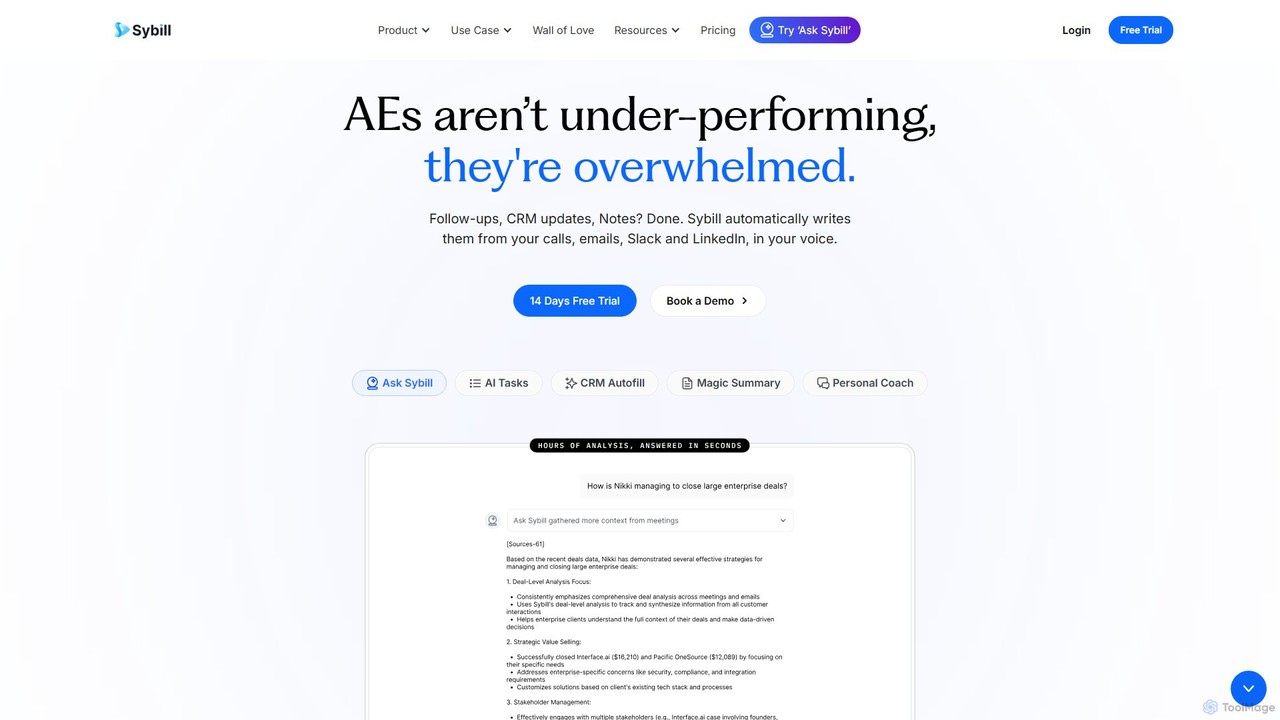
Sybill is an AI sales assistant designed to automate administrative tasks for sales teams. It analyzes calls, emails, and other communications to generate follow-ups, update CRM records, and provide deep deal insights, allowing sales professionals to focus on selling.
About Sales Intelligence
Sales Intelligence refers to AI-powered tools that gather and analyze data about sales prospects and existing customers. These platforms leverage machine learning to provide actionable insights, helping sales teams identify leads, understand buyer behavior, and optimize outreach strategies. They transform raw data into strategic information, enhancing sales efficiency and effectiveness within the broader analytics landscape.
Core Features
- Lead Scoring & Prioritization: Automatically ranks leads based on their likelihood to convert, focusing sales efforts on the most promising prospects.
- Prospect Data Enrichment: Augments contact and company profiles with comprehensive firmographic, technographic, and intent data.
- Buyer Intent Signals: Identifies prospects actively researching solutions or engaging with relevant content, indicating purchase readiness.
- Competitor Analysis: Monitors competitor activities, market trends, and customer sentiment to inform sales positioning and strategy.
- CRM Integration: Seamlessly connects with existing CRM systems to ensure unified data management and workflow automation.
Applicable Scenarios
Sales Intelligence is crucial for B2B sales teams, marketing departments, and business development professionals. It supports prospecting, lead qualification, account management, and strategic market planning. Companies looking to scale their sales operations, personalize outreach, and gain a competitive edge benefit significantly from these tools.
How to Choose
When selecting a Sales Intelligence tool, consider its data accuracy and coverage, the depth of insights provided (e.g., specific buyer intent signals), integration capabilities with your existing tech stack (especially CRM), scalability for your team size, and pricing model. Evaluate the platform's ability to deliver relevant, actionable data tailored to your industry and sales process.

Sales IntelligenceUse Cases
Identify High-Value Leads for Targeted Outreach
Sales development representatives (SDRs) use Sales Intelligence to filter through vast databases, identifying prospects whose company size, industry, technology stack, and growth signals align perfectly with their ideal customer profile. This significantly reduces time spent on unqualified leads, allowing SDRs to focus on targeted outreach to prospects with the highest conversion potential, leading to more efficient prospecting.
Personalize Outreach Messages with Enriched Data
Account executives (AEs) leverage enriched prospect data, including recent company news, job changes, technology usage, and industry trends, to craft highly personalized email and LinkedIn messages. By referencing specific details relevant to the prospect's business or role, AEs can increase engagement rates, demonstrate a deep understanding of the prospect's needs, and build rapport more effectively than with generic templates.
Monitor Buyer Intent for Timely and Relevant Engagement
Marketing and sales teams track buyer intent signals, such as website visits to competitor pages, specific keyword searches, or engagement with industry reports, to identify prospects actively researching solutions. This allows sales reps to receive real-time alerts when a prospect shows high intent, enabling timely and highly relevant outreach before competitors, significantly shortening the sales cycle.
Optimize Sales Territory Planning and Resource Allocation
Sales managers utilize geographic, industry-specific, and account-level data provided by Sales Intelligence to strategically allocate territories and optimize resource distribution. By understanding market potential, lead density, and existing customer saturation in different regions, managers can ensure balanced workloads, maximize market penetration, and align sales efforts with the highest revenue opportunities, leading to improved team performance.
Enhance Account-Based Marketing (ABM) Strategies
ABM specialists use Sales Intelligence to identify key stakeholders within target accounts, understand their roles, and gather insights into their company's challenges, initiatives, and technology stack. This granular data allows for the creation of hyper-targeted campaigns and coordinated sales efforts across multiple touchpoints, ensuring that marketing and sales messages are highly relevant and resonate with decision-makers, improving ABM effectiveness.
Analyze Competitor Landscape and Market Trends
Business strategists and sales leaders employ Sales Intelligence to continuously monitor competitor product launches, pricing changes, market share shifts, and customer feedback. This data provides a comprehensive view of the competitive landscape and emerging market trends, informing strategic adjustments, helping identify new market opportunities, and refining unique selling propositions to maintain a competitive edge and drive growth.