
ToolMage
Sign in

Best 1 Code Security AI tools for Code

Popular Code Security AI tools in Code include GitCase.dev, helping you work more efficiently.

GitCase.dev
Freemium

GitCase.dev

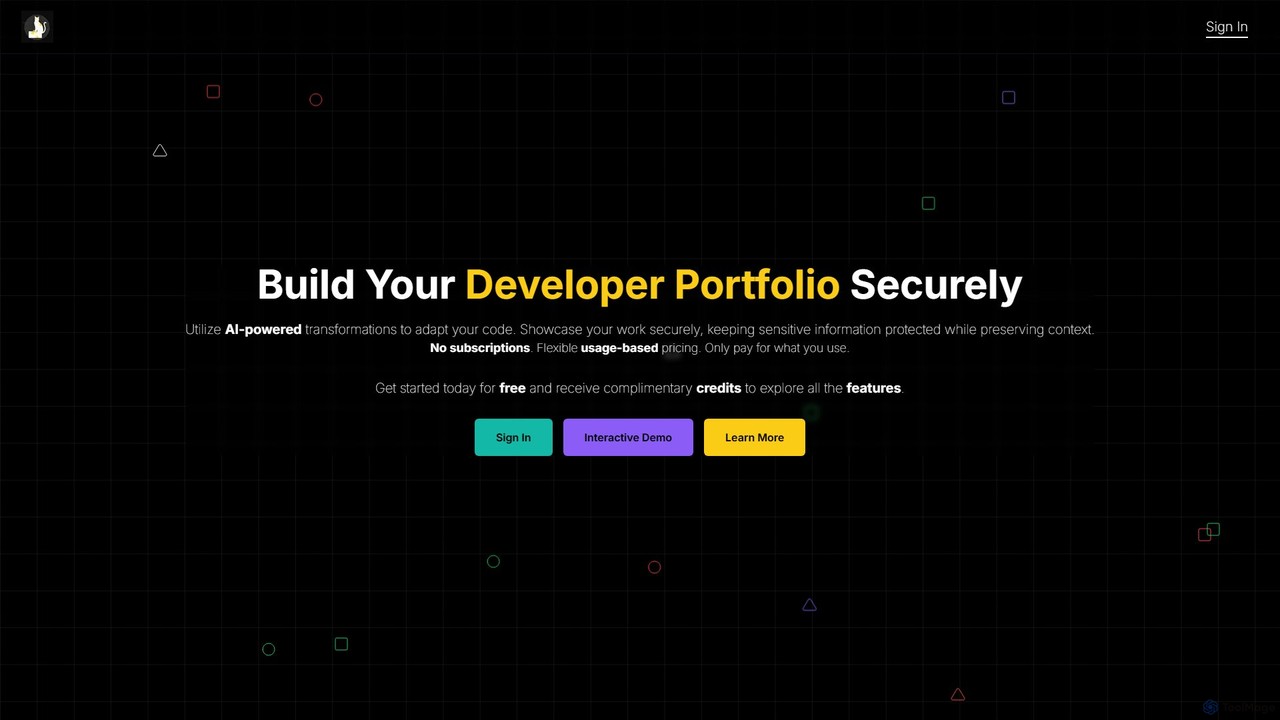
GitCase.dev is an AI-powered platform for developers to create secure portfolios. It automatically transforms code from your GitHub repositories to hide sensitive information like API keys and proprietary logic. This allows you to confidently showcase your skills to employers and clients while keeping your intellectual property protected. It features a flexible, pay-as-you-go pricing model.

Code Security
Visits 6.4KFavorites 102Likes 123

About Code Security

AI Code Security tools are specialized applications that leverage artificial intelligence to automatically detect, analyze, and remediate security vulnerabilities within source code. These tools go beyond traditional static analysis by using machine learning models trained on vast datasets of code to identify complex attack patterns and logical flaws. Their primary value lies in integrating security checks early into the development lifecycle (DevSecOps), enabling teams to build more secure software faster. By providing real-time feedback and actionable remediation advice, they empower developers to become the first line of defense against security threats.

Core Features

  • AI-Powered Vulnerability Detection: Identifies security flaws like SQL injection and cross-site scripting (XSS) with high accuracy and lower false positives.
  • Automated Code Remediation: Suggests or automatically generates code patches to fix identified vulnerabilities, accelerating the repair process.
  • Secret Scanning: Scans code repositories and CI/CD logs for accidentally exposed credentials, API keys, and other sensitive data.
  • Software Composition Analysis (SCA): Analyzes open-source dependencies to find known vulnerabilities and potential licensing issues.
  • Compliance Auditing: Automates checks against security standards such as OWASP Top 10, PCI DSS, and GDPR, generating compliance reports.

Use Cases

These tools are essential for organizations practicing DevSecOps, where security is a shared responsibility. Development teams integrate them into their IDEs and CI/CD pipelines for continuous security scanning. Security professionals and auditors use them to conduct comprehensive codebase assessments and ensure compliance with industry regulations.

How to Choose

When selecting an AI Code Security tool, consider its language and framework support to ensure it covers your tech stack. Evaluate its integration capabilities with your existing CI/CD pipeline, version control systems, and IDEs. Assess the accuracy of its detection engine by checking its false positive rates. Finally, consider the quality of its remediation suggestions and reporting features.

Code Security use cases

1

Automating Security Scans in CI/CD Pipelines

For DevOps teams, maintaining development velocity while ensuring security is a major challenge. An AI Code Security tool can be integrated directly into the Continuous Integration/Continuous Deployment (CI/CD) pipeline. Each time a developer commits new code, the tool automatically triggers a scan. It analyzes the changes for potential vulnerabilities, hardcoded secrets, or insecure dependencies. If a critical issue is found, the build can be automatically failed, preventing insecure code from ever reaching production. This 'shift-left' approach catches security flaws early, reducing remediation costs and risks significantly.

2

Real-Time Security Feedback for Developers

Developers often lack specialized security training, making it easy to introduce vulnerabilities unintentionally. By using an AI Code Security tool as a plugin within their Integrated Development Environment (IDE) like VS Code or IntelliJ, they receive instant feedback as they write code. The tool highlights insecure coding patterns, explains the potential risk in plain language, and often suggests a secure alternative. This acts as an interactive security coach, helping developers learn secure coding practices on the job and preventing vulnerabilities from being committed in the first place.

3

Comprehensive Security Audits for Compliance

A security auditor or compliance officer is tasked with verifying that an application adheres to standards like PCI DSS, HIPAA, or GDPR. Manually reviewing millions of lines of code is impractical. An AI Code Security tool automates this process by scanning the entire codebase against predefined rule sets for these regulations. It generates a detailed report that lists all potential violations, categorizes them by severity, and provides evidence by pointing to the exact lines of code. This drastically reduces audit time and provides clear, actionable data for achieving and maintaining compliance.

4

Discovering Exposed Secrets in Codebases

A common but dangerous mistake is hardcoding sensitive information like API keys, database passwords, or private certificates directly into source code. An AI Code Security tool's secret scanning feature is designed to find these exposed credentials. It uses pattern matching and entropy analysis to identify potential secrets across the entire version history of a repository. This allows security teams to proactively find and revoke exposed credentials before they can be exploited by malicious actors who gain access to the code.

5

Securing Third-Party and Open-Source Dependencies

Modern applications are heavily reliant on open-source libraries, which can introduce inherited vulnerabilities. AI-powered Software Composition Analysis (SCA) tools scan a project's dependencies (e.g., npm packages, Maven libraries) and cross-reference them against a comprehensive database of known vulnerabilities (CVEs). They can identify not only direct dependencies with issues but also transitive dependencies (dependencies of dependencies). This provides a complete picture of the supply chain risk, allowing teams to prioritize updates or replace vulnerable components.

6

Prioritizing Critical Vulnerability Fixes

A security scan can often return hundreds or even thousands of potential issues, overwhelming development teams. Advanced AI Code Security tools help prioritize these findings. They analyze factors beyond the vulnerability type, such as whether the vulnerable code is actually reachable from the internet (attack surface analysis) or if it's in a critical business function. By correlating these data points, the tool can assign a true risk score to each finding, enabling teams to focus their limited resources on fixing the vulnerabilities that pose the greatest threat to the organization first.

Code Security FAQ

What are AI Code Security tools?

AI Code Security tools are applications that use artificial intelligence, particularly machine learning, to automatically analyze source code for security vulnerabilities and weaknesses. Unlike traditional tools, they learn from vast amounts of code to identify complex and novel threat patterns. Their primary goal is to help developers find and fix security issues early in the development process, often directly within their coding environment or automated build pipelines.

How do AI Code Security tools differ from traditional static analysis (SAST)?

Traditional Static Application Security Testing (SAST) tools primarily rely on a fixed set of predefined rules and patterns to find vulnerabilities. AI Code Security tools enhance this by using machine learning models. This allows them to:

  • Reduce False Positives: AI models can better understand code context, leading to more accurate results.
  • Discover Novel Vulnerabilities: They can identify complex, multi-step vulnerabilities that don't match simple patterns.
  • Provide Smarter Remediation: AI can offer more context-aware and accurate suggestions for fixing code.
In essence, AI brings a layer of intelligence and learning that makes security analysis more effective and efficient.

How do I choose the right AI Code Security tool?

Selecting the right tool depends on your specific needs. Consider the following factors:

  • Technology Stack: Ensure the tool supports the programming languages and frameworks your team uses.
  • Integration: Check for seamless integration with your IDEs (e.g., VS Code), version control (e.g., GitHub), and CI/CD systems (e.g., Jenkins, GitLab CI).
  • Accuracy: Look for tools with a proven low rate of false positives to avoid wasting developer time.
  • Actionability: The tool should provide clear explanations of vulnerabilities and offer concrete, easy-to-implement remediation advice.

What are the key features of an AI Code Security scanner?

Most AI Code Security scanners offer a core set of features designed to provide comprehensive code analysis. Key features typically include AI-powered static analysis (SAST) for finding vulnerabilities in your own code, Software Composition Analysis (SCA) for detecting issues in open-source dependencies, secret scanning to find exposed credentials like API keys, and automated remediation suggestions to help developers fix issues quickly. Many also provide detailed reporting for compliance and security audits.

Who benefits most from using AI Code Security tools?

While the entire organization benefits from improved security, the primary users are developers and DevOps engineers. Developers benefit from real-time feedback in their IDE, helping them write secure code from the start. DevOps engineers benefit by automating security checks within their CI/CD pipelines, ensuring no insecure code is deployed. Security teams also benefit, as these tools allow them to scale security oversight across many projects without becoming a bottleneck.