
ToolMage
Sign in

Best 1 Translation AI tools for Code

Popular Translation AI tools in Code include String Catalog, helping you work more efficiently.

String Catalog
Freemium

String Catalog

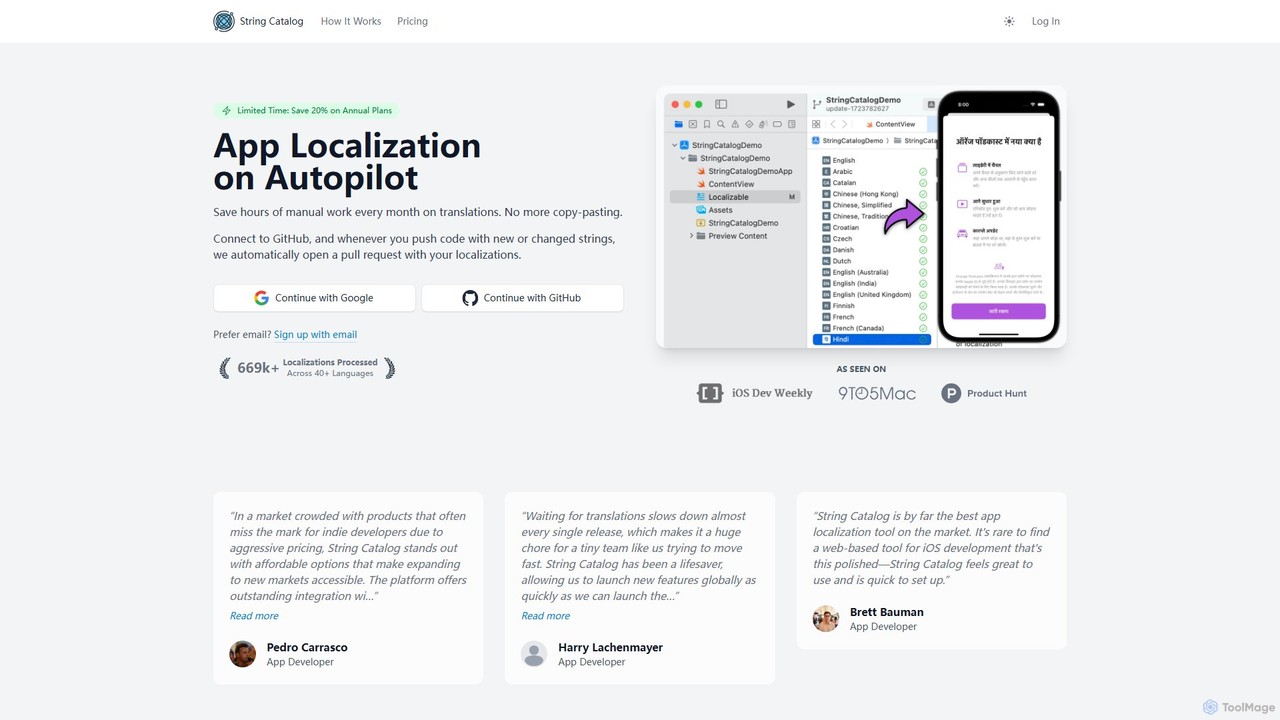
An AI-powered platform that automates iOS and Android app localization. Connect your GitHub repository, and String Catalog will automatically translate new strings and create pull requests, supporting over 40 languages and saving hours of manual work.

Translation
Visits 8.6KFavorites 94Likes 111

About Translation

AI Code Translation tools are specialized utilities that automatically convert source code from one programming language to another. Leveraging large language models (LLMs) trained on vast code repositories, these tools understand syntax, semantics, and idiomatic patterns across different languages. Their primary value lies in accelerating legacy system modernization, facilitating platform migrations, and improving interoperability between disparate codebases. This process significantly reduces the manual effort and potential for human error involved in rewriting code.

Core Features

  • Multi-Language Conversion: Translates code between various programming languages, such as Python to Java or COBOL to C.
  • Semantic Equivalence: Preserves the original logic and functionality by mapping concepts, not just syntax.
  • Dependency Analysis: Identifies libraries and frameworks in the source code and suggests suitable alternatives in the target language.
  • Idiomatic Code Generation: Produces code that follows the best practices and conventions of the target language.
  • Code Refactoring: Suggests improvements and modernizes code constructs during the translation process.

Applicable Scenarios

These tools are crucial for enterprises undertaking digital transformation projects, such as migrating mainframe applications from COBOL to modern languages like Java or Python. They are also used by software teams to unify their tech stack after a merger or to port a service to a new platform for better performance or scalability. Developers use them to quickly understand or adapt code written in an unfamiliar language.

Selection Criteria

When choosing an AI Code Translation tool, evaluate the accuracy and completeness of the translation for your specific language pair. Consider its ability to handle complex dependencies and framework-specific code. Also, assess its integration with development environments (IDEs), version control systems, and its security protocols for handling proprietary source code.

Translation use cases

1

Modernizing a Legacy COBOL System

An enterprise architect at a financial institution is tasked with migrating a 30-year-old core banking system from COBOL to Java to improve maintainability and integrate with modern cloud services. Using an AI Code Translation tool, they automate the conversion of millions of lines of COBOL code. The tool translates the business logic, data structures, and control flows into object-oriented Java code. This reduces the project timeline from years to months, minimizes the risk of manual translation errors, and allows the development team to focus on testing and integrating the new Java-based system.

2

Migrating a Python Web App to Go

A tech startup's backend service, originally built in Python, is facing performance bottlenecks as user traffic grows. The engineering team decides to migrate to Go for its superior concurrency and performance. A developer uses an AI code translator to convert the core Python application logic, including API endpoints and data processing functions, into idiomatic Go. While the framework-specific code (e.g., Django/Flask) requires manual rewriting, the tool handles over 70% of the generic logic, allowing the developer to focus on performance optimization and leveraging Go's native concurrency features, accelerating the migration process significantly.

3

Unifying a Multi-Language Microservices Architecture

Following a company acquisition, a DevOps team is tasked with managing a complex microservices environment with services written in both Java and C. To reduce operational overhead and standardize the tech stack, they decide to convert the Cservices to Java. They use an AI Code Translation tool to perform the initial conversion of the Ccodebase. The tool successfully translates .NET classes to Java classes, handles language-specific syntax differences, and provides suggestions for replacing .NET libraries with equivalent Java Spring Boot dependencies. This automated first pass saves the team weeks of manual porting effort.

4

Accelerating Cross-Platform Mobile Development

A mobile developer has built a successful Android application using Kotlin. To reach a wider audience, they need to create an iOS version. Instead of rewriting the entire application's business logic in Swift from scratch, the developer uses an AI code translator. They feed the core Kotlin logic files—such as data models, network requests, and utility functions—into the tool. The tool generates equivalent Swift code, which the developer then integrates into a new Xcode project. This allows them to focus on building the native iOS UI and adapting to platform-specific APIs, cutting down the development time for the iOS version by nearly half.

5

Automating Code Refactoring to Modern Standards

A software team maintains a large Java application written a decade ago using Java 8. To leverage new language features and improve performance, they plan to upgrade to Java 17. An AI Code Translation tool with refactoring capabilities is used to scan the codebase. The tool automatically replaces old anonymous inner classes with concise lambda expressions, converts data-holding classes to records, and applies modern API changes. This automated refactoring ensures consistency across the entire project and frees up senior developers from the tedious task of manually updating thousands of files, allowing them to focus on more complex architectural improvements.

6

Facilitating Learning a New Programming Language

A data scientist proficient in Python needs to collaborate on a project built with R. To quickly get up to speed, they use an AI code translator as a learning aid. They write familiar data manipulation and visualization snippets in Python (using pandas and matplotlib) and use the tool to see the equivalent code in R (using dplyr and ggplot2). This side-by-side comparison helps them understand R's syntax and idiomatic data handling practices much faster than reading documentation alone. It acts as an interactive dictionary, translating concepts they already know into the new language's syntax, accelerating their onboarding process.

Translation FAQ

What are AI Code Translation tools?

AI Code Translation tools are applications that use artificial intelligence, specifically large language models (LLMs), to automatically convert source code from one programming language to another. Unlike simple, rule-based transpilers, they understand the code's context, semantics, and programming paradigms. This allows them to generate more accurate and idiomatic code in the target language, often handling complex logic and suggesting replacements for language-specific libraries. They are primarily used for modernizing legacy systems and migrating applications between tech stacks.

How to choose the right AI Code Translation tool?

Choosing the right tool depends on several factors. Consider the following criteria:

  • Language Support: Ensure the tool supports your specific source and target languages (e.g., COBOL to Java).
  • Translation Accuracy: Evaluate the quality of the generated code. Does it preserve logic correctly and produce idiomatic, maintainable code?
  • Dependency Handling: Check its ability to identify and suggest replacements for external libraries and frameworks.
  • Integration: Look for integrations with your existing workflow, such as IDE plugins or connections to version control systems like Git.
  • Security: Verify the tool's security policies, especially if you are translating sensitive or proprietary code. Ensure it offers on-premise or secure cloud options.
AI Code Translation vs. a traditional transpiler: what's the difference?

The key difference lies in intelligence and context. A traditional transpiler is a source-to-source compiler that operates on a set of predefined rules to convert syntax from one language to another. It lacks understanding of the code's intent or semantics. An AI Code Translation tool, powered by an LLM, understands the underlying logic. It can make more intelligent decisions, such as mapping concepts, refactoring code to fit the target language's best practices (idioms), and handling complex patterns that a rule-based system would fail to translate correctly.

Can AI tools perfectly translate any code?

No, AI code translation is not perfect and should be viewed as a powerful accelerator, not a complete replacement for developers. While they can handle a large percentage of the conversion (often 70-95%), human oversight is essential. Complex business logic, framework-specific intricacies, and subtle performance optimizations often require manual review, testing, and refinement by an experienced developer. The translated code should always be thoroughly tested to ensure it is functionally correct, secure, and performant.

Who are the primary users of AI Code Translation tools?

The primary users are typically software engineers, enterprise architects, and IT managers involved in large-scale software projects. Key user groups include:

  • Enterprise Architects & IT Leaders: Planning and executing legacy system modernization or platform migration strategies.
  • Software Engineers & Developers: Performing the actual code conversion, refactoring codebases, or working in multi-language environments.
  • DevOps Engineers: Standardizing tech stacks and managing CI/CD pipelines for translated applications.
  • Developers Learning a New Language: Using the tools as an aid to understand syntax and patterns in an unfamiliar language.