ToolMage
Sign in

Best 1 Communication Tools for Collaboration

Popular Communication Tools in Collaboration include Gohorto, helping you work more efficiently.

Gohorto
Freemium

Gohorto

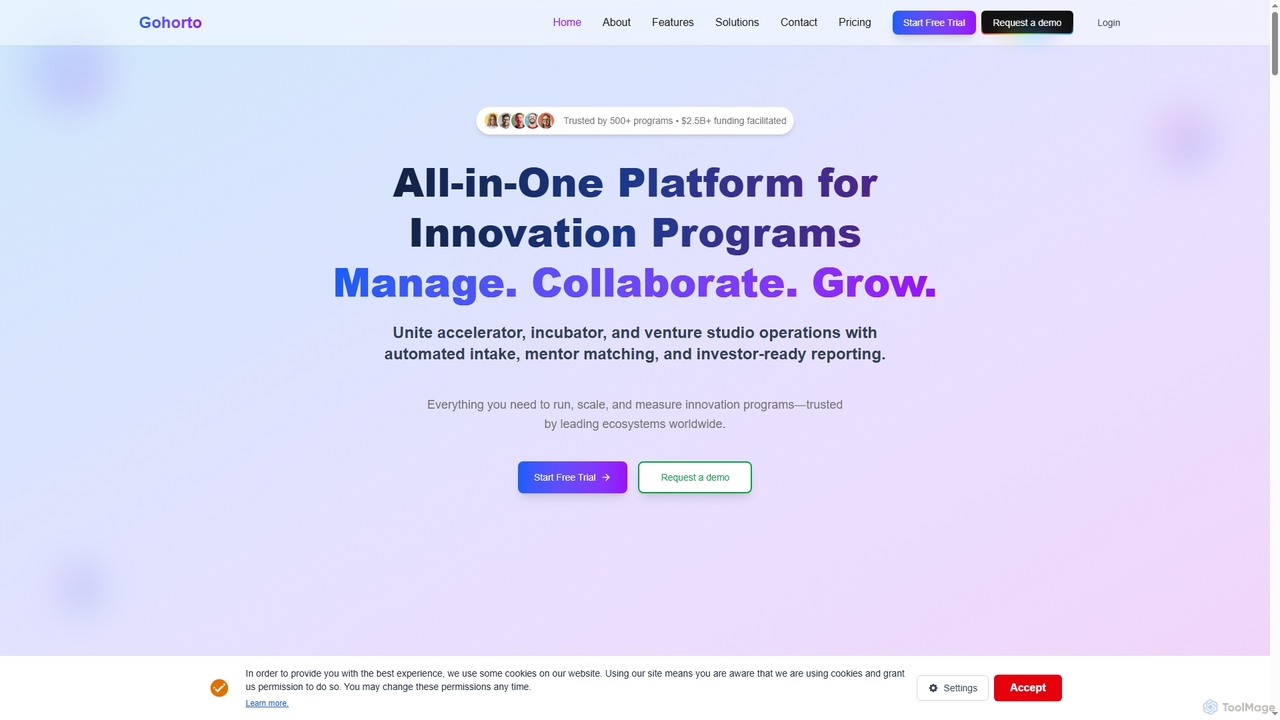
Gohorto is an AI-powered innovation program management platform designed for startup ecosystems. It unifies operations for accelerators, incubators, venture studios, universities, and corporations, streamlining application intake, mentor matching, and investor-ready reporting to foster growth and impact.

Performance Tracking
Visits 4.2KFavorites 120Likes 133

About Communication Tools

Communication Tools are AI-powered applications designed to streamline and enhance how individuals and teams interact, forming a critical subset of broader collaboration solutions. Leveraging advanced natural language processing (NLP) and machine learning, these tools automate routine communications, analyze sentiment, and facilitate clearer, more efficient information exchange. They play a crucial role in improving team cohesion, customer engagement, and overall operational efficiency, transforming traditional communication workflows with intelligent chatbots, advanced meeting summarizers, and smart notification systems.

Core Features

  • AI-powered Chatbots & Virtual Assistants: Automate customer service, internal FAQs, and routine inquiries, providing instant, accurate responses and freeing human agents for complex tasks.
  • Intelligent Meeting Summarization: Automatically transcribe and summarize meeting discussions, identifying key decisions, action items, and participant contributions for easy review and follow-up.
  • Sentiment Analysis & Tone Detection: Analyze written or spoken communication to gauge emotional tone and intent, helping users tailor responses, de-escalate conflicts, and improve overall interaction quality.
  • Automated Translation & Localization: Break down language barriers by providing real-time or asynchronous translation for global teams, international clients, and multilingual customer support.
  • Smart Notification & Alert Systems: Prioritize and deliver critical information based on urgency and relevance, reducing notification fatigue and ensuring important messages are seen and acted upon promptly.

Applicable Scenarios

These tools are indispensable for customer support teams managing high volumes of inquiries, marketing departments crafting personalized outreach campaigns, and remote teams needing efficient ways to stay connected and productive. They enable faster problem resolution in IT support, facilitate seamless project updates in agile development environments, and ensure consistent brand messaging across all customer touchpoints, from social media to email.

Key Selection Criteria

When selecting AI communication tools, prioritize solutions that offer robust integration with your existing collaboration platforms, CRM systems, and other business applications. Evaluate their natural language processing capabilities for accuracy in understanding user intent and generating human-like text, along with the level of customization available to adapt to specific industry jargon or business processes. Scalability, data security, and compliance with privacy regulations (like GDPR or HIPAA) are also critical factors, alongside user-friendliness, comprehensive analytics for performance monitoring, and responsive vendor support.

Featured tool rankings

Communication Tools use cases

1

Automating Customer Support Inquiries

E-commerce businesses can deploy AI chatbots on their websites and messaging platforms to handle common customer questions about orders, shipping, and product information 24/7. This reduces the workload on human support agents, provides instant answers to customers, and improves overall satisfaction by resolving issues quickly without human intervention for routine queries.

2

Summarizing Team Meetings & Action Items

Project managers in remote or hybrid teams use AI meeting assistants to transcribe virtual meetings and automatically generate concise summaries. These summaries highlight key decisions, assign action items to specific team members, and note deadlines, ensuring everyone is aligned and follow-ups are clear, even for those who couldn't attend.

3

Enhancing Internal Employee Communication

Large enterprises utilize AI-powered internal communication platforms to disseminate company-wide announcements, HR policies, and training materials. AI can personalize content delivery, answer employee FAQs instantly via virtual assistants, and analyze engagement metrics to ensure critical information reaches the right employees effectively and efficiently.

4

Real-time Multilingual Collaboration

International sales teams collaborating on global projects leverage AI translation tools integrated into their communication platforms. This allows team members from different linguistic backgrounds to communicate seamlessly in their native languages during calls or in chat, breaking down language barriers and fostering more inclusive and productive discussions.

5

Analyzing Customer Feedback & Sentiment

Marketing and product development teams use AI sentiment analysis tools to process vast amounts of customer feedback from social media, reviews, and support tickets. The AI identifies prevailing sentiments, common pain points, and emerging trends, providing actionable insights to refine products, improve services, and tailor marketing messages.

6

Streamlining Sales Outreach & Follow-ups

Sales professionals employ AI communication tools to automate personalized email sequences and follow-up reminders based on prospect engagement. AI can suggest optimal send times, analyze email effectiveness, and even draft initial responses to common inquiries, allowing sales reps to focus on high-value interactions and close deals faster.

Communication Tools FAQ

What are AI Communication Tools?

AI Communication Tools are software applications that use artificial intelligence, primarily natural language processing (NLP) and machine learning, to automate, enhance, and analyze human communication. They go beyond basic messaging by understanding context, generating human-like text, and providing insights. Their core purpose is to make interactions more efficient, effective, and intelligent, whether for customer service, internal team collaboration, or marketing.

How do AI Communication Tools differ from traditional communication platforms?

Traditional communication platforms (like email or standard chat apps) primarily facilitate message exchange. AI Communication Tools, however, add an intelligent layer. They can actively process, interpret, and generate content, automate responses, summarize information, analyze sentiment, and even translate languages in real-time. This proactive, analytical, and generative capability is what sets them apart, transforming passive communication into an active, intelligent process.

What are the key benefits of using AI Communication Tools for businesses?

Businesses gain several key benefits from AI Communication Tools. They significantly improve efficiency by automating routine tasks, reducing response times, and freeing up human resources. They enhance customer satisfaction through instant, personalized support and consistent messaging. Internally, they boost team productivity by streamlining information flow, summarizing meetings, and breaking down language barriers, ultimately leading to better decision-making and stronger collaboration.

How can I choose the best AI Communication Tool for my team?

To choose the best AI Communication Tool, first identify your primary communication challenges and goals (e.g., customer support automation, meeting efficiency, multilingual collaboration). Look for tools with strong NLP capabilities relevant to your industry, seamless integration with your existing tech stack (CRM, project management), and robust data security features. Consider scalability, customization options, user-friendliness, and the quality of analytics provided to measure performance and ROI.

Can AI Communication Tools replace human interaction entirely?

No, AI Communication Tools are designed to augment, not entirely replace, human interaction. While they excel at handling repetitive queries, providing instant information, and automating initial touchpoints, complex problem-solving, empathetic understanding, nuanced negotiation, and creative strategy still require human intelligence. They empower human teams to focus on high-value, complex interactions by taking over the mundane, making human communication more impactful.