Fast.io
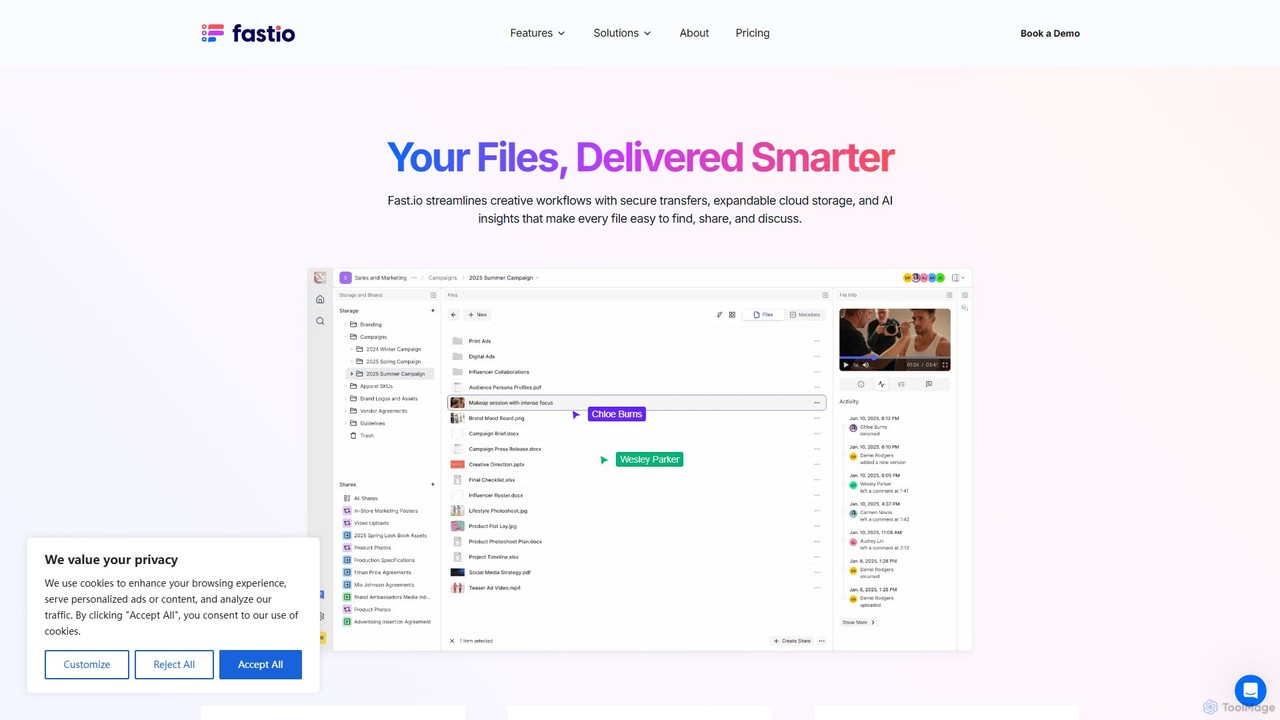
Fast.io is an intelligent file management platform that streamlines creative workflows. It offers secure file transfers, expandable cloud …
Fast.io is an intelligent file management platform that streamlines creative workflows. It offers secure file transfers, expandable cloud storage, and powerful AI insights to help teams find, share, and collaborate on digital assets effortlessly.
About Digital Asset Management
Digital Asset Management (DAM) tools are centralized systems for storing, organizing, sharing, and managing an organization's digital content. Powered by AI, these platforms often automate metadata tagging, enable advanced semantic search, and streamline content workflows, making them a cornerstone of modern collaboration. They ensure teams can quickly find, use, and distribute approved brand assets like images, videos, and documents. This enhances brand consistency, improves creative team productivity, and secures valuable intellectual property.
Core Features
- AI-Powered Auto-Tagging: Automatically analyzes images and videos to generate descriptive keywords, colors, and object tags, saving hours of manual work.
- Advanced Semantic Search: Allows users to search for assets using natural language and concepts (e.g., 'happy people at sunset') instead of just filenames.
- Version Control & History: Tracks all changes to an asset, allowing teams to access previous versions and maintain a clear audit trail.
- Access Control & Rights Management: Sets granular permissions to control who can view, edit, and download assets, ensuring compliance and security.
- Content Transformation & Distribution: Automatically converts files to different formats and sizes for various channels (web, social media, print) on the fly.
Use Cases
Digital Asset Management systems are essential for marketing departments, creative agencies, e-commerce businesses, and large enterprises. They are used to manage brand collateral for global campaigns, organize vast libraries of product photography, and streamline the content lifecycle from creation to distribution, ensuring all collaborators work with the most current and approved files.
How to Choose
When selecting a DAM tool, consider its integration capabilities with your existing software stack (e.g., Adobe Creative Cloud, CMS). Evaluate the sophistication of its AI features, such as the accuracy of auto-tagging and search. Assess its scalability to handle your growing asset library, and review its security protocols and compliance certifications to protect your digital property.

Digital Asset ManagementUse Cases
Centralize Marketing Campaign Assets
A global marketing team uses a DAM system to coordinate a new product launch. All assets—including logos, product photos, promotional videos, and social media graphics—are uploaded to a central, cloud-based library. AI automatically tags assets by product line, campaign theme, and usage rights. Team members across different regions can then search, access, and download the correct, on-brand materials, ensuring global consistency and eliminating version control issues that often arise from using shared drives or email.
Streamline E-commerce Product Imagery
An e-commerce company manages tens of thousands of product images in their DAM. When new photos arrive from a shoot, they are uploaded in bulk. The AI automatically detects product SKUs from filenames, tags images with attributes like 'color:red', 'material:cotton', and 'style:casual', and even identifies model demographics. This rich metadata allows the web team to quickly find specific images for product pages, promotions, and A/B testing, reducing manual organization time by over 80% and accelerating time-to-market for new products.
Manage Creative Agency Project Workflows
A creative agency uses a DAM as a single source of truth for all client projects. Designers upload initial concepts, which are then routed through an automated approval workflow to account managers and clients. Version control ensures everyone is reviewing the latest iteration, and feedback is captured directly on the assets. Once approved, final files are locked, and a public-facing portal can be generated to deliver the assets securely to the client, providing a professional and efficient collaboration experience from start to finish.
Enforce Corporate Brand Consistency
A large enterprise with multiple international offices uses a DAM to maintain brand consistency. A dedicated brand portal within the DAM provides all employees with self-service access to the latest logos, presentation templates, and brand guidelines. Access controls ensure that only the corporate marketing team can upload or modify core brand assets. This prevents the use of outdated logos or unapproved imagery in public-facing materials, protecting the brand's integrity across all global operations.
Automate Content Transformation for Social Media
A content creator manages a high volume of video and image content for multiple social platforms. Using a DAM, they upload a single high-resolution master video. The system's automation features then generate multiple versions tailored for different platforms: a 16:9 version for YouTube, a 9:16 vertical cut for TikTok and Reels, and a 1:1 square version for Instagram feeds. This eliminates the need for manual editing and resizing for each platform, dramatically speeding up the content publishing workflow and ensuring optimal presentation on every channel.
Archive and Retrieve Historical Media Assets
A media organization with decades of archival footage and photos uses a DAM to preserve and monetize its historical assets. Old prints are digitized and uploaded, where AI transcribes any spoken words in videos and uses facial recognition to tag public figures. Journalists and researchers can then use semantic search to find highly specific content, such as 'footage of a specific politician speaking about environmental policy in the 1990s'. This makes the vast archive easily accessible and discoverable, unlocking its value for new documentaries, reports, and licensing opportunities.