Collaboration Best in category 2 results Knowledge Management AI Tool

Popular AI tools in the Knowledge Management field of Collaboration include Collabwriting、Pillionaut, etc., helping you quickly improve efficiency.

Pillionaut

Pillionaut

Pillionaut is a hybrid intelligence platform that combines multi-model AI with human verification. It intelligently routes questions to …

2.4K
Collabwriting

Collabwriting

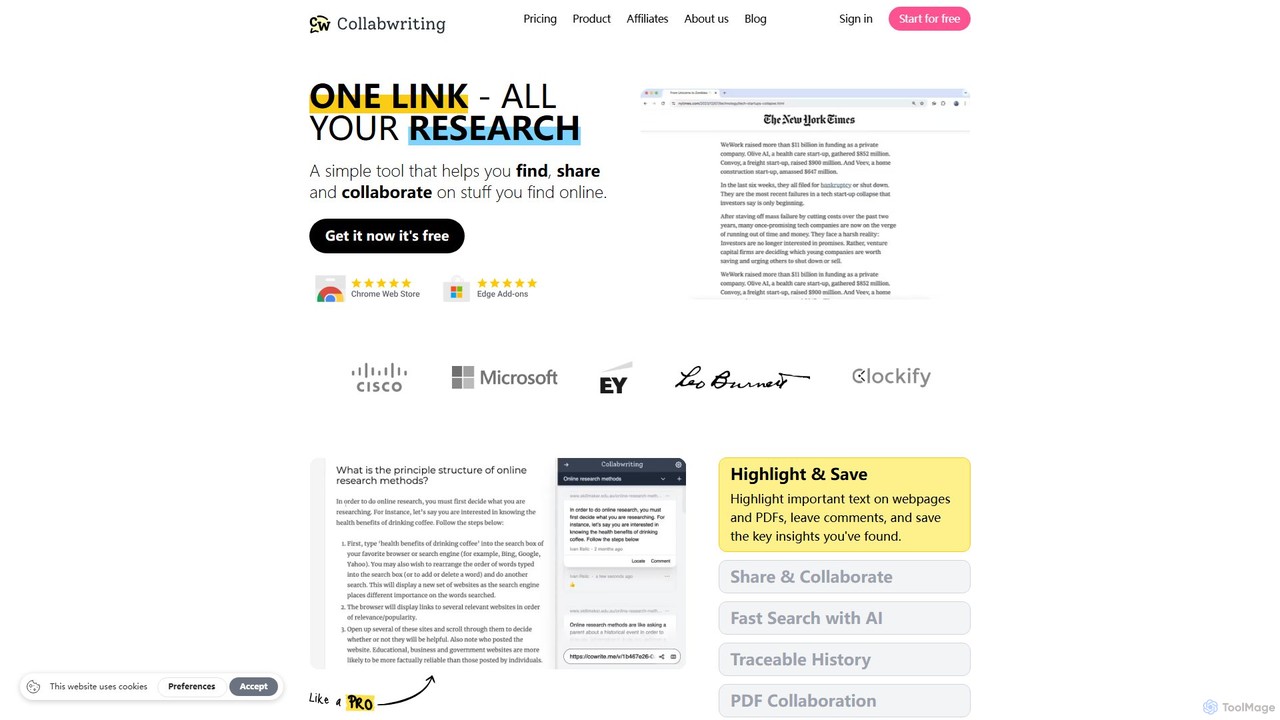
Collabwriting is an AI-powered research and collaboration tool that helps you find, save, and share information from webpages, …

3.3K

About Knowledge Management

AI Knowledge Management tools are intelligent systems designed to capture, organize, and retrieve an organization's collective information. Leveraging Natural Language Processing (NLP), these tools transform scattered data from documents, chats, and emails into a centralized, searchable knowledge base. Their primary value lies in creating a 'single source of truth' that accelerates decision-making, reduces redundant work, and streamlines employee onboarding. Unlike simple file storage, they understand the context and relationships within the information, providing precise answers instead of just a list of documents.

Core Features

  • Semantic Search: Find information based on meaning and intent, not just exact keywords.
  • Automated Content Organization: AI automatically tags, categorizes, and links related pieces of information.
  • Natural Language Q&A: Ask questions in plain language and receive synthesized answers drawn from multiple sources.
  • Knowledge Synthesis & Summarization: Generate concise summaries of long documents, meetings, or discussion threads.
  • Knowledge Graph Visualization: Map out connections between topics, people, and projects to uncover hidden insights.

Use Cases

These tools are particularly effective in knowledge-intensive environments. Customer support teams use them to find answers to complex queries instantly. R&D departments centralize research findings to avoid duplicate efforts. Consulting firms build a collective 'second brain' of case studies and market data to serve clients better.

How to Choose

When selecting an AI Knowledge Management tool, evaluate its integration capabilities with your existing platforms (e.g., Slack, Microsoft Teams, Google Drive). Assess the accuracy and speed of its search and Q&A functions. Prioritize solutions with robust security protocols and granular access controls. Finally, consider the user interface's intuitiveness and the scalability of the platform to grow with your organization's data.

Knowledge ManagementUse Cases

1

Accelerating New Employee Onboarding

An HR manager at a fast-growing tech company uses an AI Knowledge Management tool to streamline the onboarding process. Instead of manually compiling documents and answering repetitive questions, they create a centralized onboarding space. The AI ingests all company policies, project histories, and team directories. A new hire can now ask direct questions like 'What is our process for expense reports?' or 'Who is the project lead for Project Phoenix?' and receive instant, accurate answers with links to the source documents. This reduces the burden on existing team members and empowers new employees to find information independently from day one.

2

Centralizing R&D Project Knowledge

An engineering team working on a complex hardware product uses an AI knowledge base to prevent knowledge silos. The system connects their CAD files, simulation results, meeting notes from Slack, and experimental data sheets. When a new engineer joins the project, they can ask the system, 'What were the material stress test results from Q2?' The tool synthesizes information from various documents and provides a direct summary, including links to the raw data. This prevents repeating past experiments and ensures design decisions are based on all available historical data, significantly accelerating the development cycle.

3

Creating an Intelligent Customer Support Wiki

A customer support team for a SaaS product implements an AI knowledge base to improve response times. The tool automatically ingests and learns from every resolved support ticket, product documentation, and internal troubleshooting guides. When a support agent receives a new, complex query, they can type the customer's question into the knowledge base. Instead of just getting a list of articles, the AI provides a synthesized answer, suggests relevant troubleshooting steps, and even drafts a potential reply. This empowers agents to solve difficult problems faster, ensures consistency in answers, and reduces the need for escalation to senior engineers.

4

Building a 'Second Brain' for a Consulting Firm

A management consulting firm uses an AI knowledge platform to create a collective 'second brain'. The system aggregates thousands of past project reports, client presentations, market research data, and expert interviews. Before starting a new project for a client in the retail sector, a consultant can ask, 'What were our key recommendations for improving supply chain efficiency for retail clients?' The AI scans all relevant documents, synthesizes the findings, identifies recurring themes, and presents a summary with links to the most impactful case studies. This allows the team to leverage decades of collective experience instantly, improving the quality of their proposals and deliverables.

5

Managing Legal and Compliance Documentation

A corporate legal team uses an AI knowledge management system to navigate a vast repository of contracts, compliance regulations, and internal policies. Instead of manually searching through folders, a paralegal can ask, 'Which of our active contracts contain a force majeure clause related to pandemics?' The system uses semantic search to understand the query's intent and instantly surfaces the relevant clauses from hundreds of documents. This drastically reduces research time, minimizes the risk of overlooking critical information, and helps the company ensure consistent compliance across all its legal agreements.

6

Automating Market Research Analysis

A marketing team subscribes to numerous industry reports, competitor analyses, and customer feedback channels. They use an AI knowledge tool to aggregate and analyze this constant stream of information. A marketing strategist can ask, 'Summarize the key market trends for Gen Z in the last quarter based on our reports and survey data.' The AI processes dozens of documents, identifies key themes, extracts relevant statistics, and generates a consolidated brief. This allows the team to stay ahead of market shifts and make data-driven decisions for their campaigns without spending days manually reading and synthesizing information.

Knowledge ManagementFrequently Asked Questions