Moara
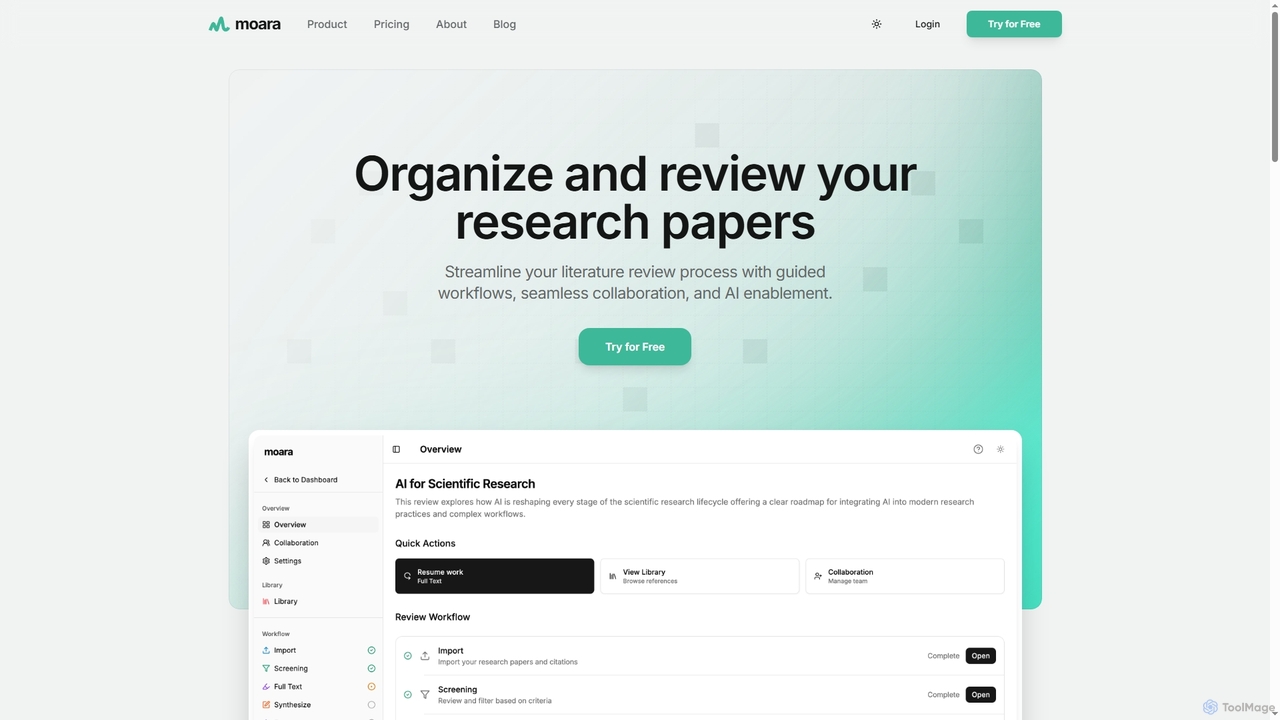
Moara is an AI-powered research platform designed to streamline the entire literature review process, from discovery and organization …
Moara is an AI-powered research platform designed to streamline the entire literature review process, from discovery and organization to analysis and synthesis. It empowers researchers, students, librarians, and R&D teams to conduct rigorous and transparent academic work with enhanced speed and structure.
About Team Research
Team Research tools are AI-powered platforms designed to streamline and enhance the collective research efforts of groups and organizations. These tools leverage artificial intelligence to automate data collection, analyze complex information, and facilitate seamless knowledge sharing among team members. They empower teams to accelerate discovery, deepen insights, and collaboratively produce high-quality research outcomes more efficiently.
Core Features
- Automated Data Aggregation: Gathers and organizes research data from diverse sources, including academic papers, web content, and internal documents, using AI.
- AI-Powered Analysis & Summarization: Utilizes natural language processing to identify key themes, summarize lengthy texts, and extract critical insights from large datasets.
- Collaborative Knowledge Base: Provides a centralized, searchable repository where teams can store, categorize, and access shared research findings and resources.
- Real-time Co-editing & Annotation: Enables multiple team members to work on research documents, reports, and presentations simultaneously, with integrated annotation and feedback features.
- Research Task Management: Helps teams plan, track, and manage research project milestones, assignments, and deadlines within the platform.
Use Cases
These tools are invaluable for academic institutions, corporate R&D departments, market research firms, and consulting agencies. They support interdisciplinary projects, competitive analysis, and literature reviews, allowing teams to manage vast amounts of information and collaborate effectively on complex investigations.
How to Choose
When selecting Team Research tools, consider the breadth of data sources it can integrate, the sophistication of its AI analysis capabilities (e.g., summarization, sentiment analysis), its collaborative features (co-editing, version control), and its compatibility with existing workflows. Scalability, security, and pricing models are also crucial factors for long-term team adoption.

Team ResearchUse Cases
Accelerate Academic Literature Reviews
Academic research teams often spend significant time sifting through vast amounts of literature. Team Research tools can automatically search, filter, and summarize relevant papers based on research questions, identifying key theories, methodologies, and gaps. This allows researchers to quickly grasp the current state of knowledge, saving hundreds of hours and enabling them to focus on critical analysis and hypothesis generation.
Streamline Market Trend Analysis
Market research teams need to continuously monitor industry trends, competitor activities, and consumer sentiment. AI-powered Team Research tools can aggregate data from news articles, social media, reports, and financial statements. They then use AI to identify emerging patterns, predict shifts, and generate concise reports, providing actionable insights for strategic decision-making and product development.
Enhance Collaborative Report Writing
For consulting firms or internal corporate teams, producing comprehensive reports often involves multiple contributors. Team Research platforms facilitate real-time co-editing of documents, track changes, and allow for integrated feedback and discussions. This ensures all team members contribute effectively, maintain version control, and produce a cohesive, high-quality final report with reduced revision cycles.
Centralize R&D Knowledge Management
R&D departments generate extensive internal research data, experimental results, and intellectual property. Team Research tools provide a secure, centralized knowledge base where all findings are stored, categorized, and made searchable. This prevents knowledge silos, enables new team members to quickly onboard, and ensures that past research can be easily leveraged for future innovations, fostering continuous learning.
Facilitate Interdisciplinary Project Collaboration
Complex projects often involve teams from different disciplines, each with unique data and perspectives. Team Research tools bridge these gaps by providing a unified platform for sharing diverse data types, from scientific datasets to qualitative interviews. AI can help synthesize information across disciplines, highlighting connections and discrepancies, thereby fostering a more integrated and holistic research approach.
Automate Competitive Intelligence Gathering
Businesses require up-to-date information on competitors' products, strategies, and market positioning. Team Research tools can continuously monitor competitor websites, press releases, patent filings, and public financial reports. AI then processes this information to identify competitive advantages, potential threats, and market opportunities, presenting a consolidated view for strategic planning teams.