ToolMage
Sign in

Best 2 Ai Governance AI tools for Compliance

Popular Ai Governance AI tools in Compliance include FRAI and Sinaptic, helping you work more efficiently.

FRAI
Free

FRAI

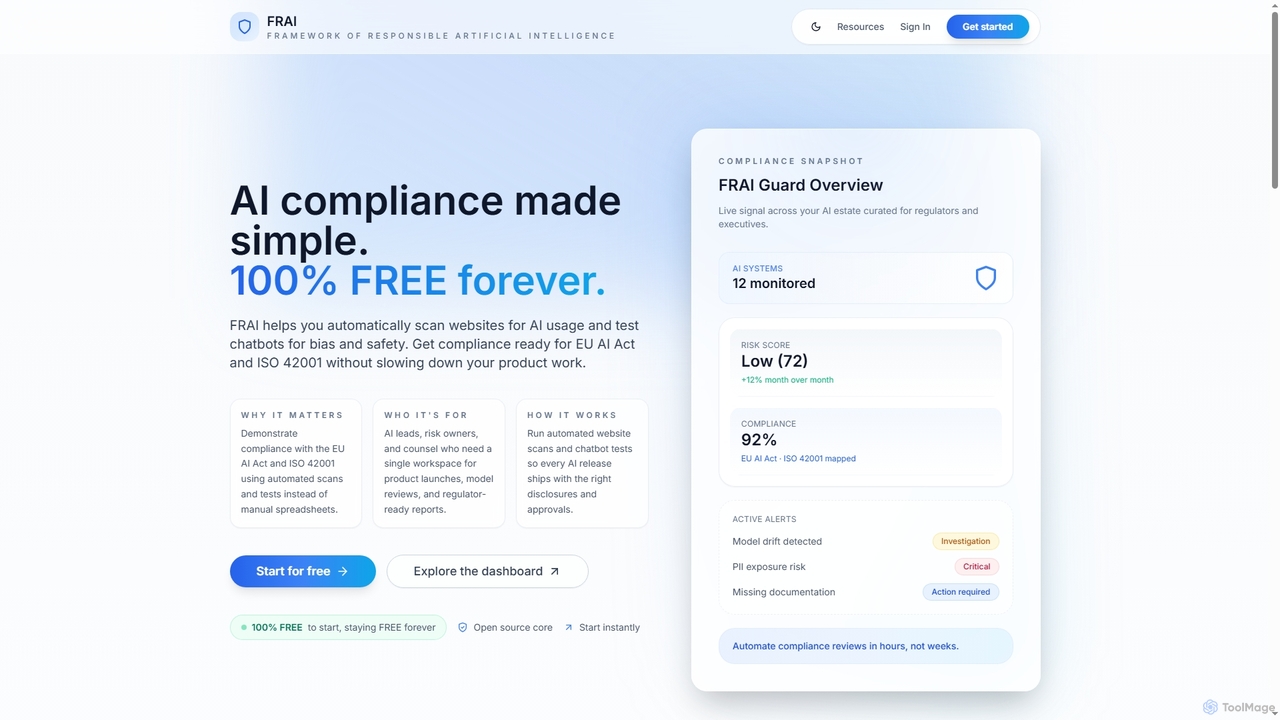
FRAI is a comprehensive, free-forever AI compliance platform designed to simplify adherence to global AI regulations like the EU AI Act and ISO 42001. It automates website scanning for AI usage and tests chatbots for bias, safety, and compliance, providing continuous monitoring and audit-ready reports.

Regulatory Affairs
Visits 7.6KFavorites 165Likes 178

About Ai Governance

AI Governance tools are a category of solutions designed to manage the ethical, legal, and operational risks associated with artificial intelligence systems. These tools provide frameworks and functionalities to ensure AI models are developed, deployed, and operated responsibly, transparently, and in compliance with evolving regulations. They help organizations establish accountability, mitigate biases, ensure fairness, and maintain auditability throughout the AI lifecycle, thereby building trust and fostering responsible AI innovation within the broader Compliance landscape.

Core Features

  • Bias Detection & Mitigation: Identifies and helps reduce unfair biases in AI models and data.
  • Explainability (XAI): Provides insights into how AI models make decisions, enhancing transparency.
  • Regulatory Compliance Mapping: Maps AI systems to relevant laws and standards (e.g., GDPR, AI Act).
  • Risk Assessment & Management: Evaluates and manages potential risks from AI deployment, including privacy and security.
  • Audit Trails & Reporting: Maintains detailed records of AI model changes and performance for accountability.

Applicable Scenarios

Enterprises deploying AI at scale, data science teams, legal and compliance departments, and risk management professionals utilize AI Governance tools. They are crucial for industries like finance, healthcare, and government where regulatory scrutiny and ethical considerations are paramount. These tools support the responsible development and deployment of AI, ensuring adherence to internal policies and external legal frameworks.

How to Choose

When selecting an AI Governance solution, consider its scope of regulatory coverage, integration capabilities with existing MLOps pipelines, the depth of its explainability features, and its ability to provide comprehensive audit trails. Evaluate its scalability to accommodate future AI initiatives and its reporting functionalities for stakeholder communication. User-friendliness and support for various AI model types are also critical factors.

Ai Governance use cases

1

Ensuring AI Regulatory Compliance

For large enterprises in regulated sectors like finance or healthcare, AI Governance tools are essential for navigating complex legal landscapes such as the EU AI Act or industry-specific data privacy laws. Compliance officers use these platforms to map AI models against regulatory requirements, track adherence, and generate audit-ready reports, significantly reducing legal risks and potential fines associated with non-compliant AI deployments.

2

Mitigating Algorithmic Bias in Hiring

HR departments using AI for candidate screening face the risk of perpetuating or amplifying biases present in historical data. AI Governance tools enable data scientists and ethics committees to proactively detect and quantify biases in hiring algorithms, offering recommendations for mitigation strategies. This ensures fairer hiring practices, promotes diversity, and protects the organization's reputation from discrimination claims.

3

Establishing Explainability for Loan Approvals

Financial institutions using AI for credit scoring or loan approvals need to provide clear explanations for their decisions, especially when denying applications. AI Governance platforms offer explainable AI (XAI) features that break down complex model decisions into understandable factors. This allows loan officers to communicate transparently with applicants and helps compliance teams demonstrate fairness and non-discrimination to regulators.

4

Managing AI Model Risk Throughout Lifecycle

Data science and MLOps teams manage numerous AI models from development to production. AI Governance tools provide a centralized framework to assess, monitor, and manage risks associated with model drift, data quality degradation, and security vulnerabilities across the entire AI lifecycle. This proactive approach ensures model reliability, performance, and security, preventing costly failures and maintaining operational integrity.

5

Automating Ethical AI Policy Enforcement

Organizations committed to ethical AI principles often have internal policies regarding data usage, privacy, and responsible deployment. AI Governance solutions allow ethics committees to codify these policies and automate their enforcement within the AI development pipeline. This ensures that all AI projects automatically adhere to organizational values, fostering a culture of responsible innovation and reducing manual oversight burdens.

6

Auditing AI System Performance and Accountability

For critical AI systems, such as those in autonomous vehicles or medical diagnostics, continuous monitoring and auditing are vital. AI Governance tools provide robust logging and monitoring capabilities, tracking model inputs, outputs, and performance metrics over time. This creates an immutable audit trail, enabling forensic analysis in case of incidents, demonstrating accountability, and supporting continuous improvement of AI system reliability and safety.

Ai Governance FAQ

What is AI Governance?

AI Governance refers to the frameworks, processes, and tools designed to ensure that artificial intelligence systems are developed, deployed, and used in an ethical, responsible, and compliant manner. It focuses on managing the risks associated with AI, such as bias, privacy breaches, lack of transparency, and regulatory non-compliance, to build trust and accountability in AI technologies.

How to choose an effective AI Governance platform?

To choose an effective AI Governance platform, consider its ability to integrate with your existing AI/ML infrastructure, its coverage of relevant regulatory frameworks (e.g., GDPR, AI Act), and its features for bias detection, explainability, and risk assessment. Look for robust reporting capabilities, scalability, and strong security measures to protect sensitive data and models.

What is the difference between AI Governance and general IT Governance?

While general IT Governance focuses on managing IT assets, infrastructure, and data across an organization, AI Governance specifically addresses the unique challenges and risks posed by AI systems. This includes algorithmic bias, model explainability, ethical considerations, and the rapidly evolving regulatory landscape specific to AI, which go beyond traditional IT concerns.

What are the main benefits of implementing AI Governance?

Implementing AI Governance offers several key benefits: it reduces legal and reputational risks by ensuring compliance with regulations and ethical standards; it builds trust among users and stakeholders through transparency and fairness; it fosters responsible innovation by providing clear guidelines; and it enhances operational efficiency by standardizing AI development and deployment processes.

What are the key components of an AI Governance framework?

A comprehensive AI Governance framework typically includes several key components: establishing clear AI policies and ethical guidelines; conducting regular risk assessments for AI models; implementing tools for bias detection and explainability; ensuring data privacy and security; maintaining audit trails for accountability; and continuous monitoring of AI system performance and compliance.