
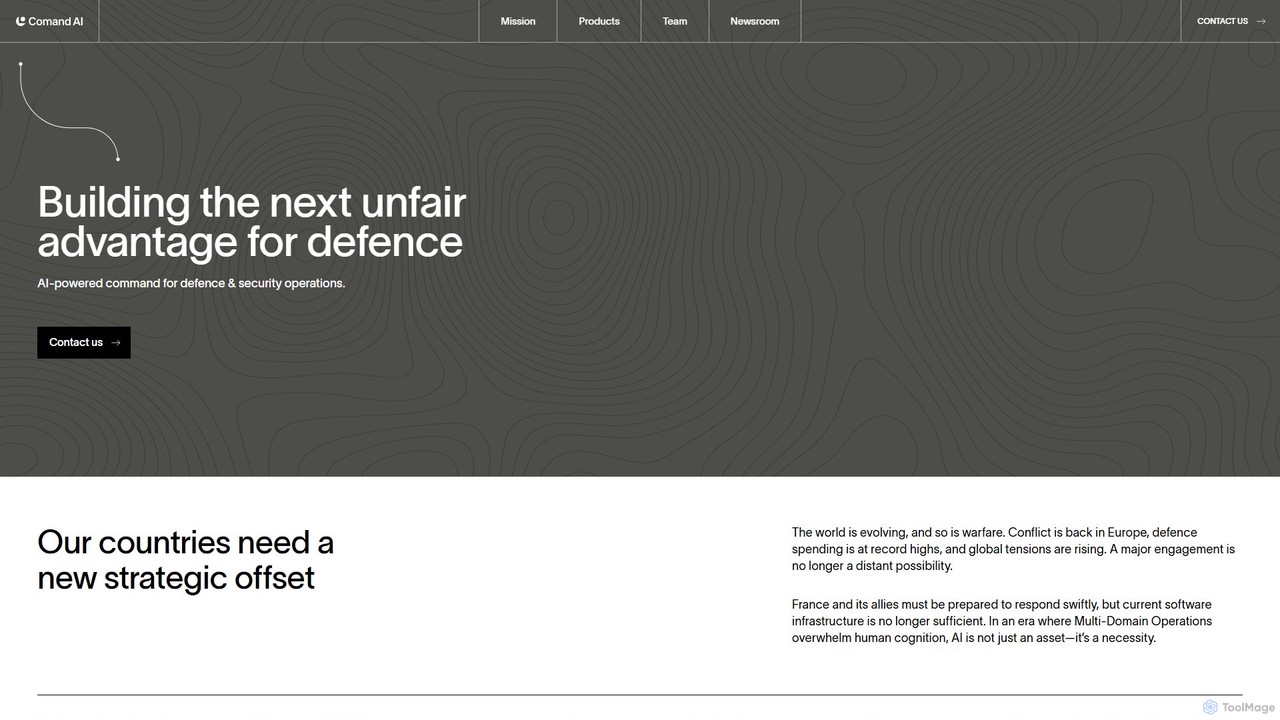
Data Analysis Best in category 1 results Decision Intelligence AI Tool

Popular AI tools in the Decision Intelligence field of Data Analysis include Comand AI, etc., helping you quickly improve efficiency.

Comand AI

Comand AI

Comand AI is a cutting-edge AI-powered command and control platform designed for defense and security operations. It provides …

6.9K

About Decision Intelligence

Decision Intelligence (DI) is a practical discipline for improving decision-making by explicitly understanding and engineering how decisions are made. It integrates data science, social science, and managerial science to move beyond simple data analysis to actively recommend or automate actions. By modeling the entire decision process, DI tools provide prescriptive insights that answer "What should we do?" rather than just "What happened?". This approach enables organizations to make more consistent, transparent, and effective choices in complex environments.

Core Features

  • Prescriptive Analytics: Goes beyond prediction to recommend specific actions and quantify their potential outcomes.
  • Decision Modeling & Simulation: Allows users to build digital models of their business decisions to test various scenarios and strategies before implementation.
  • Causal Inference: Focuses on identifying true cause-and-effect relationships, enabling more robust and reliable decision-making.
  • Automated Action & Integration: Connects directly with operational systems to automate recommended actions, closing the loop between insight and execution.

Applicable Scenarios

Decision Intelligence is highly effective in industries with complex, repeatable decisions, such as finance for credit scoring, retail for dynamic pricing and inventory management, and logistics for supply chain optimization. It is used by business analysts, operations managers, and strategists to systematically improve high-impact operational and tactical decisions.

Selection Criteria

When choosing a Decision Intelligence tool, evaluate its ability to model complex decision logic specific to your business. Assess its integration capabilities with your existing data sources and operational systems. Consider the platform's explainability features, which are crucial for understanding and trusting automated recommendations. Finally, examine its scalability to handle the volume and speed of decisions your organization requires.

Decision IntelligenceUse Cases

1

Dynamic Pricing for E-commerce

An e-commerce manager uses a Decision Intelligence platform to automate pricing strategies. The system continuously analyzes real-time data, including competitor prices, customer demand signals, inventory levels, and promotional calendars. Instead of manually setting rules, the manager defines a business goal, such as maximizing profit margin. The DI tool then models potential outcomes and automatically adjusts prices for thousands of products, responding instantly to market changes and ensuring competitiveness without constant human intervention.

2

Optimizing Supply Chain Logistics

A logistics coordinator for a global shipping company faces the daily challenge of routing hundreds of vehicles. Using a Decision Intelligence tool, they can simulate the entire delivery network. The platform ingests data on traffic patterns, weather forecasts, fuel costs, and vehicle capacity. It then recommends the most efficient routes and vehicle assignments to minimize costs and delivery times. If a disruption occurs, like a port closure, the system can instantly re-optimize all affected routes, providing a new, actionable plan in minutes instead of hours.

3

Automated Credit Risk Assessment

A financial institution aims to streamline its loan approval process. A Decision Intelligence system is implemented to assess credit risk. The system analyzes a wide range of applicant data, builds a causal model of default risk, and provides a clear recommendation: approve, deny, or flag for manual review. Crucially, it also provides an explanation for its decision, citing the key factors involved. This automates the majority of straightforward applications, freeing up loan officers to focus on complex cases and ensuring consistent, unbiased decision-making compliant with regulations.

4

Personalizing Marketing Campaigns at Scale

A marketing team wants to move beyond generic audience segments. They use a Decision Intelligence platform to decide the 'next best action' for each individual customer. The system analyzes customer behavior, purchase history, and real-time interactions. It then recommends the optimal message, channel (email, push notification, SMS), and timing for each person to maximize engagement or conversion. This decision logic is directly integrated with their marketing automation tools, enabling hyper-personalized communication for millions of customers automatically.

5

Optimizing Clinical Trial Enrollment

A pharmaceutical company needs to recruit patients for a new clinical trial efficiently. A research manager uses a Decision Intelligence tool to model the enrollment process. The platform analyzes demographic data, medical records, and geographical information to predict which clinical sites are most likely to successfully enroll eligible patients. It recommends resource allocation, such as where to focus advertising spend and staff deployment. This data-driven approach helps accelerate the trial timeline, reduce costs, and improve the chances of a successful study.

6

Managing Energy Grid Load Balancing

A utility company must maintain a stable power grid by constantly balancing energy supply and demand. An operations manager uses a Decision Intelligence system to automate this complex task. The system models the entire grid, forecasting demand based on weather and historical usage, while also predicting supply from variable sources like wind and solar. It then makes real-time decisions on which power plants to activate or deactivate to meet demand at the lowest possible cost and with the least environmental impact, ensuring grid stability 24/7.

Decision IntelligenceFrequently Asked Questions