Moara
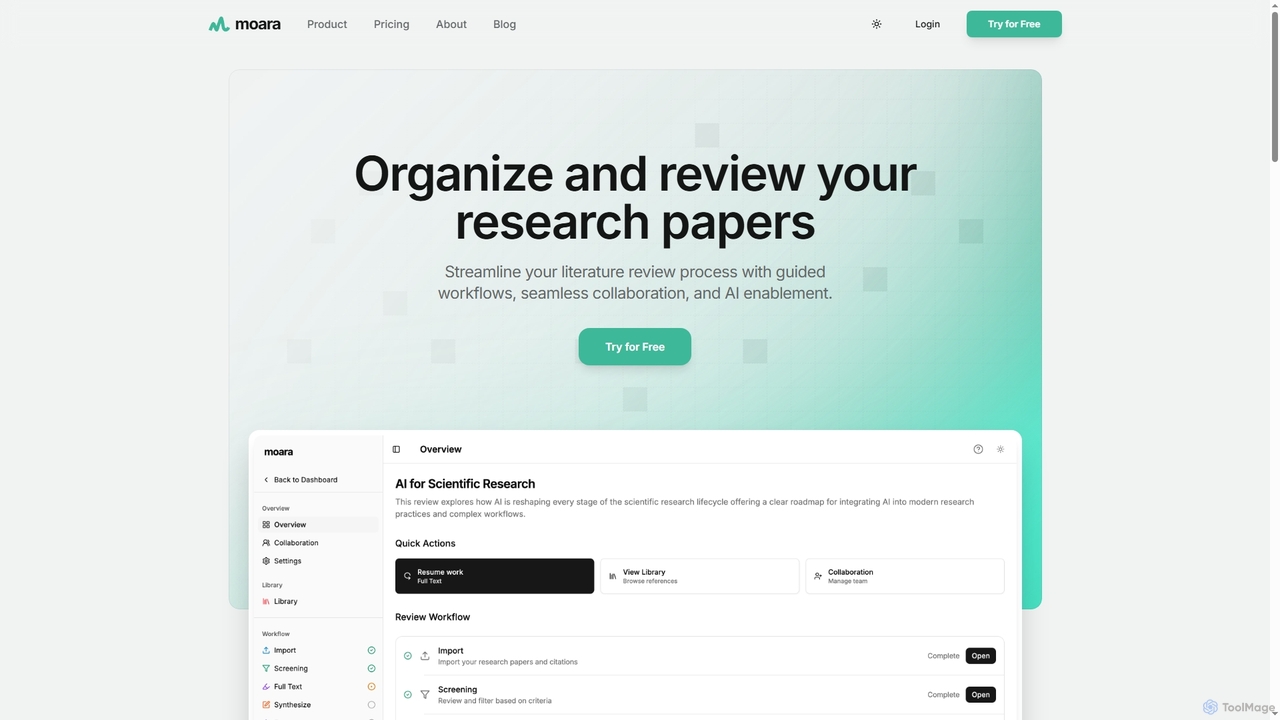
Moara is an AI-powered research platform designed to streamline the entire literature review process, from discovery and organization …
Moara is an AI-powered research platform designed to streamline the entire literature review process, from discovery and organization to analysis and synthesis. It empowers researchers, students, librarians, and R&D teams to conduct rigorous and transparent academic work with enhanced speed and structure.
About Evidence Synthesis
Evidence Synthesis tools are AI-powered platforms designed to systematically identify, evaluate, and combine findings from multiple studies or data sources to answer specific research questions. These tools leverage advanced natural language processing (NLP), machine learning, and statistical algorithms to automate and enhance the rigorous process of systematic reviews, meta-analyses, and other forms of evidence aggregation. They significantly accelerate the research workflow, improve the consistency and transparency of evidence collection, and support evidence-based decision-making across various fields.
Core Features
- Automated Literature Search: Efficiently identifies relevant studies across vast databases using AI-driven keyword expansion and semantic matching.
- AI-powered Data Extraction: Automatically extracts key data points, outcomes, and characteristics from full-text articles, reducing manual effort.
- Quality Assessment & Bias Detection: Assists in evaluating study quality and identifying potential biases using predefined criteria and machine learning models.
- Meta-analysis Support: Provides tools for statistical aggregation of quantitative data, including effect size calculation and heterogeneity analysis.
- Thematic Synthesis: Facilitates the identification and synthesis of themes from qualitative data across multiple studies.
Applicable Scenarios
Researchers, clinicians, policymakers, and systematic review teams widely utilize these tools to streamline complex evidence aggregation tasks. They are essential for academic research, developing clinical guidelines, informing public health policies, and conducting comprehensive market analyses where robust evidence is critical.
How to Choose
When selecting an AI evidence synthesis tool, consider its compatibility with your data sources, the transparency and explainability of its AI models, and its ability to handle both quantitative and qualitative data. Evaluate its customization options for specific review protocols, collaboration features for team-based projects, and the robustness of its reporting and visualization capabilities to ensure it meets your research rigor and dissemination needs.

Evidence SynthesisUse Cases
Accelerating Systematic Reviews for Medical Research
Medical researchers often spend months manually screening thousands of articles for systematic reviews. Evidence Synthesis AI tools allow them to upload search results from databases, apply inclusion/exclusion criteria, and rapidly screen relevant abstracts and full texts. This automation can reduce screening time by up to 70%, enabling faster publication of critical medical evidence and clinical guidelines.
Accelerating Systematic Reviews for Medical Research
Medical researchers can use AI evidence synthesis tools to rapidly screen thousands of abstracts and full-text articles for systematic reviews on drug efficacy or treatment outcomes. The AI automates the identification of relevant studies, extracts patient demographics, intervention details, and adverse events, significantly reducing the time from months to weeks, allowing for quicker insights into clinical practice.
Informing Public Health Policy with Rapid Evidence
Public health organizations need timely evidence to respond to emerging health crises or develop new prevention strategies. Evidence Synthesis tools enable policy analysts to quickly gather and synthesize research on specific interventions, disease outbreaks, or population health trends. This allows for evidence-based policy recommendations to be formulated and implemented much faster than traditional manual methods, improving public health outcomes.
Informing Public Health Policy Development
Policymakers and public health officials leverage these tools to synthesize evidence on the effectiveness of various interventions, such as vaccination campaigns or dietary guidelines. By quickly aggregating findings from global studies, they can develop evidence-based policies that are timely, comprehensive, and supported by the latest research, ensuring better public health outcomes.
Supporting Evidence-Based Practice in Clinical Settings
Clinicians and healthcare providers can use Evidence Synthesis tools to quickly access and understand the best available evidence for patient care. For instance, a physician might need to synthesize research on the efficacy of different treatment options for a rare disease. These tools help them efficiently navigate complex literature, ensuring that clinical decisions are informed by the most current and robust scientific findings, leading to improved patient outcomes.
Conducting Comprehensive Market & Competitive Intelligence
Market analysts and business strategists utilize AI evidence synthesis to combine insights from diverse sources like consumer reviews, industry reports, and competitor analyses. The tools help identify emerging market trends, evaluate product performance, and understand competitive landscapes by synthesizing vast amounts of unstructured and structured data, informing strategic business decisions.
Streamlining Grant Proposal Literature Reviews
Academics and researchers applying for grants must demonstrate a thorough understanding of existing literature to justify their proposed work. Evidence Synthesis tools can significantly streamline the literature review section of grant proposals by quickly identifying gaps in current research, summarizing previous findings, and highlighting the novelty of their own project. This efficiency allows them to focus more on the methodology and impact of their research, increasing the chances of securing funding.
Mapping Academic Literature & Identifying Research Gaps
Academics and PhD students employ these tools to map extensive bodies of literature in their fields, identifying key authors, theories, and methodologies. This helps in pinpointing research gaps, understanding the evolution of a topic, and formulating novel research questions for dissertations or grant proposals, ensuring their work contributes uniquely to the existing knowledge base.
Conducting Scoping Reviews for Research Landscape Mapping
Before embarking on a full systematic review, researchers often conduct scoping reviews to map the existing evidence base on a broad topic. Evidence Synthesis tools assist in this process by rapidly identifying the types of available studies, key concepts, and research gaps. This helps researchers define the scope of future, more focused reviews or identify areas where primary research is urgently needed, saving considerable time and resources in the early stages of a project.
Developing Evidence-Based Clinical Practice Guidelines
Clinical guideline developers use AI evidence synthesis to aggregate and evaluate the efficacy and safety of different diagnostic tests or treatment protocols. By systematically reviewing and synthesizing all available evidence, they can formulate robust, unbiased recommendations that guide healthcare professionals in providing optimal patient care, enhancing clinical decision-making.
Enhancing Reproducibility and Transparency in Research
A critical aspect of robust scientific research is reproducibility and transparency. Evidence Synthesis tools provide structured workflows and audit trails for every step of the review process, from search strategy to data extraction and synthesis. This ensures that the entire process is well-documented, verifiable, and can be replicated by other researchers, thereby increasing the credibility and trustworthiness of the synthesized evidence and the overall research output.
Streamlining Grant Proposal & Literature Review Sections
Researchers preparing grant proposals or extensive literature reviews can use these tools to quickly build a foundational evidence base. The AI assists in identifying seminal works, synthesizing existing findings to justify the proposed research, and demonstrating the novelty and significance of their project, thereby strengthening the overall proposal and increasing funding success rates.