ToolMage
Sign in

Best 2 Machine Learning AI tools for Data Analysis

Popular Machine Learning AI tools in Data Analysis include Verge Genomics and JADBio, helping you work more efficiently.

Freemium

JADBio

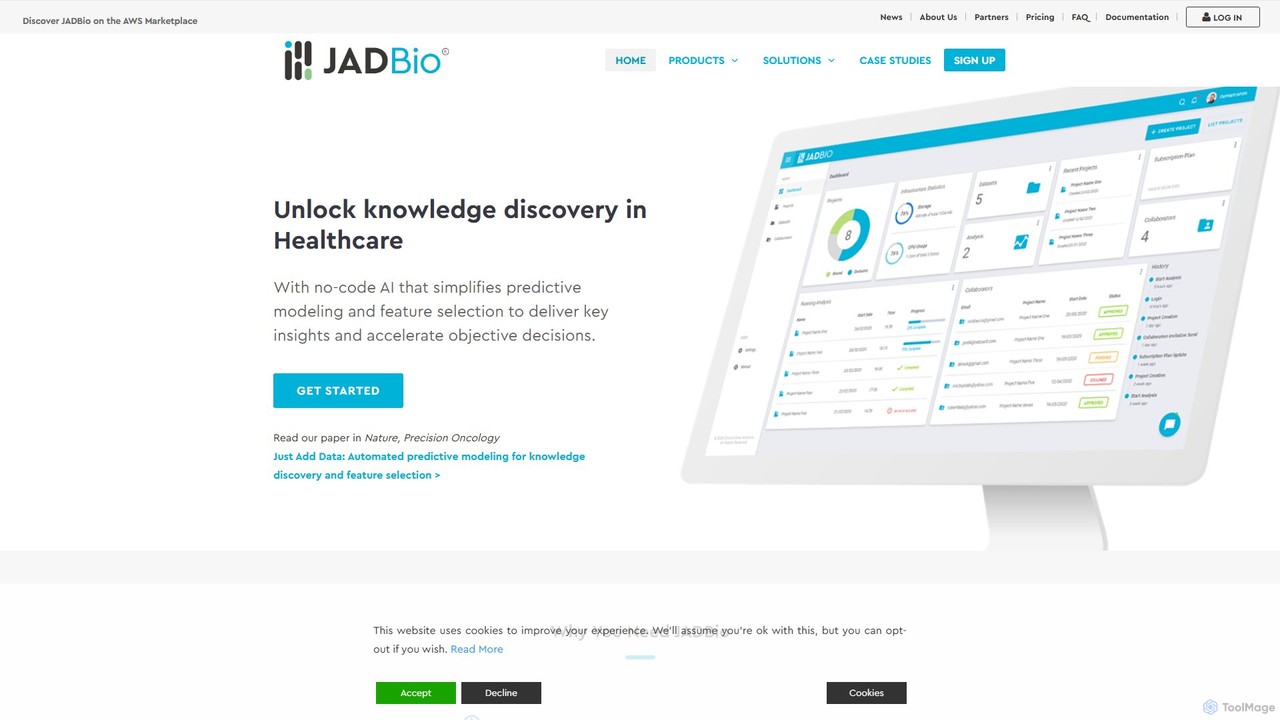
JADBio is a no-code Automated Machine Learning (AutoML) platform designed for life sciences and biotechnology. It specializes in analyzing complex, high-dimensional biological data (omics) to accelerate biomarker discovery, identify predictive biosignatures, and build accurate predictive models for precision medicine and translational research.

Machine Learning
Visits 6KFavorites 91Likes 106

Verge Genomics

Verge Genomics is a biotechnology company leveraging an all-in-human, AI-powered platform, CONVERGE®, to discover and develop drugs for complex diseases. By analyzing vast human genomic datasets, it aims to accelerate the creation of effective treatments for conditions like ALS, Parkinson's, and Frontotemporal Dementia, moving from discovery to clinic significantly faster than traditional methods.

Machine Learning
Visits 7.2KFavorites 107Likes 123

About Machine Learning

Machine Learning tools are a category of AI-powered solutions that enable systems to learn from data, identify patterns, and make predictions or decisions with minimal human intervention. These tools leverage advanced algorithms and statistical models to automatically improve performance over time as they are exposed to more data. Within the broader field of Data Analysis, Machine Learning specifically focuses on building predictive models and intelligent systems for complex tasks like classification, regression, and clustering, transforming raw data into actionable insights and automated intelligence.

Core Features

  • Model Training & Optimization: Algorithms learn from historical data to build predictive or analytical models.
  • Data Preprocessing: Cleaning, transforming, and preparing raw data for effective model input.
  • Feature Engineering: Selecting and transforming variables to improve model performance and accuracy.
  • Model Evaluation & Validation: Assessing model performance using metrics and testing against unseen data.
  • Deployment & Monitoring: Integrating trained models into applications and tracking their real-world performance.

Applicable Scenarios

Machine Learning tools are indispensable for organizations seeking to automate decision-making, personalize user experiences, and uncover hidden insights from vast datasets. They are widely used in sectors like finance for fraud detection, healthcare for diagnostic assistance, and retail for personalized recommendations, enabling data-driven strategies across various business functions.

How to Choose

When selecting Machine Learning tools, consider the types of algorithms supported, scalability for your data volume, integration capabilities with existing data pipelines, and the level of technical expertise required. Evaluate the interpretability of models, deployment options, and the total cost of ownership, including infrastructure and maintenance, to ensure alignment with your project goals and team capabilities.

Featured tool rankings

Machine Learning use cases

1

Predictive Maintenance in Manufacturing

Manufacturing engineers utilize Machine Learning tools to analyze sensor data from industrial machinery, predicting potential equipment failures before they occur. By training models on historical operational data and maintenance logs, these tools can identify subtle anomalies, enabling proactive maintenance scheduling, reducing downtime, and extending asset lifespan, significantly cutting operational costs.

2

Customer Churn Prediction for SaaS

SaaS companies employ Machine Learning to identify customers at high risk of unsubscribing. By analyzing user behavior, engagement metrics, and historical churn patterns, models predict which customers are likely to leave. This allows marketing and customer success teams to intervene with targeted retention strategies, such as personalized offers or proactive support, improving customer lifetime value.

3

Real-time Fraud Detection in Finance

Financial institutions deploy Machine Learning algorithms to detect fraudulent transactions in real-time. Models are trained on vast datasets of legitimate and fraudulent activities to recognize suspicious patterns, such as unusual spending habits or locations. This enables immediate flagging of potentially fraudulent transactions, protecting customers and minimizing financial losses for banks.

4

Medical Image Analysis for Diagnosis

Healthcare professionals use Machine Learning tools to assist in analyzing complex medical images like X-rays, MRIs, and CT scans. By training models on large annotated datasets, these tools can identify subtle indicators of diseases or abnormalities that might be missed by the human eye, providing a valuable second opinion and accelerating accurate diagnoses for patients.

5

Personalized Product Recommendations

E-commerce platforms leverage Machine Learning to provide highly personalized product recommendations to shoppers. By analyzing past purchases, browsing history, and interactions with products, recommendation engines suggest items that are most relevant to individual users, enhancing the shopping experience, increasing conversion rates, and boosting sales.

6

Automated Quality Control in Production

Manufacturers implement Machine Learning-powered computer vision systems for automated quality control on production lines. Cameras capture images of products, and ML models are trained to detect defects, inconsistencies, or deviations from quality standards in real-time. This ensures consistent product quality, reduces waste, and frees human inspectors for more complex tasks.

Machine Learning FAQ

What is Machine Learning?

Machine Learning is a subset of artificial intelligence that enables systems to automatically learn and improve from experience without being explicitly programmed. It involves developing algorithms that can analyze data, identify patterns, and make predictions or decisions. Unlike traditional programming, where rules are hard-coded, Machine Learning models learn these rules directly from the data itself, making them highly adaptable and powerful for complex, data-driven tasks.

How does Machine Learning differ from traditional programming?

The fundamental difference lies in how solutions are created. Traditional programming involves a human programmer writing explicit, step-by-step instructions for a computer to follow to achieve a specific outcome. In contrast, Machine Learning involves feeding large amounts of data to an algorithm, which then "learns" patterns and relationships within that data to build a model. This model can then make predictions or decisions on new, unseen data without explicit instructions for every possible scenario, making it ideal for tasks where rules are too complex or unknown.

What are the main types of Machine Learning?

There are three primary types of Machine Learning: Supervised Learning, where models are trained on labeled data (input-output pairs) to make predictions (e.g., classification, regression); Unsupervised Learning, which deals with unlabeled data to find hidden patterns or structures (e.g., clustering, dimensionality reduction); and Reinforcement Learning, where an agent learns to make decisions by performing actions in an environment to maximize a reward signal, often used in robotics and game playing.

How to choose the right Machine Learning tool?

Choosing the right Machine Learning tool depends on several factors: your project's specific needs, the type and volume of data you have, the complexity of the models you need to build, and your team's technical expertise. Consider the tool's support for various algorithms, its scalability, integration capabilities with your existing data infrastructure, ease of use (GUI vs. API), and the interpretability of the models it produces. Also, evaluate the cost, community support, and available documentation.

What are common applications of Machine Learning in business?

Machine Learning has transformed numerous business functions. Common applications include: Predictive Analytics (e.g., sales forecasting, customer churn prediction), Recommendation Systems (e.g., personalized product suggestions on e-commerce sites), Fraud Detection (e.g., identifying suspicious financial transactions), Natural Language Processing (e.g., chatbots, sentiment analysis), Computer Vision (e.g., facial recognition, quality control), and Process Automation (e.g., intelligent document processing).