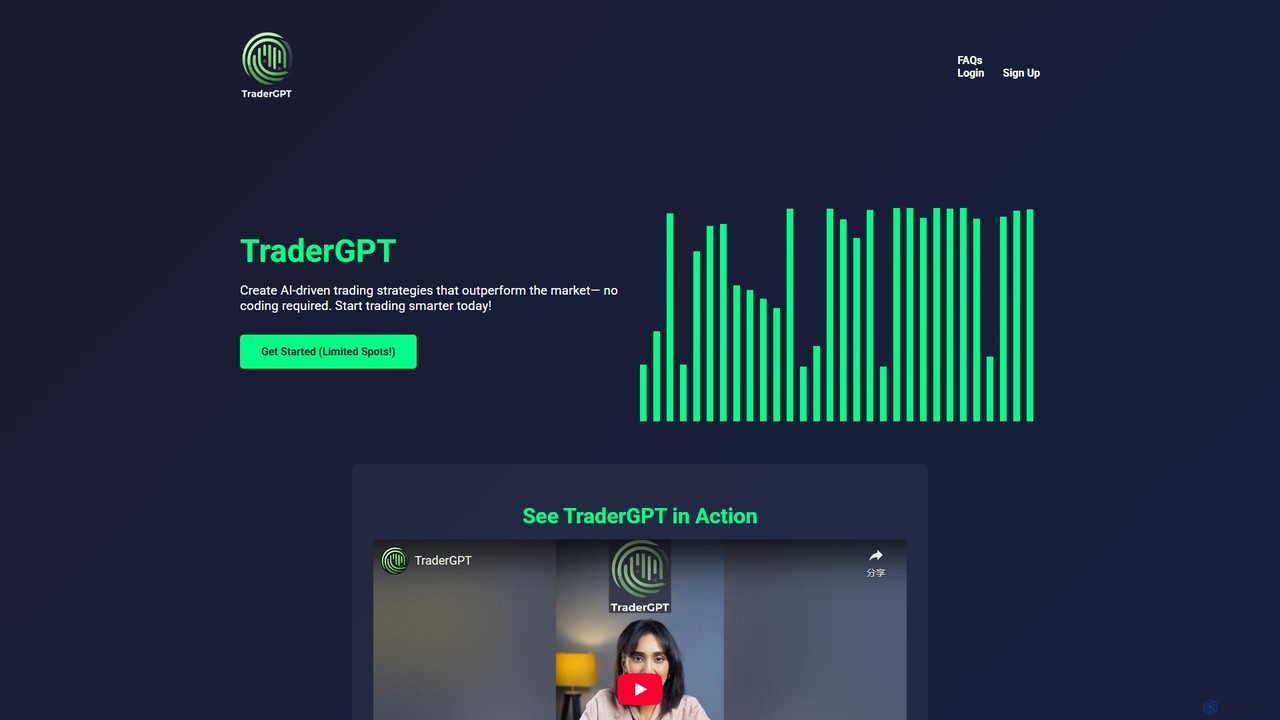
TraderGPT
TraderGPT is an AI-powered trading bot that enables users to create, test, and deploy sophisticated trading strategies without …
TraderGPT is an AI-powered trading bot that enables users to create, test, and deploy sophisticated trading strategies without any coding. It leverages AI for market sentiment analysis, historical data, and economic indicators to automate trades in stocks, crypto, and forex.
About Market Analysis
AI Market Analysis tools are a specialized category of data analysis software designed to automatically gather, process, and interpret vast amounts of market data. They leverage machine learning and natural language processing (NLP) to uncover competitor strategies, consumer trends, and sentiment patterns from external sources. These tools empower businesses to make faster, data-driven strategic decisions by transforming raw market information into actionable intelligence, offering a significant advantage over traditional manual research.
Core Features
- Competitor Intelligence: Automatically track competitors' pricing, product launches, and marketing campaigns in real-time.
- Trend Identification: Analyze data from social media and news to spot emerging consumer behaviors and market shifts.
- Sentiment Analysis: Gauge public opinion and brand perception by analyzing customer reviews, comments, and articles.
- Predictive Forecasting: Use historical data to model future market trends, demand, and sales potential.
- Customer Segmentation: Identify and group distinct customer segments based on online behavior and demographic data.
Use Cases
These tools are valuable for marketing managers, product strategists, business analysts, and investment firms. They are widely used in competitive industries like e-commerce, technology, finance, and consumer goods to maintain a competitive edge and identify growth opportunities.
How to Choose
When selecting a tool, consider the scope of data sources it integrates, such as social media APIs, news feeds, and review sites. Evaluate the depth of its analytical capabilities, like sentiment accuracy and predictive modeling. Also, assess the quality of its data visualization, reporting features, and whether it offers real-time alerts.

Market AnalysisUse Cases
Mapping the Competitive Landscape
A product manager at a tech startup uses an AI market analysis tool to monitor key competitors. The tool automatically scrapes competitor websites, press releases, and social media for announcements about new features and pricing changes. It generates a weekly dashboard comparing their product's feature set against rivals, highlighting gaps and opportunities. This allows the manager to adjust the product roadmap proactively, ensuring their offering remains competitive without spending hours on manual research.
Identifying Emerging Consumer Trends
A marketing strategist for a fashion brand analyzes millions of social media posts and fashion blog articles. The AI tool identifies a recurring pattern of conversations around 'upcycled fabrics' and 'vintage aesthetics', quantifying the trend's growth rate. Based on this data, the strategist launches a targeted marketing campaign focused on sustainability and vintage-inspired designs. This data-driven approach allows the brand to connect with an emerging consumer segment ahead of its competitors.
Monitoring Brand Health and Sentiment
After launching a major software update, a SaaS company's communications team uses a market analysis tool to monitor brand sentiment. The tool aggregates mentions from Twitter, Reddit, and tech review sites, classifying them as positive, negative, or neutral. It detects a spike in negative sentiment related to a specific bug. The team is alerted in real-time, allowing them to issue a public statement and deploy a hotfix quickly, mitigating potential damage to the brand's reputation.
Validating a New Market Entry Strategy
A consumer electronics company plans to expand into Southeast Asia. Its strategy team uses an AI tool to analyze market size, consumer purchasing power, local competition, and regulatory data for several target countries. The tool also performs sentiment analysis on local social media to gauge brand awareness and perception. The analysis reveals that while one country has a larger market, another shows higher positive sentiment and less competition, making it a more strategic entry point. This insight helps them allocate their launch budget more effectively.
Optimizing Product Launch Timing
An analyst for a video game publisher uses a predictive forecasting tool to determine the best launch window for a new title. The tool analyzes historical sales data, competitor release schedules, and seasonal search trends for the game's genre. It predicts that launching in October would clash with two major competing releases, likely reducing initial sales by 20%. However, it forecasts a less crowded market in early November with high consumer spending intent. The publisher adjusts the release date based on this forecast, maximizing its potential for a successful launch.
Analyzing Voice of the Customer (VoC) Data
A user experience (UX) researcher for an e-commerce platform aggregates thousands of customer reviews from their website, app store, and social media. The AI market analysis tool processes this unstructured text data, identifying common themes and pain points, such as 'slow checkout process' and 'confusing navigation'. It visualizes the frequency of these complaints over time. This quantitative insight allows the UX team to prioritize fixing the most impactful issues, directly improving customer satisfaction and retention based on direct feedback.