ToolMage
Sign in

Best 3 Api & Sdks AI tools for Developer Tools

Popular Api & Sdks AI tools in Developer Tools include CloudPDF, AskNews, and Vectra, helping you work more efficiently.

Vectra

Vectra

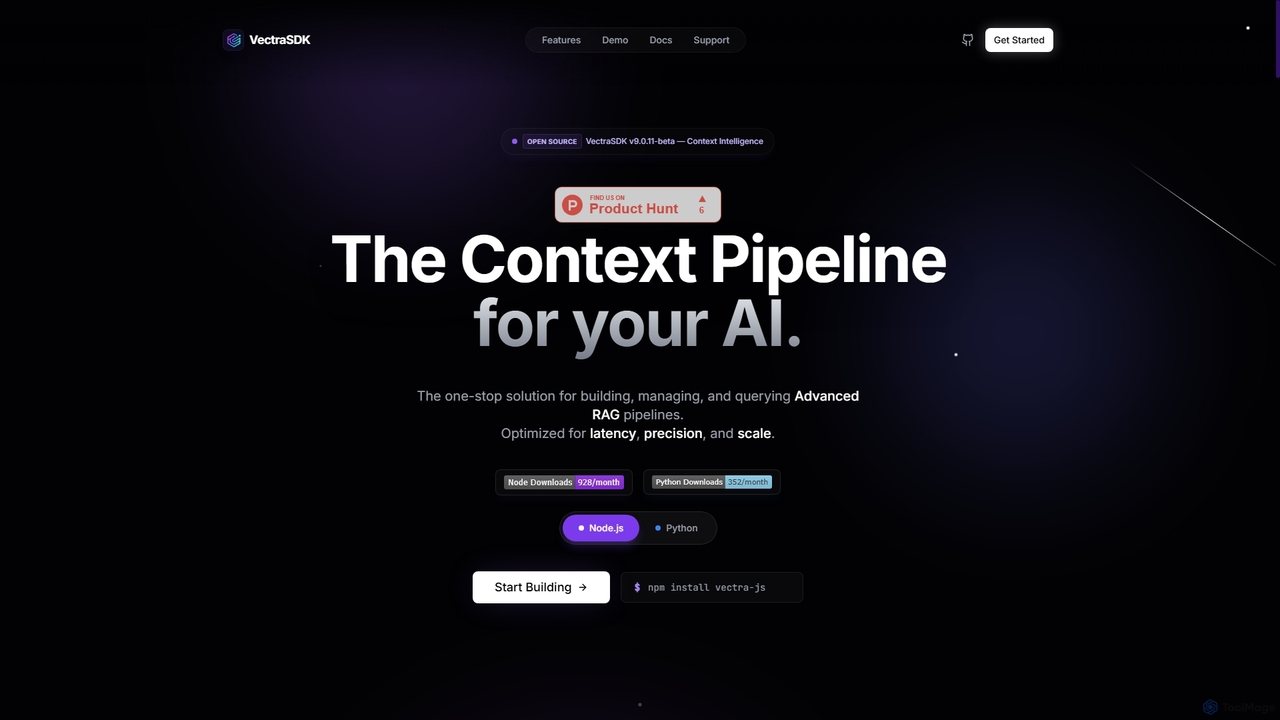
Vectra is an open-source, production-grade SDK for Node.js and Python, designed to build, manage, and query advanced Retrieval-Augmented Generation (RAG) pipelines. It offers a comprehensive toolkit for developing context-aware AI applications, optimized for low latency, high precision, and scalability.

Rag Pipelines
Visits 6.4KFavorites 45Likes 48
AskNews
Freemium

AskNews

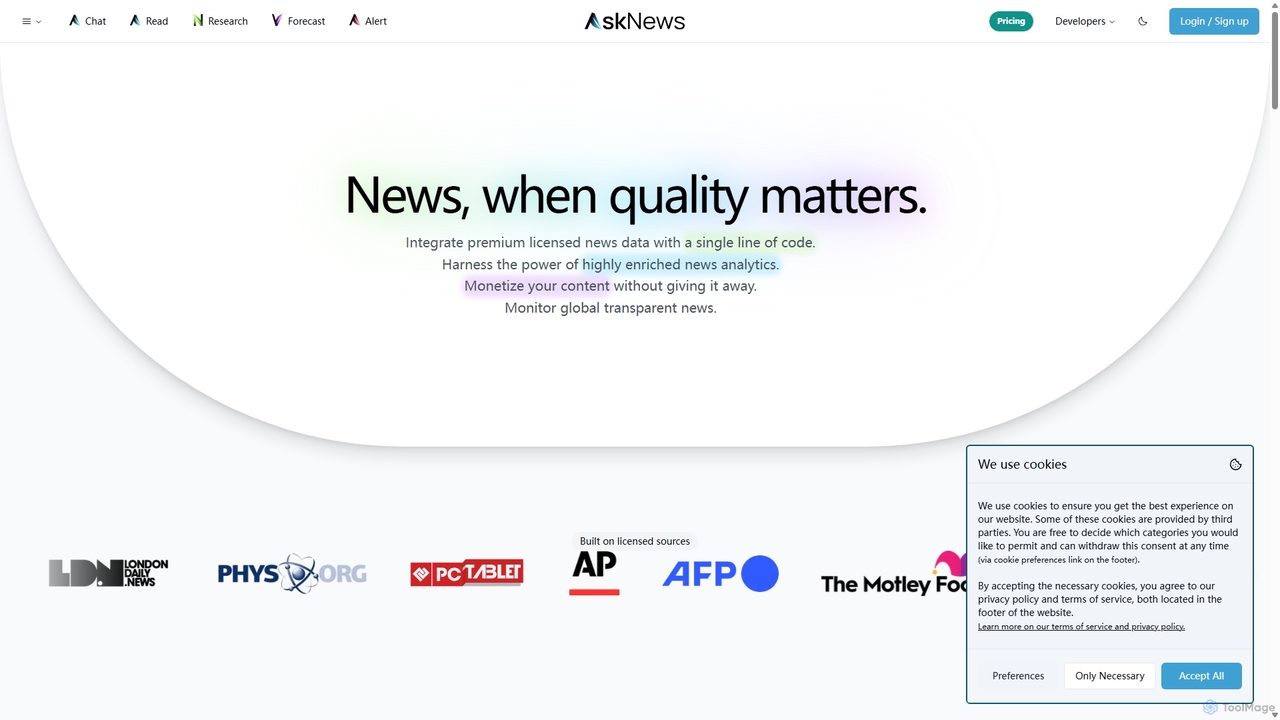
AskNews is an AI-powered news intelligence platform providing high-quality, licensed global news data through a powerful API. It offers enriched news analytics, a conversational AI for insights, and monetization tools for publishers. Ideal for developers, analysts, and researchers needing reliable, structured, and real-time news information.

Intelligence
Visits 7.7KFavorites 156Likes 163
CloudPDF
Freemium

CloudPDF

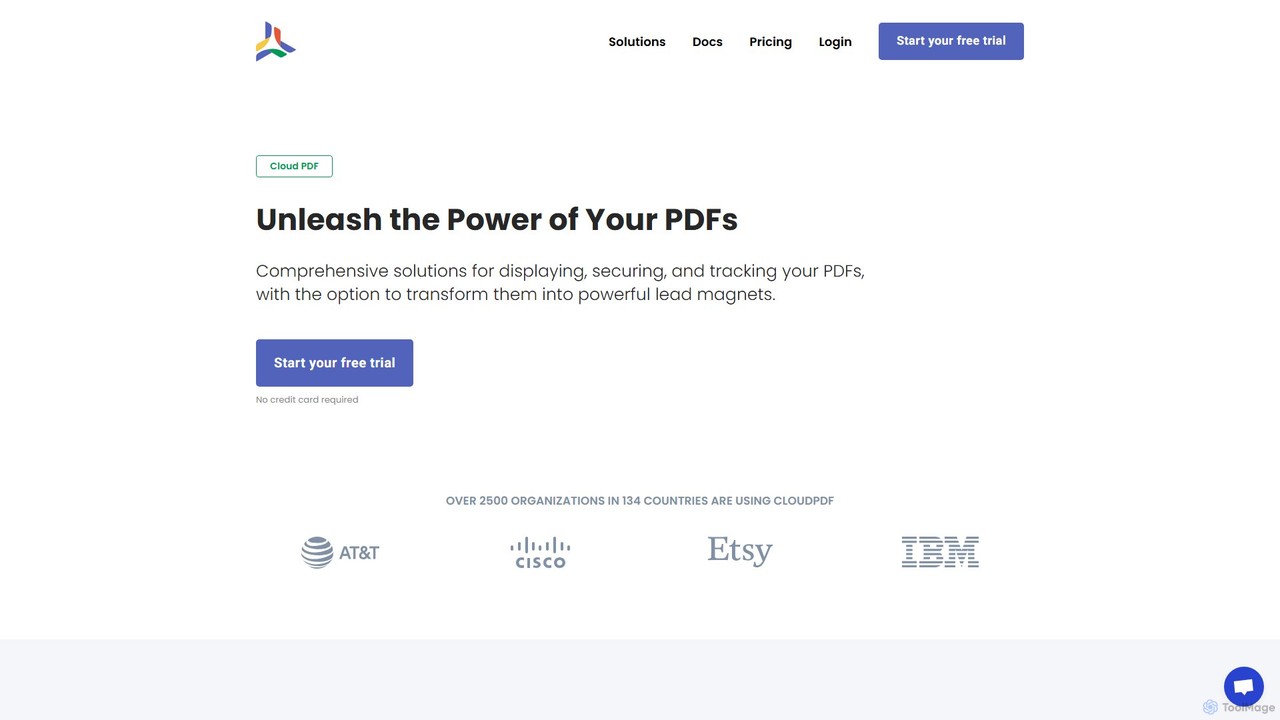
CloudPDF is a cloud-based platform for managing, displaying, securing, and tracking PDFs. It allows users to embed a customizable, fast-loading PDF viewer into websites, prevent unauthorized downloads, and capture leads with forms. A key feature is the AI-powered 'Chat with Your PDF', which transforms static documents into interactive conversational experiences. It's designed for marketers, sales teams, publishers, and developers.

Api & Sdks
Visits 13.6KFavorites 127Likes 139

About Api & Sdks

API & SDKs are essential AI-powered tools that provide developers with programmatic access to advanced artificial intelligence functionalities. These tools encapsulate complex AI models and services, enabling seamless integration of capabilities like natural language processing, computer vision, and machine learning into custom applications. They empower developers to build innovative AI-driven solutions without needing deep expertise in underlying AI algorithms, accelerating development cycles and fostering rapid innovation.

Core Features

  • Pre-trained Models: Access to ready-to-use AI models for common tasks (e.g., sentiment analysis, object detection).
  • Custom Model Training: Tools to fine-tune or train custom AI models using proprietary data via API calls or SDK functions.
  • Scalable Inference: High-performance endpoints for running AI model predictions at scale, handling varying loads efficiently.
  • Language & Framework Support: SDKs offering native integration with popular programming languages (Python, Java, Node.js) and development frameworks.
  • Data Handling & Security: Secure mechanisms for input/output data management, ensuring privacy and compliance during AI processing.

Applicable Scenarios

Developers utilize AI APIs and SDKs across various scenarios to infuse intelligence into their software. This includes integrating natural language understanding into chatbots, adding image recognition to mobile apps, or embedding predictive analytics into business intelligence platforms. They are crucial for building intelligent features that enhance user experience and automate complex processes within applications.

How to Choose

Selecting the right AI API or SDK involves evaluating several factors. Consider the breadth and depth of AI capabilities offered, ensuring they align with your project's specific needs. Assess the ease of integration and documentation quality, as well as the performance and scalability under anticipated load. Finally, compare pricing models and support options to find a solution that fits your budget and technical requirements.

Api & Sdks use cases

1

Building Intelligent Chatbots for Customer Service

Customer service teams can leverage AI APIs for natural language processing (NLP) to develop sophisticated chatbots. Developers integrate text analysis and intent recognition APIs into their messaging platforms, allowing chatbots to understand complex user queries, provide accurate responses, and escalate to human agents when necessary. This significantly reduces response times and improves customer satisfaction by automating routine inquiries.

2

Integrating Real-time Image Recognition into Mobile Apps

Mobile app developers use computer vision SDKs to embed real-time object detection and image classification capabilities. For instance, a retail app might use an image recognition API to allow users to search for products by simply taking a photo, or a security app could identify specific objects in a live video feed. This enhances user interaction and provides innovative functionalities directly within the app.

3

Automating Content Moderation for Online Platforms

Online platform administrators can implement AI APIs for content moderation to automatically detect and filter inappropriate or harmful user-generated content. By integrating text and image analysis APIs, platforms can identify hate speech, spam, or explicit imagery in real-time, reducing the manual effort required for moderation and ensuring a safer online environment for users. This is crucial for maintaining platform integrity and compliance.

4

Enhancing Data Analysis with Predictive Analytics

Data scientists and business analysts integrate machine learning APIs into their data pipelines to perform advanced predictive analytics. For example, a financial institution might use a forecasting API to predict market trends, or an e-commerce platform could employ a recommendation engine API to personalize product suggestions for users. These integrations provide deeper insights and drive data-informed decision-making.

5

Developing Voice-enabled Applications and Assistants

Developers create voice-controlled applications and virtual assistants by integrating speech-to-text and text-to-speech APIs. This allows users to interact with software using natural voice commands, enabling hands-free operation for smart home devices, automotive infotainment systems, or accessibility tools. The APIs handle the complex conversion of audio to text and vice versa, simplifying voice interface development.

6

Personalizing User Experiences in Web Applications

Web developers utilize AI APIs to personalize user experiences based on individual preferences and behaviors. By integrating recommendation engine APIs, they can suggest relevant articles, products, or services to users, or use sentiment analysis APIs to tailor content delivery. This dynamic personalization increases user engagement, improves conversion rates, and fosters a more intuitive browsing experience.

Api & Sdks FAQ

What are AI APIs and SDKs?

AI APIs (Application Programming Interfaces) and SDKs (Software Development Kits) are tools that allow developers to integrate artificial intelligence functionalities into their applications without building AI models from scratch. APIs provide a set of protocols and tools for accessing AI services over the internet, while SDKs offer pre-built code libraries and development tools for specific programming languages, simplifying the integration process. They act as bridges, connecting custom software with powerful AI capabilities like natural language processing, computer vision, and machine learning.

How do AI APIs and SDKs differ from pre-built AI applications?

AI APIs and SDKs provide raw AI capabilities for developers to build custom solutions, offering maximum flexibility and control over integration and user experience. In contrast, pre-built AI applications are ready-to-use software products with specific AI functionalities (e.g., a complete AI chatbot platform or an AI image editor). While pre-built apps are quicker to deploy for specific tasks, APIs and SDKs are ideal for embedding AI into existing systems or creating unique, tailored AI-powered features within new applications, requiring more development effort but offering greater customization.

What types of AI functionalities can be accessed via APIs and SDKs?

AI APIs and SDKs offer access to a wide range of artificial intelligence functionalities. Common types include Natural Language Processing (NLP) for text analysis, sentiment analysis, and language translation; Computer Vision for image recognition, object detection, and facial analysis; Speech Recognition for converting audio to text and Text-to-Speech for generating natural-sounding voice; and Machine Learning for predictive analytics, recommendation engines, and anomaly detection. Many also provide access to generative AI models for creating text, images, or code.

What are the key benefits of using AI APIs and SDKs in development?

Using AI APIs and SDKs significantly accelerates development by abstracting away the complexity of AI model training and deployment. Developers can quickly integrate advanced AI features, reducing time-to-market and development costs. They also provide access to highly optimized, scalable, and often pre-trained models from leading AI providers, ensuring high performance and reliability. This allows teams to focus on core application logic and user experience, rather than managing intricate AI infrastructure, fostering innovation and enabling rapid prototyping of intelligent features.

How do I choose the best AI API or SDK for my project?

To choose the best AI API or SDK, first define your project's specific AI requirements, such as the exact functionality needed (e.g., sentiment analysis, object detection) and expected performance. Evaluate providers based on the accuracy and robustness of their models, the quality of documentation and developer support, and the ease of integration with your existing tech stack. Consider scalability and latency for real-time applications, and carefully review pricing models (pay-as-you-go, subscription) and data privacy policies to ensure compliance and cost-effectiveness. Testing with free tiers or trials is also highly recommended.