Developer Tools Best in category 2 results Data Analysis AI Tool

Popular AI tools in the Data Analysis field of Developer Tools include Lightdash、Roboto, etc., helping you quickly improve efficiency.

Roboto

Roboto

Roboto is an advanced analytics engine designed for physical AI and robotics. It empowers robotics teams to organize, …

13.3K
Lightdash

Lightdash

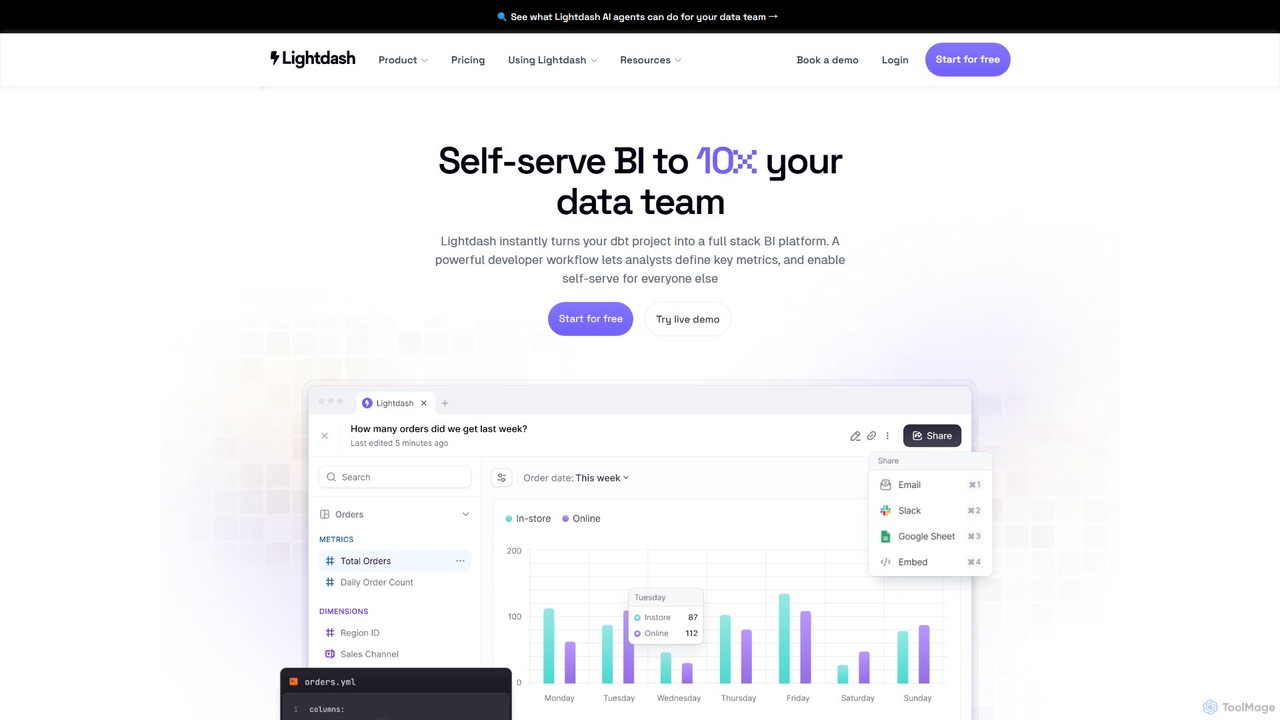
Lightdash is an open-source, AI-powered business intelligence (BI) platform built specifically for dbt. It empowers entire teams with …

51.2K

About Data Analysis

AI Data Analysis tools are a specialized category of developer utilities that leverage machine learning and natural language processing to automate the exploration, interpretation, and visualization of complex datasets. They go beyond traditional spreadsheets by automatically identifying patterns, predicting future trends, and generating actionable insights from raw data. These tools empower developers and analysts to ask complex questions in plain language and receive immediate, data-backed answers, significantly accelerating the data-to-decision pipeline. This approach reduces the need for extensive manual coding in languages like SQL or Python for routine analytical tasks.

Core Features

  • Natural Language Querying: Ask questions about your data in plain English and get back charts and summaries.
  • Automated Insight Discovery: Proactively identifies significant trends, correlations, and anomalies without manual exploration.
  • Predictive Modeling: Builds and deploys machine learning models for forecasting, classification, and churn prediction.
  • Automated Data Preparation: Cleans, transforms, and structures raw data from various sources to make it analysis-ready.
  • Interactive Visualization: Automatically generates dynamic charts, graphs, and dashboards to communicate findings effectively.

Applicable Scenarios

These tools are widely used by data scientists, business intelligence analysts, product managers, and developers who need to embed analytics into applications. Common applications include analyzing user behavior in SaaS products, forecasting sales trends in e-commerce, detecting fraudulent transactions in finance, and optimizing marketing campaign performance.

Selection Criteria

When choosing an AI Data Analysis tool, consider its integration capabilities (API access, database connectors), the range of supported data sources (SQL, NoSQL, cloud storage), its scalability for handling large datasets, and the balance between no-code interfaces for business users and code-based extensibility (e.g., Python/R support) for developers.


Data AnalysisUse Cases

1

E-commerce Sales and Inventory Forecasting

An e-commerce manager connects their sales database (e.g., Shopify, Magento) to an AI analysis tool. The tool automatically analyzes historical sales data, seasonality, and promotional events to generate accurate demand forecasts for the next quarter. This allows the manager to optimize stock levels, prevent stockouts of popular items, and reduce overstocking of slow-moving products, directly improving cash flow and profitability without needing a dedicated data science team.

2

Analyzing User Engagement in a SaaS Application

A product manager for a software-as-a-service (SaaS) platform wants to understand how users interact with a new feature. Instead of writing complex SQL queries, they use a tool with natural language querying to ask: 'Show me the adoption rate of the new dashboard feature by user segment over the last 30 days.' The tool generates an interactive chart revealing that enterprise users have a high adoption rate while trial users rarely engage, providing clear direction for targeted user onboarding improvements.

3

Automated Anomaly Detection in Financial Transactions

A fintech company's development team integrates an AI data analysis tool via its API into their transaction processing system. The tool continuously monitors transaction data in real-time, using machine learning models to learn normal patterns. It automatically flags suspicious activities, such as unusually large transfers or transactions from atypical locations, that deviate from these norms. This provides an early warning system for potential fraud, reducing financial losses and enhancing platform security.

4

Optimizing Marketing Campaign Spend

A digital marketing team consolidates data from Google Ads, Facebook Ads, and their CRM into a single AI analysis platform. The tool analyzes conversion rates, cost-per-acquisition (CPA), and customer lifetime value (LTV) across all channels. It identifies underperforming ad sets and highlights high-value audience segments, providing clear recommendations to reallocate the marketing budget towards the most profitable campaigns, maximizing return on investment (ROI).

5

Root Cause Analysis of Application Errors

A DevOps engineer is tasked with identifying the cause of intermittent performance issues in a web application. They feed server logs and performance metrics into an AI analysis tool. The tool sifts through millions of log entries to correlate error spikes with specific events, such as a new code deployment or a surge in traffic from a particular region. This quickly pinpoints the root cause, reducing system downtime and saving hours of manual log investigation.

6

Predicting Customer Churn for Subscription Services

A data analyst for a subscription box service uses an AI tool to build a churn prediction model. The model analyzes customer behavior, including login frequency, support ticket history, and usage of key features. It assigns a 'churn risk score' to each customer. The marketing team then uses this list to proactively engage at-risk customers with targeted offers or support, effectively reducing the overall churn rate and retaining valuable revenue.

Data AnalysisFrequently Asked Questions