Hex
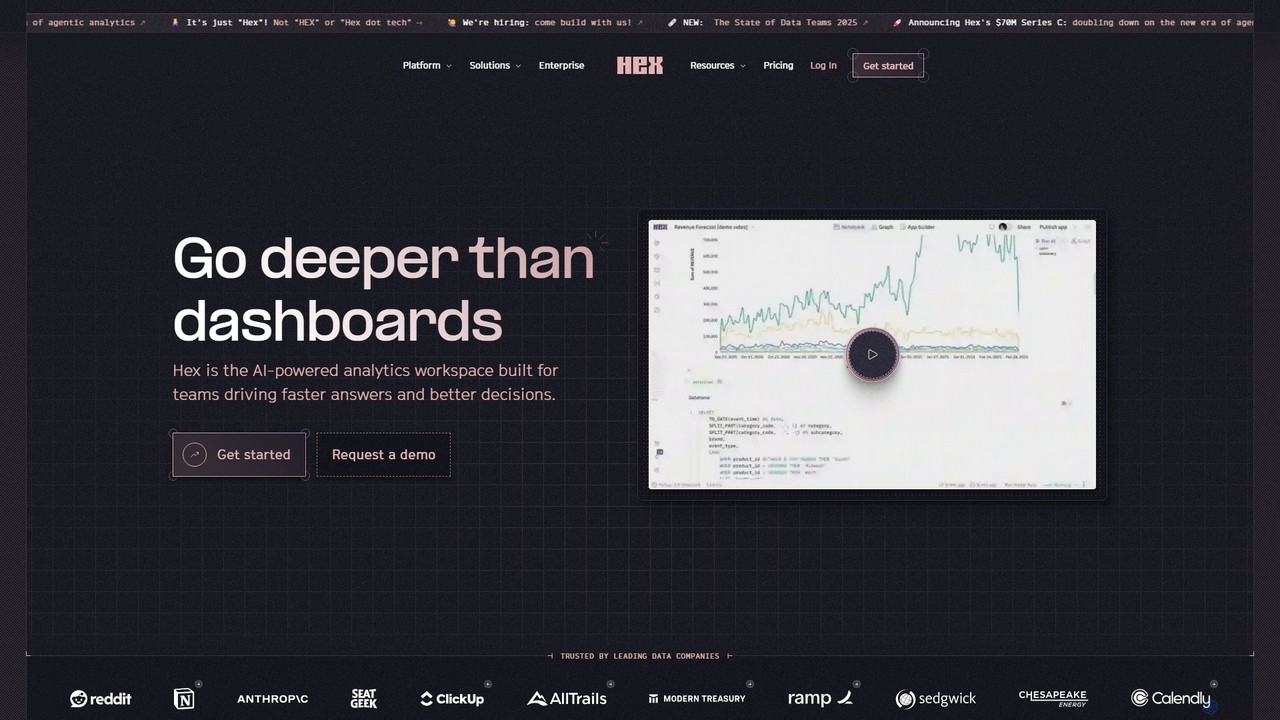
Hex is an AI-powered analytics workspace designed for teams. It integrates notebooks for Python and SQL, interactive data …
Hex is an AI-powered analytics workspace designed for teams. It integrates notebooks for Python and SQL, interactive data apps, and self-serve exploration into a single collaborative platform, enabling faster, data-driven decision-making.
Lightdash
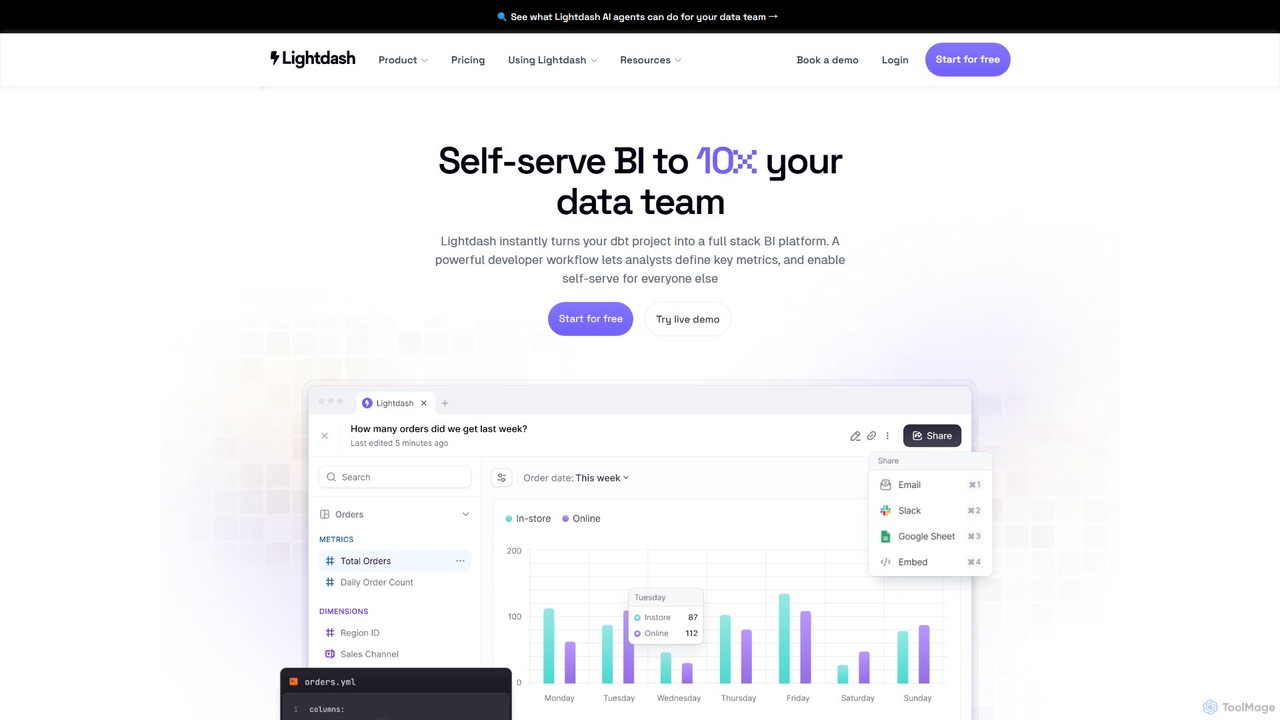
Lightdash is an open-source, AI-powered business intelligence (BI) platform built specifically for dbt. It empowers entire teams with …
Lightdash is an open-source, AI-powered business intelligence (BI) platform built specifically for dbt. It empowers entire teams with self-serve analytics, allowing users to ask data questions in plain English. With developer-friendly workflows and no per-user pricing, it's designed to make data accessible to everyone, from data engineers to business stakeholders.
About Data Science
Data Science tools are specialized AI platforms designed to extract knowledge and insights from complex datasets. They integrate machine learning algorithms, statistical modeling, and data visualization to support the entire data analysis lifecycle, from preparation to model deployment. These tools empower organizations to build predictive models, uncover hidden patterns, and make data-driven decisions with greater accuracy. They are distinct within the broader AI field by focusing specifically on the structured workflow of data exploration, model training, and operationalization (MLOps).
Core Features
- Data Preparation & Cleaning: Automate handling of missing values, data transformation, and feature engineering for modeling.
- Model Development & Training: Provide environments for building, training, and evaluating various machine learning models.
- Exploratory Data Analysis (EDA): Generate interactive visualizations and statistical summaries to understand data characteristics.
- Model Deployment & MLOps: Streamline putting models into production, monitoring their performance, and managing their lifecycle.
- Collaborative Notebooks: Offer interactive, code-based environments for teams to collaborate on analysis and share results.
Use Cases
Data Science tools are crucial in finance for credit scoring and fraud detection, in retail for demand forecasting, and in healthcare for predictive diagnostics. Data scientists, machine learning engineers, and business analysts leverage these platforms to solve complex analytical problems.
How to Choose
When selecting a Data Science tool, consider your team's technical skill (code-first vs. low-code/no-code), the scale of your data, integration capabilities with existing data sources, and the specific types of models you need to build (e.g., NLP, computer vision).

Data ScienceUse Cases
Predicting Customer Churn for Retention
A marketing analyst at a subscription-based service company uses a data science platform to analyze customer behavior data, including usage frequency, support ticket history, and subscription tenure. By building a classification model, they can predict the likelihood of each customer churning in the next month. This allows the marketing team to proactively target at-risk customers with personalized retention offers, reducing overall churn rate and increasing customer lifetime value.
Real-Time Fraud Detection in Financial Transactions
A financial institution employs a data science tool to build and deploy a machine learning model that analyzes transaction data in real-time. The model identifies anomalies and patterns indicative of fraud by evaluating variables like transaction amount, location, time, and historical user behavior. When a potentially fraudulent transaction is detected, the system can automatically block it or flag it for immediate review by a human analyst, significantly reducing financial losses and protecting customer accounts.
Optimizing Inventory with Demand Forecasting
A retail chain's operations manager uses a data science platform to forecast product demand. The tool analyzes historical sales data, seasonality, promotional events, and even external factors like weather. The resulting predictive model provides accurate demand forecasts for each product at each store location. This enables the company to optimize inventory levels, preventing stockouts of popular items and reducing overstock of slow-moving products, which in turn improves cash flow and profitability.
Personalizing Marketing with Customer Segmentation
A digital marketing team uses a data science tool to perform customer segmentation. By applying clustering algorithms to a dataset containing purchase history, website browsing behavior, and demographic information, they identify distinct customer groups. For example, they might find 'high-spending loyalists,' 'bargain hunters,' and 'new visitors.' This segmentation allows them to create highly targeted marketing campaigns, sending relevant product recommendations and promotions to each group, which increases engagement and conversion rates.
Assisting Medical Diagnosis with Image Analysis
A team of healthcare researchers uses a data science platform to train a deep learning model on a large dataset of medical images, such as X-rays or MRIs. The model learns to identify subtle patterns that may indicate the presence of a disease. When deployed, this tool can assist radiologists by highlighting areas of concern on new scans, potentially leading to earlier and more accurate diagnoses. It acts as a powerful second opinion, augmenting the expertise of medical professionals rather than replacing them.
Enabling Predictive Maintenance in Manufacturing
An operations manager in a manufacturing plant uses a data science tool to analyze sensor data from factory machinery. This data includes temperature, vibration, and pressure readings. By building a time-series forecasting model, the system can predict when a piece of equipment is likely to fail. This allows the maintenance team to schedule repairs proactively before a breakdown occurs, minimizing costly unplanned downtime, extending the lifespan of the equipment, and improving overall plant efficiency.