Tiptap
Tiptap is a headless, open-source, and framework-agnostic editor toolkit for developers. It allows for the creation of highly …
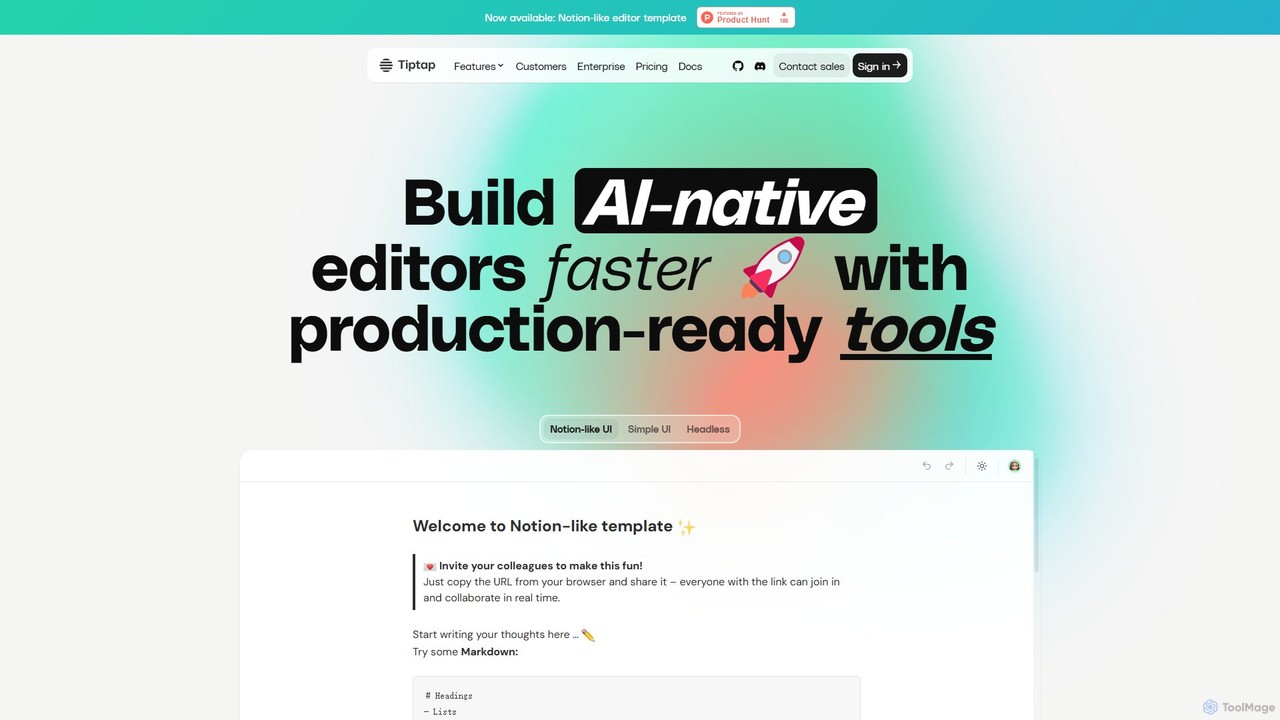
Tiptap is a headless, open-source, and framework-agnostic editor toolkit for developers. It allows for the creation of highly customizable rich text editors with over 100 extensions. Tiptap also offers premium cloud services, including real-time collaboration, AI-powered content generation and editing, document conversion, and commenting features, enabling developers to build sophisticated, modern editing experiences into their applications with ease.
About Editor Framework
An Editor Framework is a foundational software toolkit that enables developers to build custom, feature-rich text and code editors. These frameworks provide core components like a document model, a high-performance rendering engine, and an extensible API, abstracting away the complexities of editor development. They are used to create tailored editing experiences, from simple embedded text areas to full-fledged Integrated Development Environments (IDEs). By offering a robust base, editor frameworks significantly accelerate the creation of specialized tools for specific programming languages, data formats, or collaborative workflows.
Core Features
- Extensible Plugin Architecture: Allows developers to add new functionalities, themes, and language support through a well-defined API.
- Advanced Document Model: Manages complex text structures, syntax trees, and collaborative editing states efficiently.
- High-Performance Rendering: Optimized to handle large files, long lines, and complex syntax highlighting without performance degradation.
- Language Service Protocol (LSP) Support: Natively integrates with language servers for features like autocompletion, diagnostics, and code navigation.
- Customizable UI Components: Provides tools to modify every aspect of the editor's appearance and user interface.
Applicable Scenarios
Editor Frameworks are primarily used by software companies and individual developers building developer tools. This includes creating new IDEs for emerging programming languages, embedding code editors into SaaS platforms for data science or cloud infrastructure management, and developing collaborative real-time coding environments for educational or team-based projects.
Selection Criteria
When choosing an Editor Framework, evaluate its performance and memory footprint, especially for large files. Assess the quality of its documentation and the size of its community. Also, consider the framework's licensing model (open-source vs. commercial), its primary platform (web vs. desktop), and the richness of its API for custom extensions.

Editor FrameworkUse Cases
Building a Domain-Specific IDE
A software company is developing a new programming language for data analysis. To foster adoption, they need a dedicated Integrated Development Environment (IDE). By using an editor framework, their development team can focus on language-specific features like custom syntax highlighting, intelligent code completion based on data schemas, and an integrated debugger. The framework provides the core editor functionality, saving thousands of hours of development time compared to building from scratch.
Creating a Collaborative Web-Based Code Editor
An EdTech startup wants to build a platform for live coding interviews and pair programming. They need a web-based editor that supports real-time collaboration, showing multiple cursors and selections simultaneously. They choose a web-native editor framework with strong support for collaborative features. This allows them to implement shared editing sessions, operational transforms for conflict-free merging, and user presence indicators, creating a seamless experience for their users without having to solve the complex distributed systems problems themselves.
Embedding a Configuration Editor in a SaaS Platform
A cloud infrastructure management platform allows users to define their infrastructure using YAML files. To improve user experience, they decide to embed a specialized editor directly into their web application. Using an editor framework, they build a component that provides YAML syntax validation, autocompletion based on their platform's API, and inline documentation for configuration options. This guided editing experience significantly reduces configuration errors and makes the platform more accessible to new users.
Developing a Rich Markdown Editor for a CMS
A company building a headless Content Management System (CMS) wants to provide content creators with a superior writing experience. Instead of a plain textarea, they use an editor framework to build a rich Markdown editor. This custom editor includes features like a side-by-side live preview, slash commands for inserting complex components (e.g., `/image`, `/video`), and collaborative editing capabilities. This empowers non-technical users to create structured, rich content efficiently, setting the CMS apart from its competitors.
Prototyping Novel Code Visualization Tools
A university research group is exploring new ways to visualize code execution and data structures to help students learn programming. They use an editor framework as a foundation for their prototype. This allows them to quickly build an interactive environment where they can render graphical overlays on top of the code, link variables to live diagrams, and step through execution visually. The framework handles all the standard text editing, syntax parsing, and UI management, letting the researchers focus entirely on their innovative visualization logic.
Building a Live Tutorial and Coding Sandbox
An online learning platform wants to create interactive tutorials where users can read instructions and write code in the same view. They use an editor framework to build a 'coding sandbox' component. This component is embedded alongside tutorial text, providing a live environment for users to experiment with code snippets. The framework's API is used to run the code, capture the output, and provide real-time feedback and validation, creating an engaging, hands-on learning experience that significantly improves knowledge retention.