ToolMage
Sign in

Best 1 Local Llms AI tools for Developer Tools

Popular Local Llms AI tools in Developer Tools include Offeline, helping you work more efficiently.

Offeline
Free

Offeline

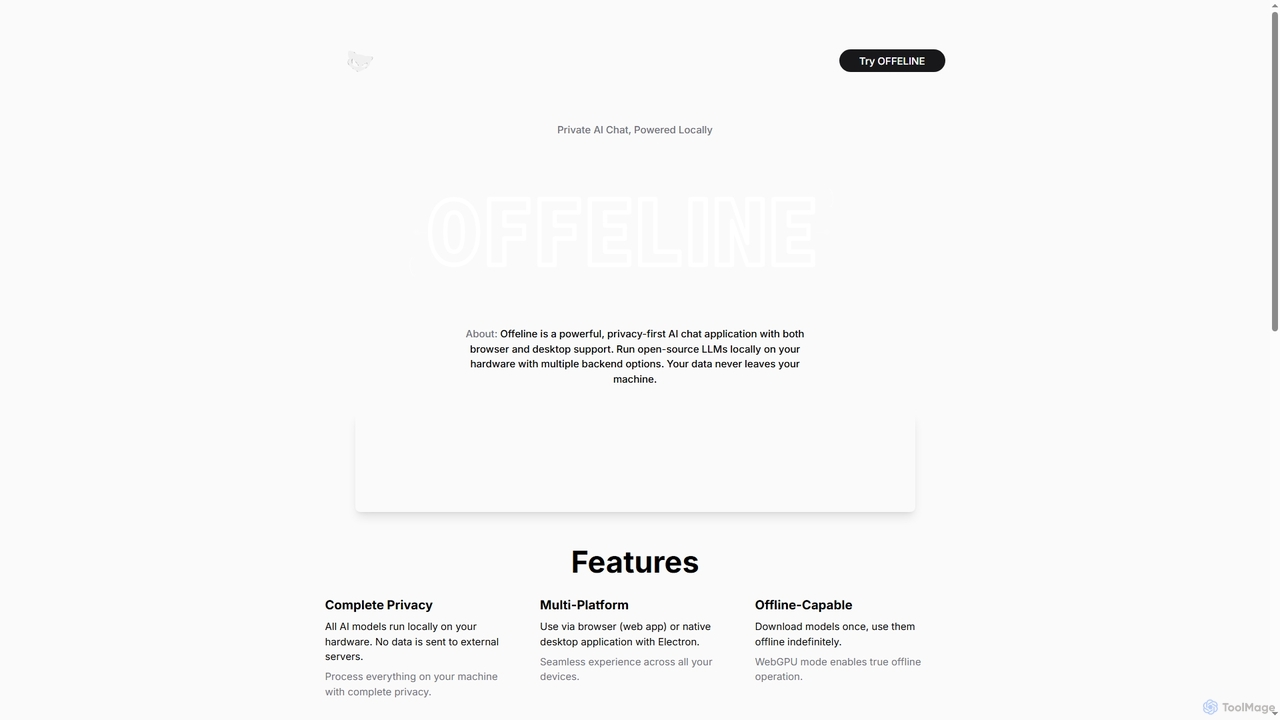
Offeline is a powerful, privacy-first AI chat application that runs open-source Large Language Models (LLMs) locally on your hardware. It supports both browser and native desktop use, ensuring your data never leaves your machine. Enjoy offline capabilities, web search integration, document analysis, and voice support.

Local Llms
Visits 4.2KFavorites 147Likes 150

About Local Llms

Local LLMs are large language models designed to run directly on local hardware, such as personal computers or edge devices, without requiring an internet connection to external cloud servers. This approach enables enhanced data privacy, reduced operational costs, and real-time inference capabilities. They are particularly valuable for developers building applications where data sovereignty, low latency, or offline functionality is paramount.

Core Features

  • Offline Operation: Enables AI model inference without an internet connection, ideal for remote or secure environments.
  • Data Privacy: Processes sensitive information locally, ensuring data never leaves the user's device.
  • Cost Efficiency: Eliminates recurring API call costs associated with cloud-based LLMs, reducing long-term expenses.
  • Low Latency: Provides near-instantaneous responses as computations occur directly on the device, bypassing network delays.
  • Customization & Fine-tuning: Allows developers to fine-tune models with proprietary data locally, enhancing domain-specific performance.

Applicable Scenarios

Developers and enterprises utilize Local LLMs for applications requiring strict data governance, such as internal document analysis in finance or healthcare. They are also crucial for edge computing scenarios, like smart home devices or industrial IoT, where real-time processing and offline capabilities are essential. Furthermore, individual users can leverage them for personal AI assistants that prioritize privacy.

How to Choose

When selecting a Local LLM, consider the model's size and performance requirements relative to your hardware capabilities. Evaluate the ease of integration with your existing development stack, available quantization options for efficiency, and the community support for specific frameworks (e.g., Llama.cpp, Ollama). Data privacy features and the ability to fine-tune locally are also critical factors.

Featured tool rankings

Local Llms use cases

1

Building Privacy-Focused AI Assistants

Developers create personal AI assistants or chatbots that process user queries and generate responses entirely on the user's device. This ensures sensitive personal data, such as health information or financial details, remains private and never leaves the local environment, appealing to users with strong privacy concerns.

2

Offline Document Analysis and Summarization

Researchers or legal professionals use Local LLMs to analyze large volumes of confidential documents (e.g., legal briefs, medical records) on their laptops without uploading them to cloud services. The LLM can summarize content, extract key information, or answer questions, providing insights while maintaining strict data security and compliance.

3

Edge AI for Industrial IoT

Manufacturers deploy Local LLMs on edge devices within factories to monitor machinery, predict maintenance needs, or analyze sensor data in real-time. This enables immediate decision-making without relying on potentially unreliable or high-latency cloud connections, improving operational efficiency and safety in remote or critical infrastructure.

4

Local Code Generation and Refactoring

Software developers integrate Local LLMs into their IDEs to assist with code generation, refactoring, or debugging. This allows them to receive coding suggestions and complete tasks without sending proprietary code to external servers, enhancing productivity while keeping intellectual property secure within their local development environment.

5

Personalized Content Generation for Creators

Content creators or marketers use Local LLMs to generate personalized marketing copy, social media posts, or creative writing prompts directly on their workstations. This provides immediate, tailored content suggestions based on their local data and preferences, offering creative assistance without incurring cloud API costs or privacy risks.

6

Educational Tools for AI Learning

Students and educators utilize Local LLMs to experiment with AI models, understand their mechanics, and develop applications without needing powerful cloud infrastructure or incurring costs. This provides a hands-on learning environment for natural language processing, allowing for safe experimentation and development of AI skills.

Local Llms FAQ

What are Local LLMs?

Local LLMs are large language models designed to run directly on a user's personal device, such as a computer or smartphone, rather than on remote cloud servers. They process information locally, offering benefits like enhanced data privacy, reduced operational costs, and the ability to function entirely offline. They are ideal for applications where data sovereignty and low latency are critical.

Why choose a Local LLM over a cloud-based LLM?

Local LLMs offer distinct advantages over cloud-based alternatives, primarily in data privacy (data never leaves your device), cost efficiency (no recurring API fees), and offline accessibility. They also provide lower latency for real-time applications and greater control over model customization. Cloud LLMs, however, typically offer superior performance for very large models and require less local hardware.

What hardware is needed to run Local LLMs?

The hardware requirements for running Local LLMs vary significantly depending on the model's size and complexity. Generally, a modern CPU with sufficient RAM (16GB or more is often recommended) is a good starting point. For better performance, especially with larger models, a dedicated GPU with ample VRAM (8GB+ is beneficial) is highly recommended. Quantized models can run on less powerful hardware.

Can Local LLMs be fine-tuned with custom data?

Yes, many Local LLMs can be fine-tuned with custom, proprietary data directly on the user's device. This process allows developers to adapt the model's knowledge and behavior to specific domains or tasks, enhancing its relevance and accuracy for particular applications. Fine-tuning locally ensures that sensitive training data remains secure and private.

How do Local LLMs compare to traditional "Developer Tools" in the AI space?

While Local LLMs are a subset of "Developer Tools" in the AI space, their unique characteristic is the emphasis on on-device execution. Traditional AI developer tools might focus on cloud API integration, model training platforms, or MLOps for cloud deployments. Local LLMs, conversely, provide the tools and frameworks (like Llama.cpp or Ollama) specifically for deploying and managing AI models directly on local hardware, catering to privacy-sensitive or offline-first development needs.