
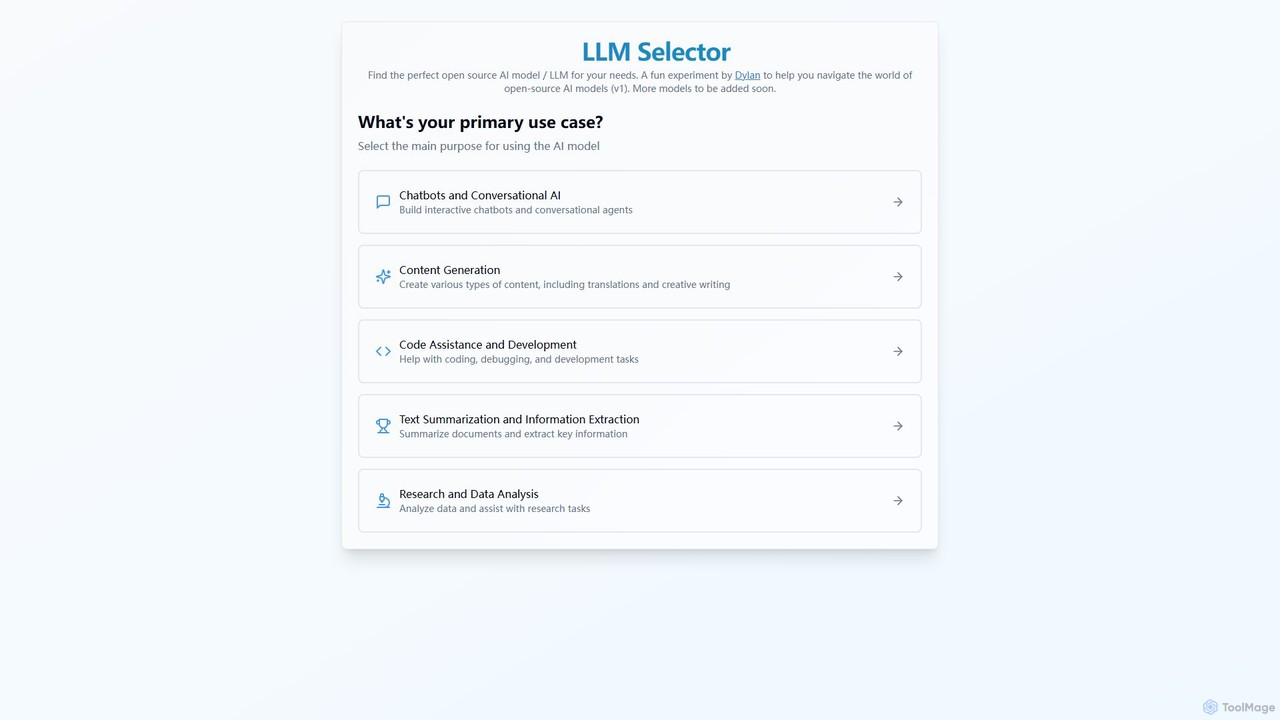
LLM Selector
An intuitive tool designed to help developers and researchers find the perfect open-source Large Language Model (LLM) for …
An intuitive tool designed to help developers and researchers find the perfect open-source Large Language Model (LLM) for their specific needs. Filter by use case, compare models, and simplify your selection process.
AIModels.fyi
AIModels.fyi is a specialized AI research assistant designed for professionals to track, summarize, and discover the latest AI …
AIModels.fyi is a specialized AI research assistant designed for professionals to track, summarize, and discover the latest AI papers, models, and tools. It cuts through the noise with curated digests and focused alerts, ensuring you never miss a critical breakthrough in the fast-paced world of AI.
About Model Discovery
Model Discovery platforms are centralized hubs for finding, comparing, and accessing pre-trained AI models. These tools aggregate thousands of models from various sources, providing a searchable and filterable catalog for developers and researchers. They enable users to evaluate models based on performance benchmarks, cost, and specific use cases, significantly accelerating the integration of AI into applications. This approach eliminates the need to train models from scratch, reducing development time and infrastructure costs.
Core Features
- Comprehensive Model Catalog: Search and filter a vast library of models by task, framework, license, and popularity.
- Performance Benchmarking: Compare models side-by-side using standardized metrics like accuracy, latency, and throughput.
- Standardized API Access: Run inference on various models through a unified API without managing underlying infrastructure.
- Model Versioning: Track updates and changes to models to ensure reproducibility and manage dependencies.
- Community and Leaderboards: Discover trending models, view user ratings, and see performance rankings on common datasets.
Use Cases
These platforms are primarily used by developers, machine learning engineers, and data scientists who need to quickly integrate AI capabilities. They are valuable in scenarios like rapid prototyping for startups, academic research for comparing model architectures, and enterprise environments for selecting production-ready models for features like recommendation engines or content moderation.
How to Choose
When selecting a Model Discovery platform, consider the breadth and quality of the model catalog. Evaluate the ease of API integration and the clarity of documentation. Assess the platform's benchmarking transparency and whether the pricing model (e.g., pay-per-call) aligns with your expected usage. Finally, consider community support and the availability of tutorials or starter code.
Model DiscoveryUse Cases
Rapid Prototyping for a New App Feature
A startup developer is tasked with adding a sentiment analysis feature to their social media monitoring app. Instead of spending weeks building and training a custom model, they use a Model Discovery platform. They filter models by 'sentiment analysis' task, sort by API cost and latency, and find a suitable pre-trained model. Using the provided API key and code snippets, they integrate the feature into their prototype within a few hours, allowing for immediate user testing and feedback collection.
Benchmarking Models for Academic Research
A university researcher is comparing the performance of different object detection models for a paper. They use a Model Discovery platform to access various architectures like YOLO, SSD, and Faster R-CNN. The platform provides standardized performance metrics on common datasets like COCO. This allows the researcher to efficiently gather comparative data, analyze trade-offs between speed and accuracy, and cite the results directly, saving significant time on setting up and running each model's environment individually.
Selecting a Production-Ready Enterprise Model
An MLOps team at a large e-commerce company needs to implement a content moderation system for product reviews. They require a model that is highly accurate, low-latency, and compliant with their data privacy policies. Using a Model Discovery platform, they filter for text classification models with commercial-use licenses. They then use the platform's benchmarking tools to compare the top candidates on their own test data via API, ultimately selecting the model with the best balance of performance and operational cost for deployment.
Exploring Generative Models for Creative Projects
A digital artist wants to experiment with various text-to-image models to create unique visuals for a project. A Model Discovery platform provides them with a playground to test the same prompt across different models like Stable Diffusion, DALL-E, and Midjourney variants. They can easily compare the artistic styles, coherence, and output quality of each model without needing to set up separate accounts or environments. This allows for rapid creative exploration and helps them identify the best model for their specific aesthetic goals.
Finding a Cost-Effective Translation API
A freelance developer is building a budget-conscious mobile app that requires a text translation feature. They use a Model Discovery platform to find translation models. They filter by source and target languages and, most importantly, sort the results by the cost per 1,000 characters. By comparing the pricing and performance of several API-accessible models, they can select a reliable translation service that fits within their tight operational budget, avoiding the high costs associated with major cloud provider services.
Evaluating State-of-the-Art Language Models
An AI research lab has developed a new large language model (LLM). To validate its capabilities, they need to benchmark it against existing state-of-the-art (SOTA) models. They consult a Model Discovery platform's public leaderboards, which rank models on standard NLP benchmarks like GLUE and SuperGLUE. This provides an immediate, objective comparison point for their model's performance, helping them identify its strengths and weaknesses and position their research within the broader AI landscape without manually running every competing model.