Developer Tools Best in category 3 results Prompt Management AI Tool

Popular AI tools in the Prompt Management field of Developer Tools include Promptiz、PromptGround、Promptspot, etc., helping you quickly improve efficiency.

Promptspot

Promptspot

Promptspot is an advanced marketplace and toolkit for AI prompts. It empowers users to discover, create, share, and …

2.4K
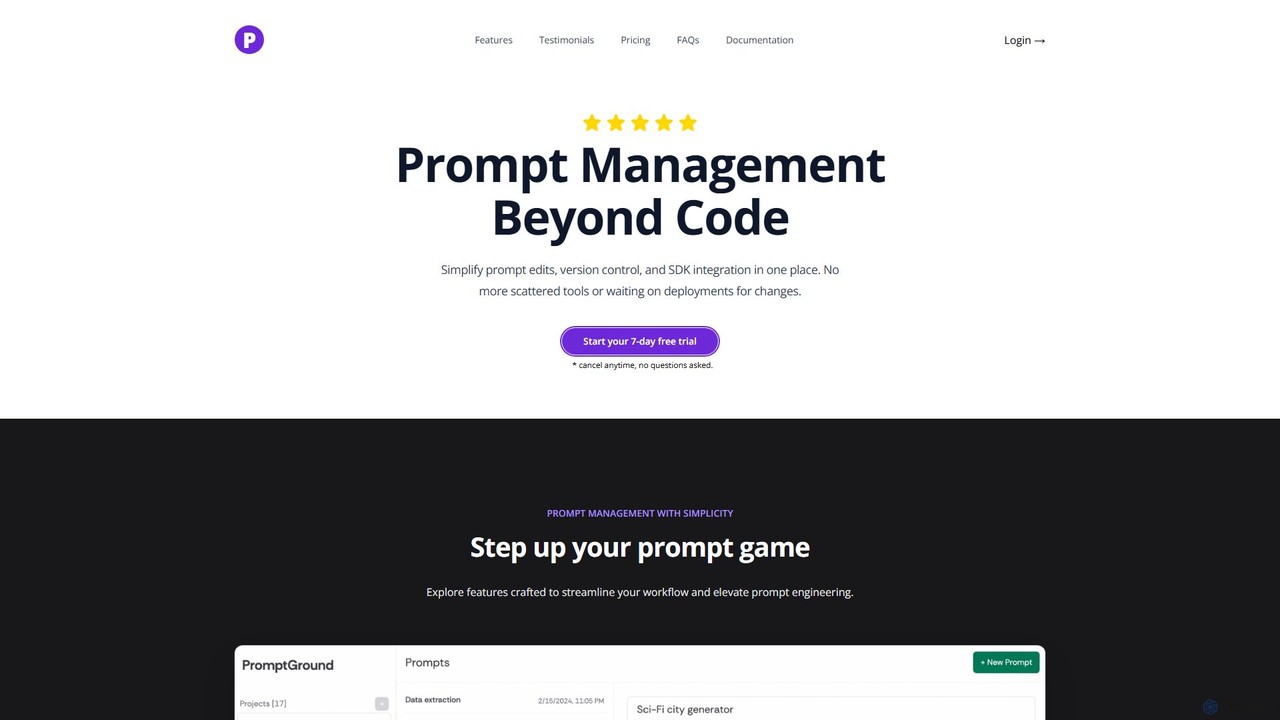
PromptGround

PromptGround

PromptGround is a centralized platform for developers and teams to manage, version, test, and analyze AI prompts. It …

2.4K
Promptiz

Promptiz

Promptiz is an advanced AI prompt engineering platform designed to help users create, optimize, and manage high-performance prompts …

2.4K

About Prompt Management

Prompt Management tools are specialized platforms for systematically creating, testing, versioning, and deploying prompts for Large Language Models (LLMs). These tools treat prompts as critical software assets, similar to source code, enabling structured development and collaboration. By providing a centralized environment for prompt engineering, they help teams improve the consistency, performance, and reliability of AI applications. This approach transforms prompt creation from an ad-hoc activity into a disciplined engineering practice.

Core Features

  • Prompt Versioning: Tracks changes to prompts over time, allowing teams to revert to previous versions and compare performance, similar to Git for code.
  • Collaborative Prompt Library: A central repository for teams to store, share, and reuse effective prompts and templates, ensuring consistency and knowledge sharing.
  • A/B Testing & Evaluation: Systematically compare different prompt variations against multiple LLMs or datasets to identify the most effective wording and structure.
  • Prompt Templating: Create dynamic prompts with variables that can be programmatically filled, enabling personalization and scalability for various use cases.
  • Deployment & Observability: Integrate tested prompts into applications via APIs and monitor their performance, cost, and output quality in production.

Use Cases

Prompt Management tools are essential for AI developers, prompt engineers, and MLOps teams building applications on top of LLMs. They are widely used in developing sophisticated customer service chatbots, building reliable content generation pipelines, and creating systems for structured data extraction from text. Product teams also use them to experiment with and optimize prompts for new GenAI features before launch.

How to Choose

When selecting a Prompt Management tool, consider its integration support for various LLMs (e.g., OpenAI, Anthropic, Google). Evaluate the robustness of its version control and collaboration features. Assess the platform's testing and evaluation capabilities, including the metrics it provides. Finally, examine the deployment options (API, SDK) and how well it fits into your existing MLOps or CI/CD workflows.

Prompt ManagementUse Cases

1

Developing a Customer Service Chatbot

An AI development team is tasked with building a chatbot to handle customer inquiries about order status and returns. They use a prompt management platform to create a library of prompts, each tailored to a specific user intent. The team can version control these prompts, allowing them to safely test improvements. Using the A/B testing feature, they compare a concise prompt against a more detailed one for the 'return policy' intent, measuring which one leads to fewer escalations to human agents. The finalized, top-performing prompts are then deployed via an API, ensuring the chatbot provides consistent and accurate responses.

2

Standardizing Marketing Copy Generation

A corporate marketing team needs to ensure brand voice consistency across all content generated by AI. They use a prompt management tool to establish a central, collaborative library of approved prompt templates. These templates for generating ad copy, social media posts, and blog outlines include variables for product names and target audiences. New marketers can quickly get started with proven prompts, while senior members can update and refine the templates, with all changes tracked. This system prevents inconsistent messaging and significantly speeds up the content creation workflow for campaigns.

3

Optimizing Data Extraction from Documents

A data science team is building a pipeline to extract structured information, like invoice numbers and total amounts, from thousands of PDF documents. The accuracy of the LLM's output is highly dependent on the prompt. Using a prompt management tool, they create and iterate on a base prompt. Each modification is saved as a new version. They run evaluations on a test set of documents to compare the accuracy of different prompt versions. This systematic approach allows them to pinpoint which phrasing changes lead to better extraction results, ultimately building a more reliable and accurate data processing pipeline.

4

Managing Prompts for a Multi-Lingual Application

A company is launching its AI-powered Q&A feature in five different languages. Instead of managing separate text files for each language, the development team uses a prompt management platform. They create a single prompt template with placeholders for language-specific nuances. The platform allows them to link different language variations to the same core prompt logic. When they need to update the prompt's instructions, they can make the change once in the template, and it propagates to all language versions. This drastically simplifies maintenance and ensures a consistent user experience across all supported regions.

5

A/B Testing Prompts for a SaaS Feature

A product manager for a SaaS company wants to improve a new AI-powered text summarization feature. They hypothesize that a prompt encouraging bullet points will be more popular than one that generates a paragraph. Using a prompt management tool, they set up an A/B test to serve 50% of users Prompt A (paragraph) and 50% Prompt B (bullet points). The tool integrates with their analytics, allowing them to track user engagement metrics like 'copy summary' clicks and user satisfaction ratings for each prompt version. After a week, the data clearly shows Prompt B has higher engagement, giving the product manager confidence to roll it out to all users.

6

Building a Collaborative Enterprise Prompt Library

In a large enterprise, multiple teams are independently developing prompts for various AI applications, leading to duplicated effort and inconsistent quality. An MLOps team implements a prompt management platform to create a centralized, enterprise-wide prompt library. They establish best practices and create base templates for common tasks like summarization and classification. Now, a team in finance can reuse and adapt a prompt originally built by the marketing team, saving weeks of development time. The library becomes a shared knowledge base, improving the quality and efficiency of AI development across the entire organization.

Prompt ManagementFrequently Asked Questions