Fastly
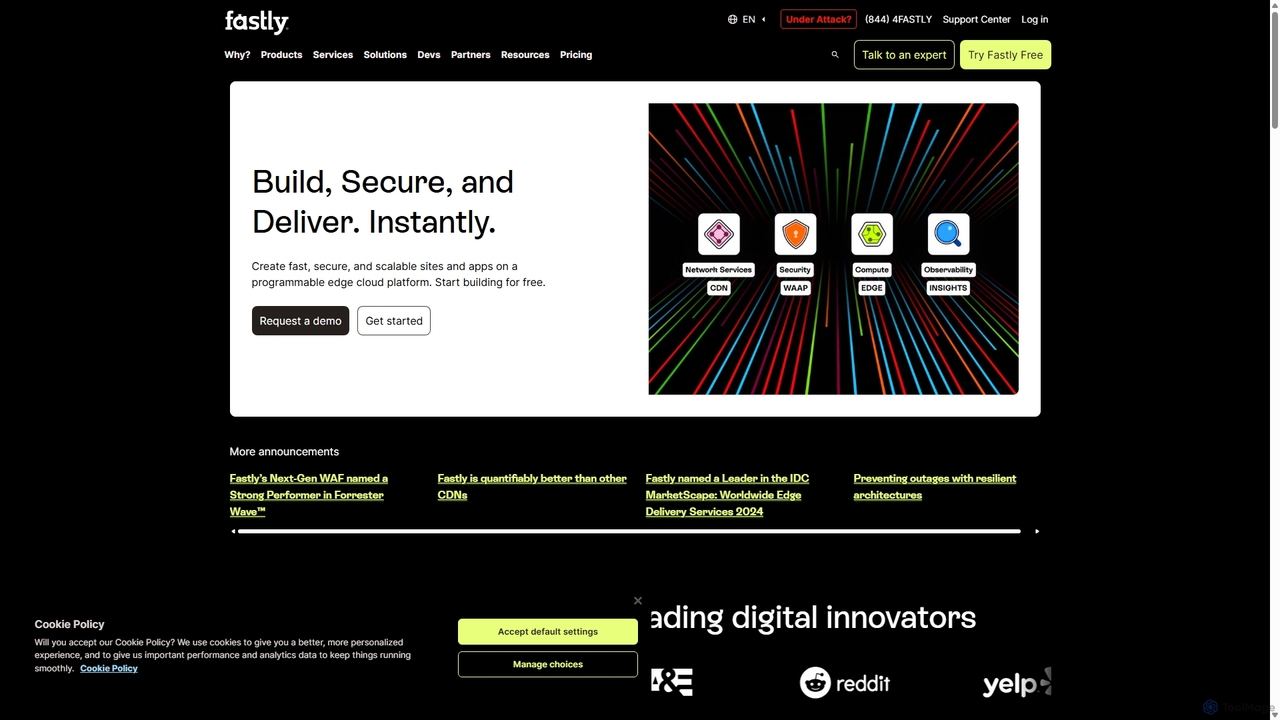
Fastly is a leading edge cloud platform designed to build, secure, and deliver fast, scalable digital experiences. It …
Fastly is a leading edge cloud platform designed to build, secure, and deliver fast, scalable digital experiences. It combines a modern CDN, robust security features like a Next-Gen WAF, and a powerful serverless compute environment. Fastly helps businesses improve performance, enhance security, and innovate closer to their users, with specific solutions for e-commerce, streaming, and AI-powered applications.
Cloudflare
Cloudflare is a global connectivity cloud platform offering a comprehensive suite of services for security, performance, and reliability. …
Cloudflare is a global connectivity cloud platform offering a comprehensive suite of services for security, performance, and reliability. It protects websites and applications from online threats with its WAF and DDoS mitigation, accelerates content delivery via its global CDN, and provides a serverless platform for developers to build and deploy applications, including AI-powered services at the edge.
About Serverless
Serverless computing is an execution model in cloud computing where the cloud provider dynamically manages the allocation and provisioning of servers. Developers write and deploy code, often in the form of functions, without needing to provision, scale, or manage any underlying infrastructure. This event-driven paradigm allows applications to automatically scale up or down based on demand, leading to significant cost savings and reduced operational overhead for developers.
Core Features
- Event-Driven Execution: Functions are triggered by specific events like HTTP requests, database changes, or file uploads, rather than running continuously.
- Automatic Scaling: The platform automatically scales resources up or down to match the workload, handling fluctuating traffic seamlessly.
- Pay-per-Execution: Users are billed only for the compute resources consumed during the execution of their code, eliminating costs for idle servers.
- Reduced Operational Overhead: Developers can focus solely on writing code, as the cloud provider manages all server maintenance, patching, and security.
- Language Flexibility: Supports various programming languages, allowing developers to choose their preferred tools.
Applicable Scenarios
Serverless architecture is ideal for applications with unpredictable traffic patterns or intermittent workloads. It excels in scenarios requiring rapid response to events, such as processing real-time data streams, handling API requests for mobile and web applications, or integrating with third-party services via webhooks. It's also well-suited for backend services of chatbots and IoT data processing.
How to Choose
When selecting a Serverless platform, consider the provider's ecosystem (e.g., AWS Lambda, Azure Functions, Google Cloud Functions) and its integration capabilities with other cloud services. Evaluate the supported programming languages, cold start performance for latency-sensitive applications, and the pricing model's alignment with your usage patterns. Also, assess monitoring and debugging tools offered by the platform.

ServerlessUse Cases
Building Scalable API Backends
Mobile and web application developers can leverage Serverless functions to create highly scalable and cost-effective API endpoints. When a user makes a request, a function is triggered to process the logic, interact with databases, and return data, automatically scaling to handle millions of concurrent requests without manual server management. This significantly reduces infrastructure costs and maintenance efforts.
Automating Data Processing Pipelines
Data engineers and analysts can use Serverless to build event-driven data processing workflows. For instance, when a new file is uploaded to cloud storage, a Serverless function can automatically trigger to clean, transform, and load the data into a data warehouse or another service. This ensures real-time data readiness and eliminates the need for always-on compute instances for intermittent tasks.
Processing Webhooks and Third-Party Integrations
Developers integrating with external services like payment gateways (Stripe), version control systems (GitHub), or communication platforms can use Serverless functions to process incoming webhooks. Instead of maintaining a dedicated server to listen for these events, a Serverless function can be invoked only when a webhook is received, executing custom logic and responding efficiently, reducing idle resource consumption.
IoT Device Data Ingestion and Processing
For Internet of Things (IoT) solutions, Serverless functions are excellent for ingesting and processing data streams from numerous devices. As devices send telemetry data, functions can be triggered to filter, aggregate, store, or trigger alerts based on specific conditions. This allows for massive scalability to accommodate a growing number of devices and data volume without provisioning large server clusters.
Executing Scheduled Tasks and Batch Jobs
Operations teams and developers can replace traditional cron jobs with Serverless functions for executing scheduled tasks like daily database backups, generating weekly reports, or sending periodic notifications. These functions run only at specified intervals or on demand, consuming resources only during execution, which is more cost-efficient than maintaining a dedicated server for intermittent batch processing.
Building Chatbot Backends
Developers building conversational AI applications can use Serverless functions to power their chatbot backends. Each user message or interaction can trigger a function to process natural language, integrate with external APIs for information retrieval, or manage dialogue flow. This provides a highly scalable and resilient architecture for handling fluctuating user engagement without managing server infrastructure.