ToolMage
Sign in

Best 2 Analysis AI tools for Document Management

Popular Analysis AI tools in Document Management include The Drive AI and PDF Summarizer, helping you work more efficiently.

Freemium

PDF Summarizer

PDF Summarizer is an AI-powered tool that lets you understand documents in seconds. Upload PDFs, Word files, or PowerPoints, and instantly get summaries or ask specific questions. It supports multi-file chats for comprehensive research, works with any language, and provides source-linked answers for easy verification. Ideal for students, researchers, and professionals looking to save time and extract key information efficiently.

Analysis
Visits 13.1KFavorites 113Likes 110
Freemium

The Drive AI

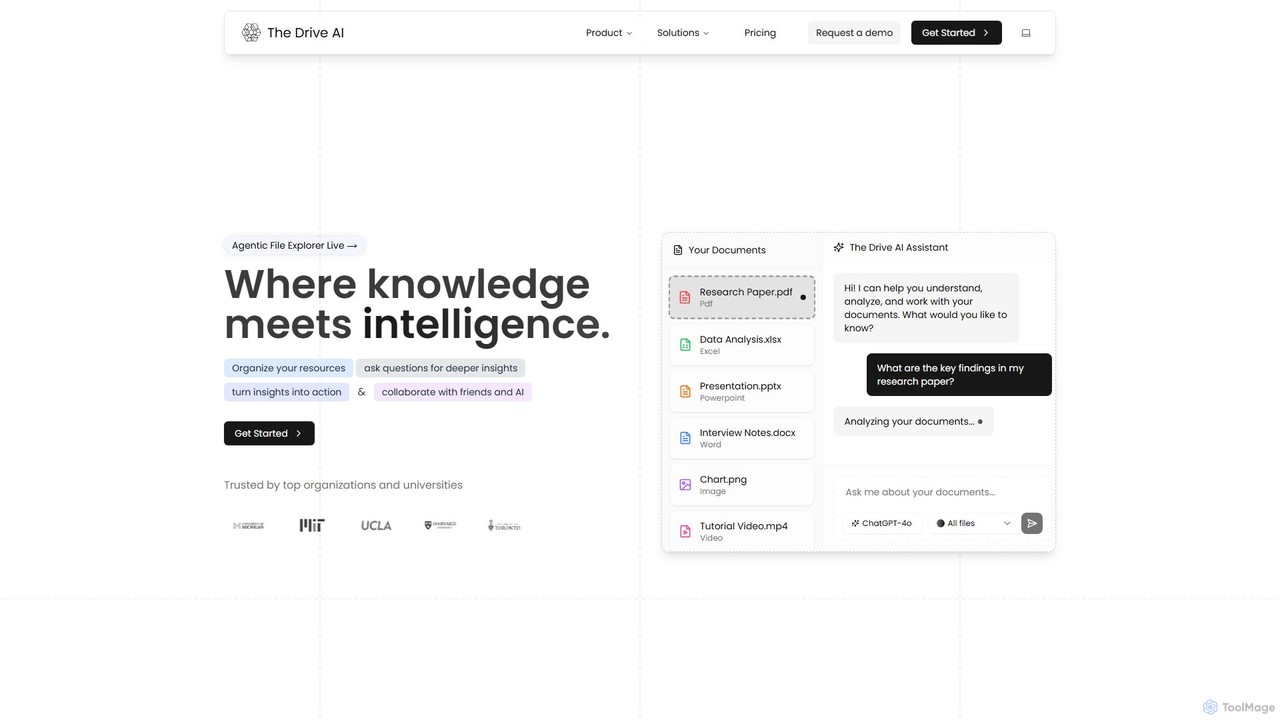
The Drive AI is an all-in-one AI-powered workspace that combines file management, document analysis, team collaboration, and content creation. Upload any file type, ask questions to get instant insights with cited sources, and collaborate with your team in real-time. It's designed to replace multiple tools, streamlining your workflow and boosting productivity for individuals and teams across various industries.

Analysis
Visits 50.9KFavorites 102Likes 88

About Analysis

AI-powered document analysis tools are a specialized category within document management, designed to automatically process, understand, and extract valuable insights from unstructured and semi-structured text. These tools leverage advanced natural language processing (NLP), machine learning, and computer vision to interpret document content, identify key information, and reveal patterns that would be time-consuming or impossible for humans to find manually. They transform raw document data into actionable intelligence, significantly enhancing efficiency, accuracy, and decision-making across various industries by automating complex information retrieval tasks.

Core Features

  • Information Extraction: Automatically identifies and extracts specific entities like names, dates, organizations, addresses, and custom data points from various document types, such as invoices, contracts, and reports.
  • Sentiment Analysis: Determines the emotional tone (positive, negative, neutral) within textual content, which is particularly useful for analyzing customer feedback, social media comments, and survey responses.
  • Document Summarization: Generates concise, coherent summaries of lengthy documents, allowing users to quickly grasp the main points without reading the entire text, saving significant time.
  • Content Categorization: Automatically tags, classifies, and organizes documents into predefined categories based on their content, greatly improving searchability, retrieval, and overall document management.
  • Compliance & Risk Detection: Scans documents for specific clauses, sensitive personal information (PII), legal terms, or potential regulatory non-compliance, crucial for legal, finance, and healthcare sectors.
  • Anomaly Detection: Identifies unusual patterns or outliers in document data that might indicate fraud, errors, or critical deviations from norms.

Applicable Scenarios

These tools are invaluable for legal professionals automating contract review to identify key clauses and obligations, for financial analysts extracting critical data from quarterly reports for market analysis, and for customer service teams analyzing vast volumes of customer feedback to pinpoint common issues and sentiment trends. They also empower researchers to quickly synthesize information from academic papers and enable businesses to automate data capture from invoices and receipts, significantly reducing manual effort and accelerating operational workflows.

How to Choose

When selecting an AI document analysis tool, consider its accuracy in extracting relevant information across diverse document layouts and languages, the range of document formats it supports (e.g., scanned PDFs, Word, images, handwritten notes), and its integration capabilities with your existing enterprise resource planning (ERP), customer relationship management (CRM), or document management systems. Evaluate its scalability to handle your current and future document volumes, the level of customization offered for specific extraction needs, and its adherence to robust data security and privacy standards (e.g., GDPR, HIPAA). User-friendliness and the availability of robust API access are also critical factors for seamless adoption and deployment.

Featured tool rankings

Analysis use cases

1

Automated Legal Contract Review

Legal professionals often spend countless hours manually reviewing contracts to identify key clauses, obligations, and potential risks. AI document analysis tools can automatically scan thousands of legal documents, extracting specific terms like party names, effective dates, termination clauses, and liability limits. This significantly reduces review time, minimizes human error, and ensures compliance, allowing legal teams to focus on strategic tasks rather than repetitive data extraction.

2

Analyzing Customer Feedback and Reviews

Businesses receive vast amounts of customer feedback through surveys, emails, and social media. AI document analysis tools can process this unstructured text to perform sentiment analysis, identify recurring themes, and categorize common complaints or suggestions. This helps product development teams prioritize features, marketing teams understand brand perception, and customer service improve overall satisfaction by addressing key pain points efficiently.

3

Extracting Data from Financial Reports

Financial analysts and investors need to quickly extract specific data points like revenue, profit margins, and growth rates from quarterly and annual reports. AI document analysis tools can automate this process, accurately identifying and pulling relevant figures and textual explanations from complex financial documents, including tables and footnotes. This accelerates financial modeling, competitive analysis, and investment decision-making, reducing the manual effort involved in data aggregation.

4

Summarizing Research Papers and Articles

Researchers, students, and professionals often need to review numerous academic papers, articles, and reports. AI document analysis tools can generate concise summaries of these lengthy texts, highlighting key findings, methodologies, and conclusions. This enables users to quickly grasp the core content, decide if a full read is necessary, and efficiently synthesize information from multiple sources, significantly boosting productivity in research and knowledge acquisition.

5

Automating Invoice and Receipt Data Capture

Businesses handle a large volume of invoices, receipts, and purchase orders daily. Manually entering data from these documents into accounting or ERP systems is prone to errors and time-consuming. AI document analysis tools can automatically extract critical information such as vendor names, invoice numbers, dates, line items, and total amounts from various formats, including scanned images. This streamlines accounts payable processes, improves data accuracy, and frees up staff for more strategic financial management tasks.

6

Compliance Monitoring in Regulatory Documents

Organizations in highly regulated industries (e.g., finance, healthcare, pharmaceuticals) must ensure strict compliance with numerous laws and internal policies. AI document analysis tools can continuously monitor and analyze regulatory documents, internal policies, and communications to identify potential compliance breaches, missing disclosures, or outdated information. This proactive approach helps mitigate risks, avoid hefty fines, and maintain regulatory adherence by flagging non-compliant content for human review.

Analysis FAQ

What are AI document analysis tools?

AI document analysis tools are software solutions that use artificial intelligence, primarily natural language processing (NLP) and machine learning, to automatically read, understand, and extract specific information and insights from various types of documents. They go beyond simple keyword searches by interpreting context, sentiment, and relationships within the text, transforming unstructured data into structured, actionable intelligence for improved decision-making and automation.

How to choose the right AI document analysis tool?

When selecting an AI document analysis tool, prioritize accuracy in information extraction, especially for your specific document types and industry. Consider the range of document formats supported (e.g., scanned PDFs, handwritten notes), integration capabilities with your existing systems (ERP, CRM), and scalability for future growth. Data security, compliance certifications (like GDPR), and the level of customization for extraction rules are also crucial factors to ensure it meets your unique operational needs.

What types of documents can AI analysis tools process?

AI document analysis tools are highly versatile and can process a wide array of document types. This includes structured documents like forms and tables, semi-structured documents such as invoices, receipts, and purchase orders, and unstructured text like contracts, legal briefs, research papers, emails, customer reviews, and social media posts. Many advanced tools can also handle scanned images (PDFs, JPEGs) through Optical Character Recognition (OCR) to convert them into searchable and analyzable text.

What are the main benefits of using AI for document analysis?

The primary benefits of using AI for document analysis include significant improvements in efficiency, accuracy, and insight generation. AI tools automate repetitive data extraction and review tasks, saving countless hours and reducing human error. They can process vast volumes of documents much faster than humans, uncover hidden patterns and trends, and provide deeper, data-driven insights that inform better strategic decisions. This leads to cost savings, faster operational workflows, and enhanced compliance.

How do AI document analysis tools differ from traditional keyword search?

AI document analysis tools differ significantly from traditional keyword search by offering a deeper level of understanding. While keyword search simply matches exact words or phrases, AI tools use natural language processing to comprehend context, semantics, and relationships between terms. This allows them to extract specific entities, perform sentiment analysis, summarize content, and identify complex patterns, even in variations of phrasing, providing far more nuanced and actionable insights than basic search functionalities.