
Formula Bot
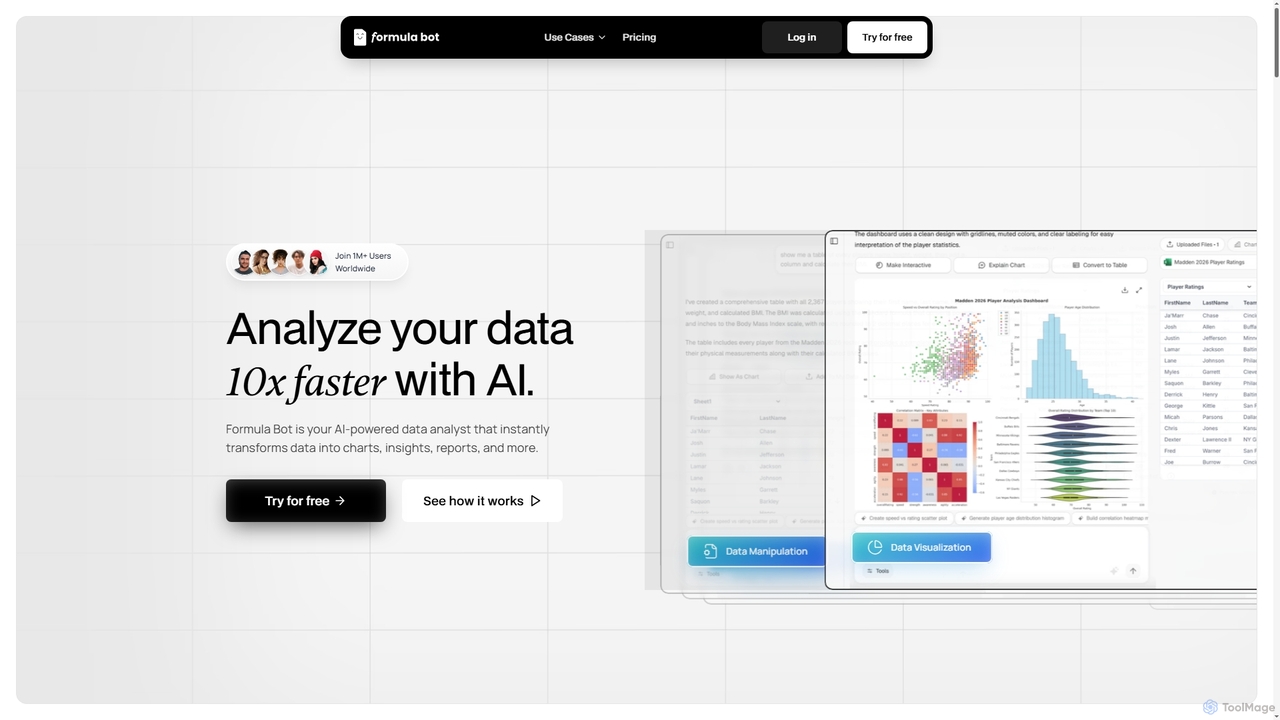
Formula Bot is an AI-powered data analyst that instantly transforms raw data into actionable insights, stunning charts, and …
Formula Bot is an AI-powered data analyst that instantly transforms raw data into actionable insights, stunning charts, and comprehensive reports. It also offers specialized AI tools for generating Excel formulas, converting PDFs to Excel, and providing step-by-step homework assistance across various subjects, streamlining data handling and learning processes for users worldwide.
About Conversion
AI-powered Conversion tools are designed to intelligently transform documents and their content from one format or medium to another, often enhancing their usability and accessibility. Leveraging advanced AI, these tools can accurately extract, restructure, and convert information, making previously inaccessible data editable, searchable, or ready for further analysis. They streamline workflows by automating complex data transformation tasks within document management.
Core Features
- Intelligent OCR: Accurately converts scanned documents and images into editable, searchable text, recognizing various fonts and layouts.
- Format Transformation: Seamlessly converts documents between different file types (e.g., PDF to Word, audio to text) while preserving layout and data integrity.
- Data Extraction & Structuring: Identifies and extracts specific data points (e.g., invoices, receipts) from unstructured documents, then organizes them into structured formats.
- Content Summarization: Generates concise summaries from lengthy documents, facilitating quick comprehension and information retrieval.
Applicable Scenarios
Businesses frequently use these tools to digitize legacy paper archives into searchable digital formats. Legal professionals convert scanned contracts into editable text for review. Researchers transform academic papers into accessible formats for data analysis.
How to Choose
Evaluate the tool's accuracy in content recognition and format preservation, especially for complex layouts. Consider its integration capabilities with existing document management systems and the range of input/output formats supported. Assess the security features for sensitive document handling and the pricing model based on volume or features.
ConversionUse Cases
Digitizing Historical Archives
Cultural institutions and libraries use AI conversion tools to transform vast collections of scanned historical documents, manuscripts, and books into searchable digital text. This enables researchers to quickly find information, preserves fragile originals, and makes content accessible to a global audience.
Automating Invoice Processing
Finance departments leverage AI conversion to automatically extract key data (vendor, amount, date, line items) from various invoice formats (PDF, image) and convert it into structured data for accounting systems. This significantly reduces manual data entry errors and accelerates payment cycles.
Converting Legal Documents for Review
Law firms utilize these tools to convert scanned legal contracts, court filings, and discovery documents into editable and searchable text. This allows legal teams to efficiently search for specific clauses, compare versions, and collaborate on document revisions, saving substantial time.
Transcribing Meeting Minutes and Interviews
Businesses and researchers employ AI conversion to transform audio recordings of meetings, interviews, and presentations into accurate text transcripts. This provides a searchable record, facilitates content analysis, and ensures important discussions are documented without manual effort.
Migrating Content Across Platforms
Content managers use AI conversion to transform website content, articles, or product descriptions from one CMS format to another, or from legacy systems to modern platforms. The AI helps preserve formatting, extract relevant media, and adapt content structure for the new environment.
Extracting Data from Research Papers
Scientists and academics use AI conversion to extract specific data points, tables, and figures from large volumes of research papers and journals. This allows for rapid aggregation and analysis of information, accelerating literature reviews and meta-analyses.