ToolMage
Sign in

Best 1 Product Customizer AI tools for Ecommerce

Popular Product Customizer AI tools in Ecommerce include konfiwear, helping you work more efficiently.

konfiwear
Paid

konfiwear

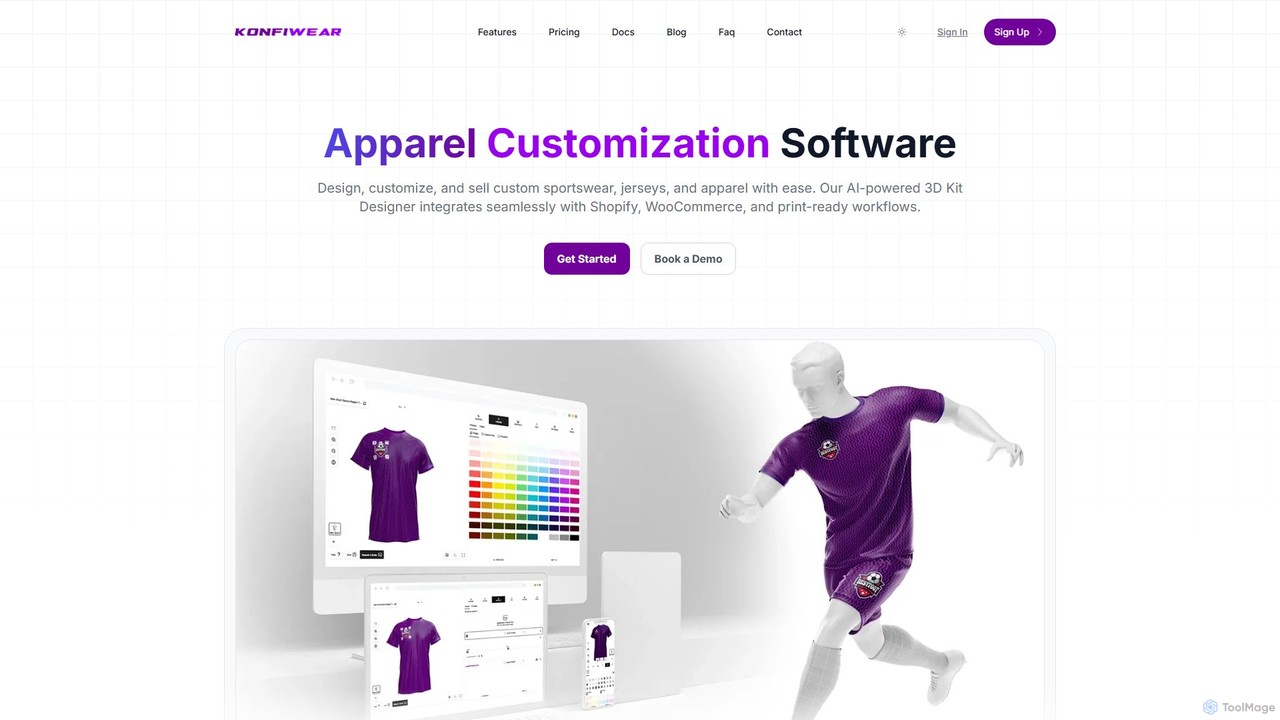
Konfiwear is an AI-powered 3D apparel customization software designed for e-commerce businesses. It enables brands to offer real-time, interactive product design for sportswear, jerseys, and other apparel. The platform seamlessly integrates with Shopify, WooCommerce, and other major platforms, streamlining the entire process from customer design to print-ready production files.

3D Modeling
Visits 6.3KFavorites 128Likes 129

About Product Customizer

Product Customizer tools are AI-powered solutions designed to empower customers to personalize products directly on e-commerce platforms. These tools leverage advanced AI, 3D rendering, and real-time configuration engines to allow users to modify product attributes like color, material, size, and add custom text or graphics. By offering an interactive design experience, they significantly enhance customer engagement, drive sales, and reduce return rates for businesses in the broader e-commerce landscape.

Core Features

  • Real-time 3D Visualization: Instantly renders product changes in a dynamic 3D environment, allowing customers to see their custom designs from all angles.
  • Complex Logic & Rule Engine: Manages intricate customization rules, ensuring compatibility and preventing invalid configurations based on product constraints.
  • Dynamic Pricing Calculation: Automatically updates product prices in real-time as customers add or remove customization options.
  • Asset Management & Generation: Stores and manages a library of customizable components, and can generate new product images or mockups based on user designs.

Applicable Scenarios

Online retailers selling configurable goods, custom product manufacturers, and print-on-demand businesses heavily benefit from Product Customizer tools. They are ideal for scenarios where customers desire unique items, such as personalized gifts, bespoke furniture, custom apparel, or made-to-order industrial components, enabling a seamless design-to-purchase journey.

How to Choose

When selecting a Product Customizer, consider its integration capabilities with your existing e-commerce platform, the quality and realism of its 3D rendering, and the flexibility of its rule engine for complex configurations. Evaluate the user-friendliness of the design interface, scalability for future product lines, and the pricing model to ensure it aligns with your business needs and budget.

Product Customizer use cases

1

Real-time 3D Furniture Design

A furniture retailer uses a Product Customizer to allow customers to design their own sofas or chairs. Customers can select fabric types, colors, leg styles, and dimensions, viewing the changes instantly in a high-fidelity 3D model. This interactive experience helps customers visualize the final product in their space, reducing uncertainty and increasing conversion rates for unique, made-to-order pieces.

2

Personalized Apparel & Merchandise Creation

An online print-on-demand store integrates a Product Customizer, enabling users to design custom t-shirts, hoodies, or mugs. Customers can upload their own images, add text, choose fonts, and select product colors. The tool provides a live preview, ensuring the design meets their expectations before placing an order, streamlining the personalized merchandise workflow.

3

Configuring Custom Jewelry

A jewelry brand employs a Product Customizer to offer bespoke engagement rings or necklaces. Customers can choose the metal type, diamond cut and size, add engravings, and select specific settings. The tool renders the unique piece in 3D, allowing buyers to explore every detail and confidently purchase a truly personalized and high-value item.

4

Automated Variant Generation for E-commerce Catalogs

An e-commerce manager for a fashion brand utilizes a Product Customizer to efficiently generate product images for various color and size combinations. Instead of costly photoshoots for every variant, the tool creates realistic digital mockups based on a single base image and customization rules, significantly speeding up product listing and reducing content creation costs.

5

B2B Industrial Equipment Configuration

A manufacturer of industrial machinery provides a Product Customizer for B2B clients to specify complex equipment. Buyers can select modules, power options, safety features, and connectivity ports, with the tool validating configurations against engineering rules. This ensures accurate orders, reduces sales cycle time, and provides clear specifications for manufacturing.

6

Customized Sports Equipment Design

A sports equipment company offers a Product Customizer for items like custom bicycles or golf clubs. Athletes can select frame materials, component brands, color schemes, and ergonomic adjustments, seeing the personalized equipment come to life in 3D. This caters to individual performance needs and aesthetic preferences, enhancing customer satisfaction and brand loyalty.

Product Customizer FAQ

What are Product Customizer tools?

Product Customizer tools are AI-driven software solutions that allow customers to design and personalize products directly on an e-commerce website. They go beyond simple dropdown options by providing interactive interfaces, often with 3D visualization, enabling real-time modification of product attributes like color, material, size, and the addition of custom elements. Their core purpose is to offer a highly engaging and tailored shopping experience.

How do Product Customizer tools benefit e-commerce businesses?

Product Customizer tools offer several key benefits to e-commerce businesses. They significantly enhance customer engagement and satisfaction by providing a unique, interactive shopping experience, which often leads to higher conversion rates. Businesses can also reduce returns by ensuring customers visualize and approve their exact design before purchase. Furthermore, they enable the sale of higher-margin personalized products and can streamline internal processes by automating variant generation and order specifications.

What should I consider when choosing a Product Customizer tool?

When selecting a Product Customizer tool, consider its compatibility with your existing e-commerce platform (e.g., Shopify, WooCommerce). Evaluate the quality and realism of its 3D rendering capabilities, as visual fidelity is crucial for customer trust. Assess the flexibility of its rule engine for handling complex customization logic, the ease of use for both customers and administrators, and its scalability to accommodate future product expansions. Finally, compare pricing models and support options.

How do Product Customizer tools differ from standard e-commerce product options?

Standard e-commerce product options typically involve pre-defined variations (e.g., small, medium, large; red, blue, green) selected from dropdowns or swatches. Product Customizer tools, however, offer a much deeper level of personalization. They allow customers to actively design and modify products, often with real-time visual feedback (like 3D models), complex conditional logic, and the ability to add unique elements like text or uploaded images, creating a truly bespoke item rather than simply selecting a variant.

What technologies power AI Product Customizer tools?

AI Product Customizer tools are powered by a combination of advanced technologies. Artificial intelligence (AI) and machine learning (ML) are used for intelligent recommendations, design validation, and sometimes even generative design. 3D rendering engines are crucial for real-time visualization of customized products. Other technologies include robust rule engines for managing complex configuration logic, natural language processing (NLP) for text-based inputs, and sometimes augmented reality (AR) or virtual reality (VR) for immersive preview experiences.