Ecommerce Best in category 1 results Subscription Management AI Tool

Popular AI tools in the Subscription Management field of Ecommerce include Bottomless, etc., helping you quickly improve efficiency.

Bottomless

Bottomless

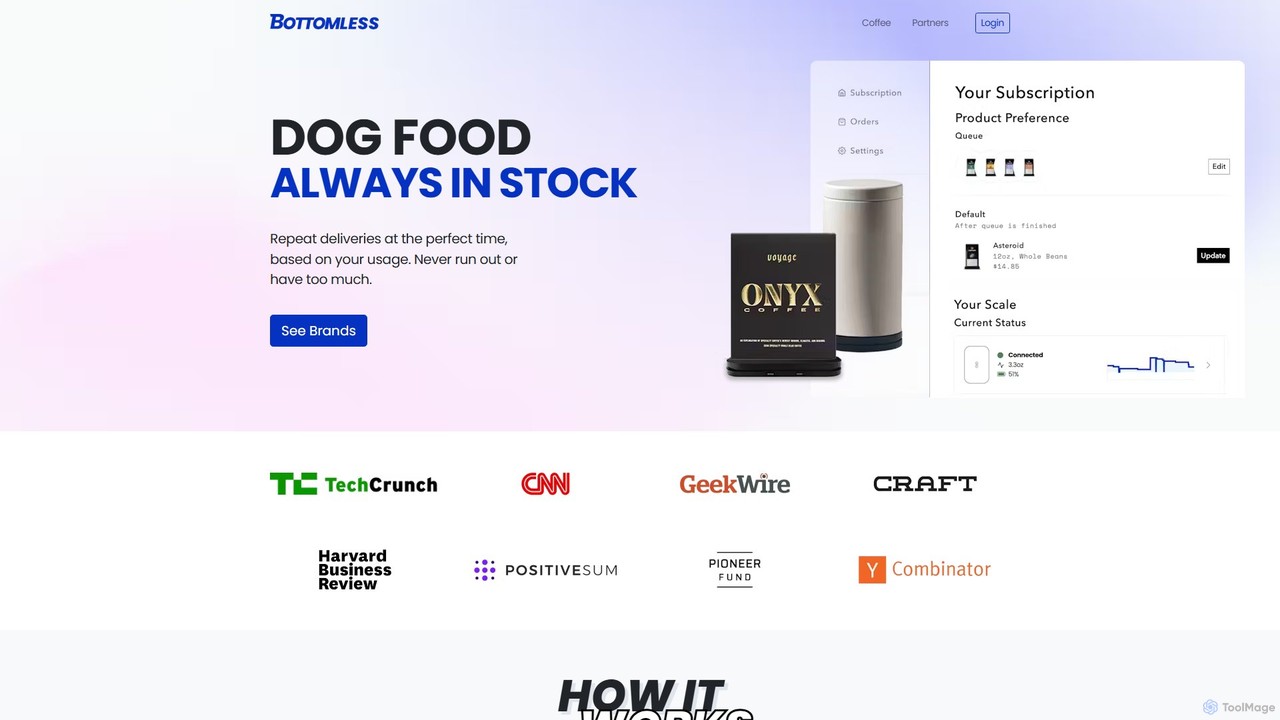
Bottomless is an AI-powered subscription service that uses a smart WiFi scale to automatically reorder products like coffee …

16.8K

About Subscription Management

Subscription Management tools are a specialized class of software designed to automate the entire lifecycle of recurring billing and customer relationships. These platforms are built to handle complex billing logic, from initial sign-up and recurring payments to upgrades, downgrades, and cancellations. They provide the essential infrastructure for any business operating on a subscription model, helping to maximize revenue, reduce customer churn, and streamline financial operations. As a key component within the Ecommerce ecosystem, they enable the shift from one-time sales to long-term customer value.

Core Features

  • Recurring Billing Engine: Automates scheduled payment collection (monthly, annually, etc.) and generates invoices.
  • Subscription Lifecycle Management: Allows customers to self-manage plans, including upgrades, downgrades, pauses, and cancellations.
  • Dunning Management: Automatically handles failed payments by retrying charges and sending recovery notifications to reduce involuntary churn.
  • Analytics and Reporting: Tracks critical metrics like Monthly Recurring Revenue (MRR), churn rate, and Customer Lifetime Value (LTV).
  • Proration and Metered Billing: Calculates charges for plan changes mid-cycle and supports usage-based pricing models.

Use Cases

These tools are crucial for SaaS companies, digital media publishers, subscription box services, membership-based organizations, and any e-commerce business offering recurring products or services. They are used by finance teams to automate accounting, marketing teams to analyze customer behavior, and product teams to experiment with different pricing structures.

How to Choose

When selecting a Subscription Management tool, consider its integration capabilities with your existing payment gateways, CRM, and accounting software. Evaluate its ability to support various pricing models (tiered, usage-based, flat-rate). Assess the robustness of its analytics and dunning management features. Finally, ensure it meets security and compliance standards like PCI DSS for handling sensitive payment data.

Subscription ManagementUse Cases

1

Automating Billing for a SaaS Company

A B2B SaaS startup uses a subscription management tool to handle its tiered pricing plans (Basic, Pro, Enterprise). The platform automatically bills customers monthly or annually, sends invoices, and provides a self-service portal where clients can upgrade their plan or update payment information without contacting support. This reduces administrative overhead by over 90% and ensures a smooth customer experience, allowing the startup to scale its user base efficiently.

2

Managing a Subscription Box Service

An e-commerce business selling monthly curated coffee boxes uses a subscription management platform to offer different subscription types (e.g., single origin, blend). The tool manages recurring orders, allows customers to easily skip a month or change their coffee preference via a customer portal, and integrates with their shipping software. This flexibility significantly improves customer retention and simplifies the complex logistics of a physical subscription product.

3

Reducing Churn with Automated Dunning

A mobile fitness app provider noticed a high rate of involuntary churn due to failed credit card payments. By implementing a subscription management tool with smart dunning capabilities, they automated the payment recovery process. The system automatically retries failed charges at optimal times and sends a series of customized email reminders to users with expired cards. This strategy helped recover over 15% of previously lost revenue and significantly reduced their overall churn rate.

4

Analyzing Subscription Health with Key Metrics

A product manager for a digital media platform uses the analytics dashboard of their subscription management tool to monitor business health. They track Monthly Recurring Revenue (MRR) to gauge growth, analyze churn rate by cohort to understand customer retention, and calculate Customer Lifetime Value (LTV) to inform marketing spend. These insights allow them to make data-driven decisions, such as adjusting pricing or identifying at-risk customer segments for proactive engagement.

5

Implementing Usage-Based Billing for an API Service

A developer platform that charges based on API call volume uses a subscription management tool to implement metered billing. The tool integrates with their system to track usage for each customer in real-time. At the end of each billing cycle, it automatically calculates the invoice based on consumption, combining a base subscription fee with overage charges. This provides a fair and transparent pricing model that scales with customer usage, attracting both small developers and large enterprises.

6

Managing Promotions and Trials for a Streaming Service

A video streaming service uses its subscription management system to attract new users. They create and manage various promotional offers, such as a '30-day free trial' or '50% off for the first 3 months'. The system automatically handles the trial-to-paid conversion, applies discounts correctly, and tracks the performance of each campaign. This allows the marketing team to experiment with different acquisition strategies and measure their ROI without complex manual tracking.

Subscription ManagementFrequently Asked Questions