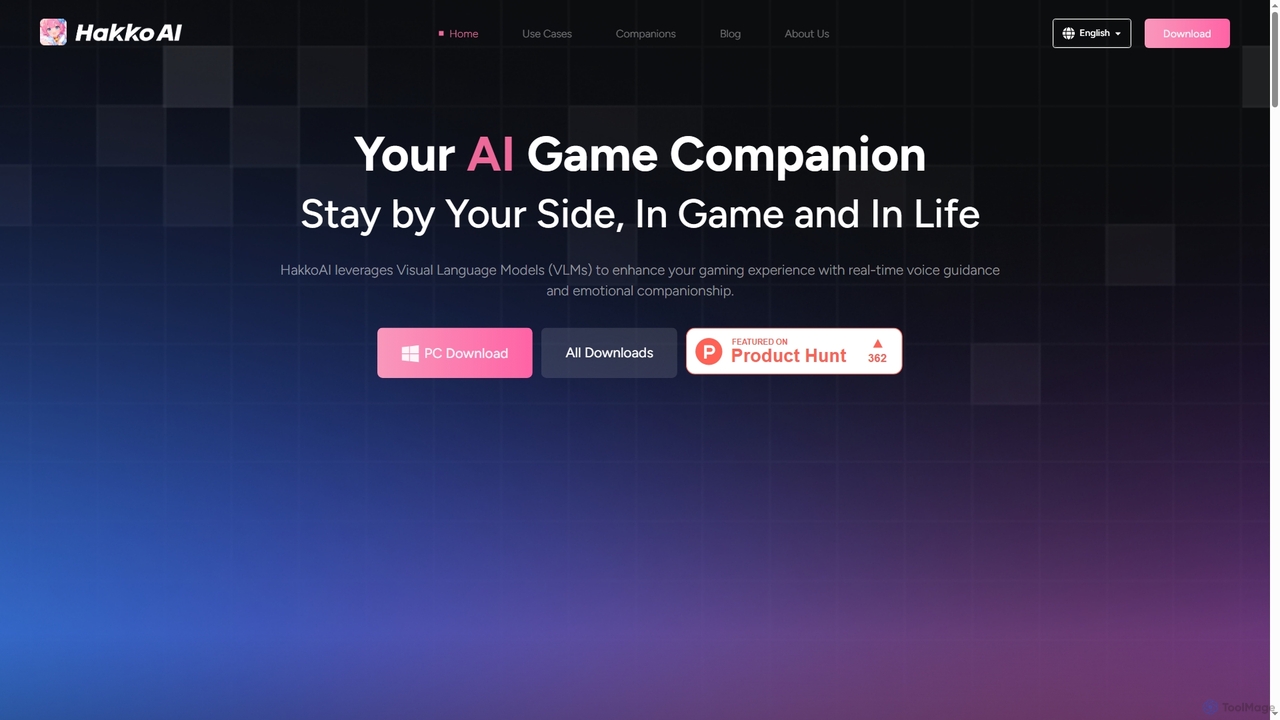
AI Companion tools are a specialized category within AI Gaming, designed to enhance player interaction and engagement by simulating intelligent, responsive entities within virtual worlds. These tools leverage advanced AI, including natural language processing, machine learning, and behavioral algorithms, to create dynamic non-player characters (NPCs) or virtual assistants that adapt to player actions and provide personalized support. They aim to deepen immersion, offer strategic assistance, and enrich the narrative experience, making gameplay more interactive, unpredictable, and uniquely tailored for each user.
Core Features
- Dynamic Interaction: AI companions respond contextually and intelligently to player input, dialogue choices, and evolving in-game events, creating a sense of genuine partnership.
- Personalized Assistance: They offer tailored advice, strategic hints, or direct support during gameplay, adapting their guidance based on the player's skill level, progress, and specific challenges.
- Emotional Simulation: These tools enable companions to exhibit simulated emotions, personality traits, and even develop relationships with the player, fostering deeper emotional connections and narrative depth.
- Adaptive Learning: AI companions can evolve their behavior, combat tactics, and conversational patterns over time, learning from player interactions and environmental changes to become more effective and engaging.
- Procedural Content Generation: Some advanced companions can influence or contribute to dynamic questlines, generate unique dialogue, or even modify environmental elements based on their actions and interactions with the player.
Applicable Scenarios
Game developers utilize AI Companion tools to craft more lifelike and engaging non-player characters, ranging from loyal combat allies and insightful mentors to complex antagonists, significantly enriching the game world and narrative possibilities. Players benefit from highly personalized coaching in strategy games, receiving real-time tactical advice, or experiencing dynamic, branching storytelling in role-playing games where companions react uniquely to every choice. Additionally, these tools can be employed in educational games to provide adaptive tutoring or in virtual reality experiences to create more immersive social interactions.
How to Choose
When selecting an AI Companion tool, consider the desired level of autonomy, intelligence, and emotional depth required for your in-game entities, ensuring it aligns perfectly with your game's design and genre. Evaluate its natural language processing capabilities for realistic and nuanced dialogue, along with its ability to understand and respond to complex player commands. Assess its integration compatibility with your existing game engines and development pipelines, looking for robust APIs and ease of customization. Furthermore, review the tool's capacity for adaptive learning and long-term behavioral evolution, as well as its performance impact on game resources and scalability for multiplayer environments. Finally, examine the flexibility for developers to define and fine-tune personality traits and relationship dynamics.