
ToolMage
Sign in

Best 1 Ai Companion AI tools for Gaming

Popular Ai Companion AI tools in Gaming include Questie, helping you work more efficiently.

Questie
Paid

Questie

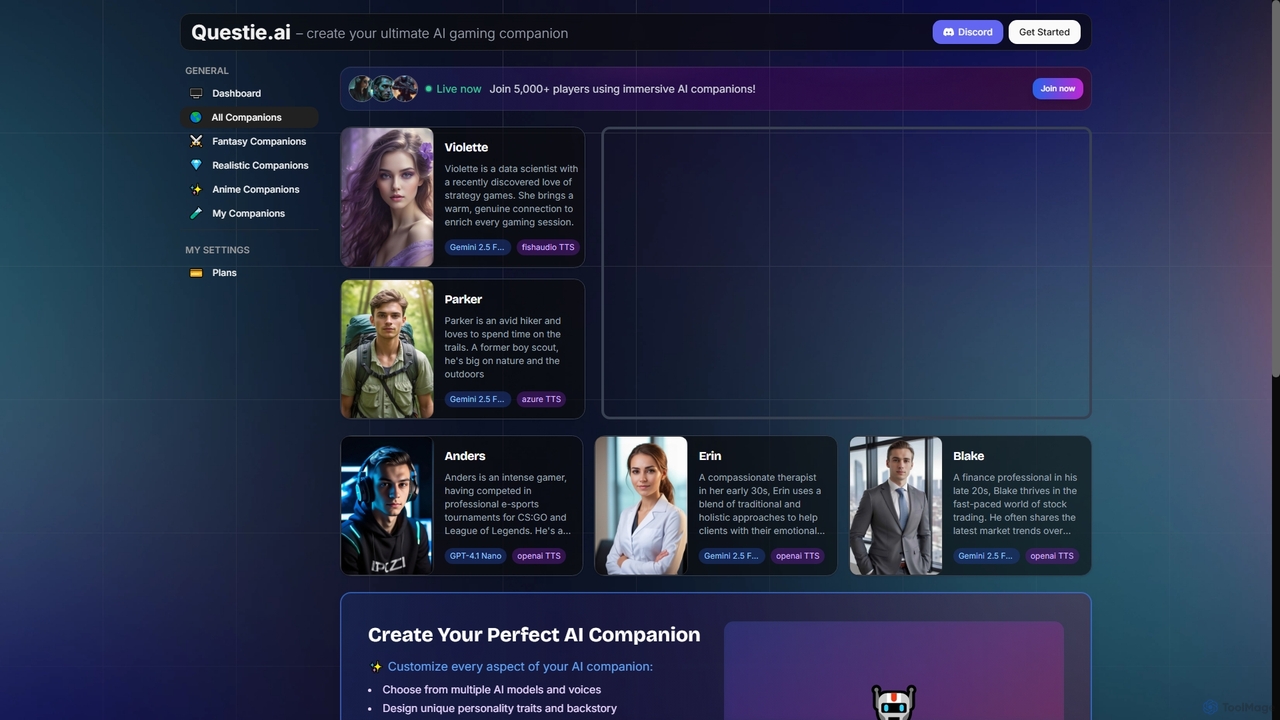
Questie is an innovative AI companion platform designed to revolutionize gaming and roleplay experiences. It offers immersive AI characters with real-time vision, voice chat, and memory, adapting to your gameplay. Users can customize every aspect of their AI companion, from personality and backstory to conversation style, enhancing interactive entertainment.

Interactive Storytelling
Visits 91.9KFavorites 123Likes 130

About Ai Companion

AI Companions are a class of AI tools that create interactive, adaptive virtual characters for gaming and digital experiences. These tools utilize advanced natural language processing (NLP) and machine learning models to enable characters that can learn from user interactions, develop unique personalities, and form dynamic relationships. They provide players with deeply immersive and personalized gameplay, moving beyond pre-scripted NPC behavior to offer genuine companionship and intelligent assistance. This technology allows for more emergent narratives and emotionally resonant gaming moments.

Core Features

  • Adaptive Personality: The AI learns from conversations and actions to evolve its behavior, mood, and relationship with the player.
  • Natural Language Understanding: Enables fluid, unscripted conversations via text or voice, understanding context and sentiment.
  • Context-Aware Assistance: Provides dynamic in-game hints, strategic advice, or lore explanations relevant to the player's current situation.
  • Emotional Simulation: Expresses a believable range of emotions, reacting appropriately to events and player interactions to enhance immersion.
  • Long-Term Memory: Remembers past events and conversations, creating a continuous and meaningful long-term bond.

Use Cases

AI Companions are primarily used by game developers to create more dynamic and believable worlds. They are ideal for role-playing games (RPGs), adventure games, and simulations where player-character relationships are central. They can also be used in training simulations to create adaptive partners or in educational games to act as personalized tutors.

How to Choose

When selecting an AI Companion tool, consider the depth of its personality model and its ability to learn. Evaluate the quality of its natural language processing and its integration capabilities with game engines like Unity or Unreal. Also, assess the level of developer control over the AI's core traits, safety filters, and the scalability of the platform for supporting many players simultaneously.

Ai Companion use cases

1

Creating a Dynamic RPG Quest Giver

A game developer uses an AI Companion tool to design a key NPC. Instead of following a rigid script, this character remembers the player's past choices, offers unique quests based on their playstyle, and provides different dialogue in every playthrough. This results in a highly replayable and personalized narrative experience that adapts to each player's journey, making the game world feel truly alive and responsive.

2

Personalized Esports Training Partner

A competitive gamer uses an AI Companion integrated into a training mode. The AI analyzes their gameplay patterns in a fighting game, identifies weaknesses (e.g., consistently failing to block a specific combo), and then acts as a sparring partner that specifically exploits those weaknesses. It provides real-time feedback and drills, accelerating skill improvement far more effectively than a static training dummy.

3

Building an Interactive Virtual Pet

A developer creates a simulation game centered around raising a magical creature. The AI Companion framework gives the creature a complex personality, moods, and needs. It learns to recognize its owner's voice, responds to commands with unique animations and sounds, and develops a distinct bond over time based on how it's treated, creating a deep emotional connection for the player.

4

Immersive Language Learning in a Game

An educational game studio implements AI Companions as native speakers within a virtual world. Learners can practice conversational skills by talking to these characters, who can correct their grammar, introduce new vocabulary in context, and adapt the difficulty of the conversation to the player's proficiency level, making language learning engaging and effective.

5

Procedural Storytelling with an AI Co-author

In an open-world survival game, an AI Companion acts as a fellow survivor. It dynamically comments on the world, suggests goals (e.g., "We're low on water, I saw a river to the east"), and reacts to dangers. This creates an emergent narrative driven by the player's and the AI's joint actions, rather than a pre-written plot, ensuring no two gameplay experiences are the same.

6

Enhancing Accessibility for Gamers

An AI Companion is used as an intelligent accessibility assistant within a complex strategy game. A player with visual impairments can ask the companion questions like, "What are my units doing near the northern base?" or "Give me a summary of the current resource situation." The AI provides clear, concise audio descriptions, making the game playable for a wider audience by overcoming traditional UI barriers.

Ai Companion FAQ

What is an AI Companion?

An AI Companion is an advanced virtual character powered by artificial intelligence, designed for interactive companionship, primarily in games. Unlike traditional NPCs, they use machine learning to understand language, remember past interactions, and adapt their personality and behavior over time, creating a more dynamic and personal connection with the user.

How is an AI Companion different from a standard game NPC?

The key difference lies in adaptability and interaction depth. A standard NPC (Non-Player Character) follows pre-written scripts and decision trees. An AI Companion uses generative AI and learning models to engage in unscripted conversations, evolve its personality based on player actions, and remember past events, making each interaction unique and unpredictable.

How do I choose an AI Companion tool for a game?

When choosing, focus on these four aspects:

  • Integration: Ensure it has robust APIs or SDKs for your game engine (e.g., Unity, Unreal).
  • Customization: Check how much control you have over the AI's core personality, knowledge base, and safety guidelines.
  • Performance: Evaluate its processing speed and resource usage to avoid impacting game performance.
  • Scalability: Consider if the backend can support the number of concurrent players your game anticipates.

What are the main features of a modern AI Companion?

Modern AI Companions typically feature a combination of advanced capabilities. Key features include long-term memory to recall past interactions, natural language understanding for fluid conversation, emotional simulation to display believable reactions, adaptive behavior that evolves with the player, and context awareness to provide relevant in-game assistance.

Who benefits from using AI Companions?

Both players and developers benefit significantly. Players get a more immersive, personalized, and replayable gaming experience with characters that feel alive. Game developers can create incredibly dynamic worlds and narratives with less manual scripting, foster stronger emotional engagement from players, and introduce innovative gameplay mechanics centered around intelligent character interaction.