iMyFone MagicMic
iMyFone MagicMic is a real-time AI voice changer with over 225 AI voice filters and 600+ sound effects. …
iMyFone MagicMic is a real-time AI voice changer with over 225 AI voice filters and 600+ sound effects. It's designed for gamers, streamers, and content creators to modify their voice on platforms like Discord, Fortnite, Twitch, and Zoom. It also features voice cloning and a customizable soundboard.
Dabing AI Voice Changer
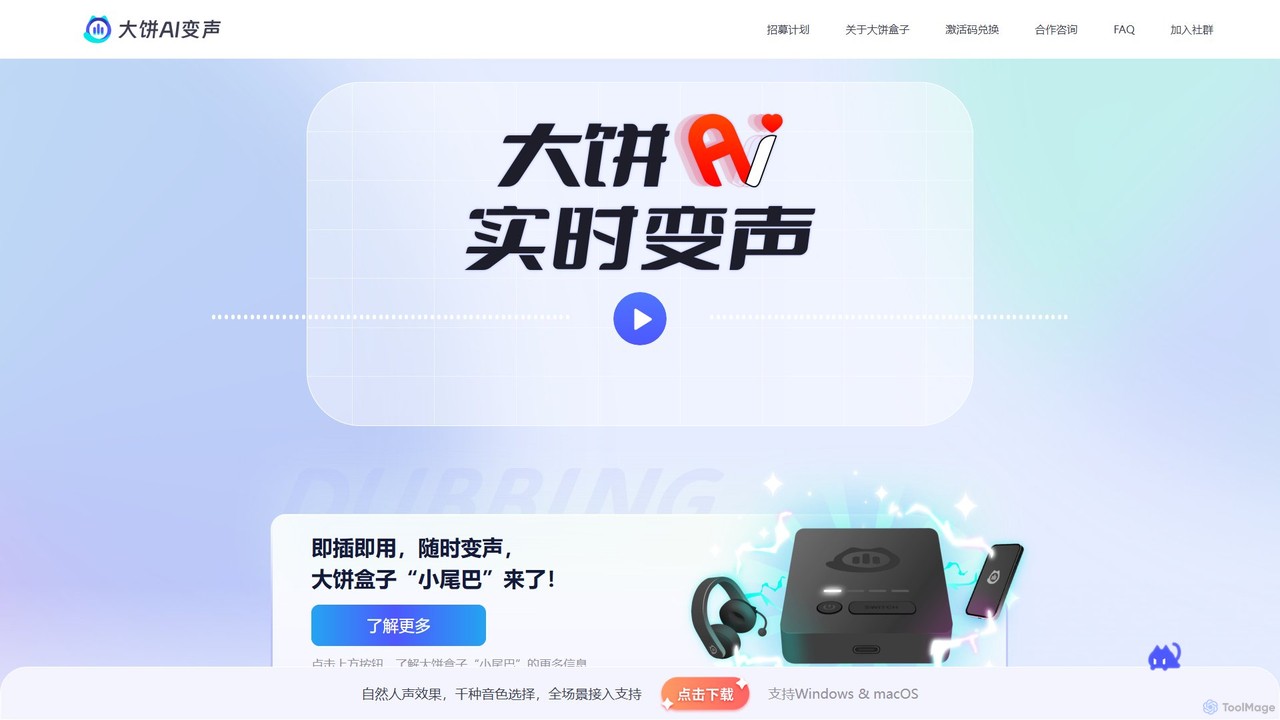
Dabing AI Voice Changer is a real-time AI voice modulation tool for gamers, streamers, and content creators. It …
Dabing AI Voice Changer is a real-time AI voice modulation tool for gamers, streamers, and content creators. It offers a wide range of high-quality, low-latency voices, supports multiple platforms (Windows, macOS, iOS, Android), and integrates seamlessly with popular games and applications. It also provides text-to-speech and voice timbre conversion features.
About Gaming Tools
Gaming Tools are AI-powered applications designed to enhance various aspects of the gaming industry, from development to player experience. These tools leverage machine learning, natural language processing, and computer vision to automate complex tasks, generate content, and personalize interactions. They significantly streamline game creation, improve player engagement, and ensure fair play by offering intelligent solutions for complex challenges. This category focuses on innovative AI solutions that transform how games are made, played, and managed.
Core Features
- AI-Powered Asset Generation: Automatically create 3D models, textures, sound effects, and character animations.
- Intelligent NPC Behavior: Develop sophisticated non-player character AI for realistic interactions and adaptive gameplay.
- Automated Level Design: Generate diverse and challenging game levels or scenarios based on specified parameters.
- Player Experience Personalization: Tailor game content, difficulty, and recommendations to individual player preferences.
- Anti-Cheat & Moderation: Utilize AI to detect and prevent cheating, and moderate in-game communications.
Applicable Scenarios
Game developers use AI for rapid prototyping and asset creation, reducing development cycles. Game designers leverage AI to generate dynamic levels and test complex scenarios. Esports organizations employ AI for performance analysis and strategic planning, gaining insights into player and team performance.
How to Choose
Consider the specific development stage or player experience aspect you aim to enhance. Evaluate the tool's integration capabilities with existing game engines and pipelines. Assess the AI model's customization options and the quality of its output. Review pricing models and community support for long-term viability and scalability.
Gaming ToolsUse Cases
Automating Game Asset Creation
Game artists and developers use AI tools to rapidly generate variations of 3D models, textures, and environmental elements. By inputting basic concepts or reference images, they can produce high-quality assets in minutes, significantly accelerating the art pipeline and allowing for more iterative design, saving hundreds of hours of manual work.
Designing Dynamic Game Levels
Level designers employ AI to procedurally generate diverse and challenging game maps or scenarios. These tools can adapt layouts based on player data or specific design constraints, ensuring fresh gameplay experiences and reducing the manual effort required for complex world-building, leading to more engaging and replayable content.
Enhancing NPC Intelligence
Game programmers and designers utilize AI to create more realistic and adaptive non-player character behaviors. AI-driven NPCs can learn from player actions, make strategic decisions, and engage in more natural dialogue, leading to deeper immersion and more engaging gameplay, making the game world feel more alive and responsive.
Personalizing Player Experiences
Game publishers and live-ops teams use AI to tailor in-game content, difficulty, and recommendations for individual players. This personalization can increase player retention and engagement by offering relevant challenges, customized rewards, and adaptive storytelling based on player preferences and performance, leading to a unique journey for each user.
Detecting and Preventing Cheating
Online game operators deploy AI-powered anti-cheat systems to identify and mitigate unfair play. These tools analyze player behavior patterns, network data, and game logs in real-time to detect anomalies indicative of cheating, maintaining a fair and competitive environment for all players and preserving game integrity.
Streamlining Game Testing and QA
QA testers and developers leverage AI to automate repetitive game testing processes. AI agents can simulate player interactions, identify bugs, and stress-test game mechanics across various scenarios, drastically reducing manual testing time and improving game stability before launch, ensuring a higher quality product.