Gaming Best in category 1 results Puzzle Games AI Tool

Popular AI tools in the Puzzle Games field of Gaming include 2085.world, etc., helping you quickly improve efficiency.

2085.world

2085.world

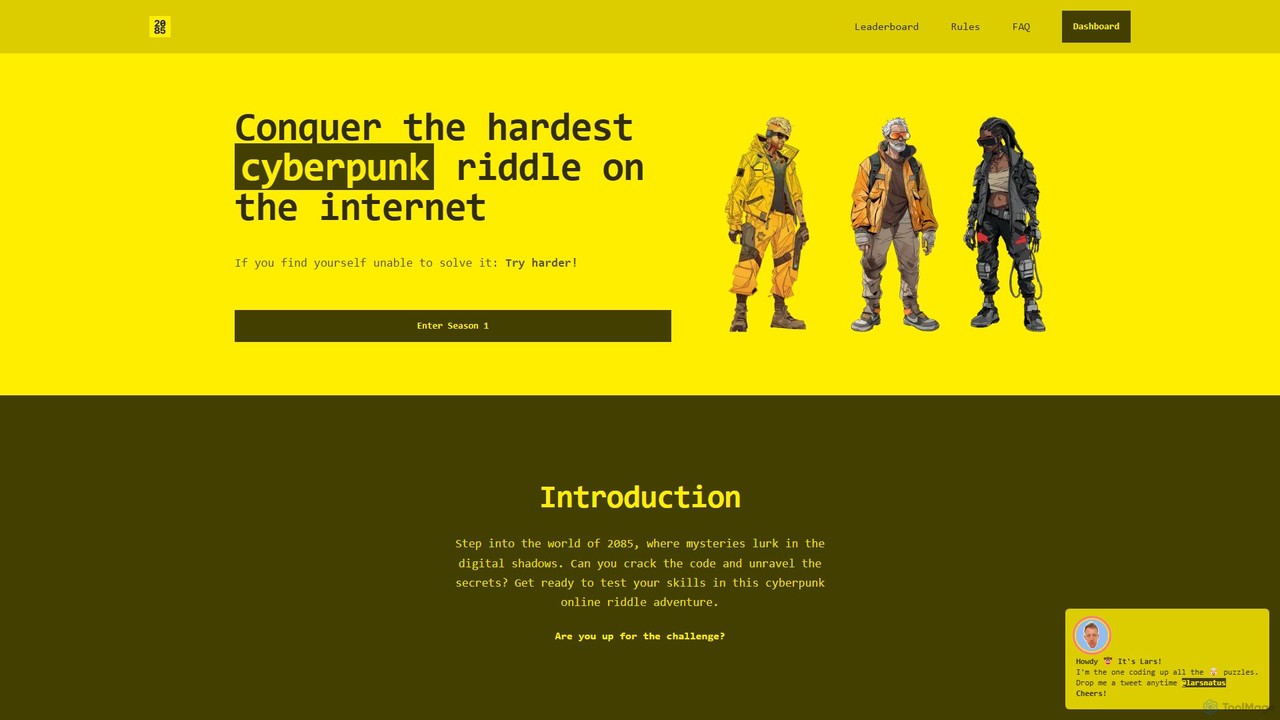
2085.world is an immersive online cyberpunk riddle game. Players are challenged to solve a series of complex enigmas …

3.0K

About Puzzle Games

AI Puzzle Games are a class of games that leverage artificial intelligence to create dynamic and intellectually stimulating challenges. These tools use algorithms for procedural content generation (PCG) and dynamic difficulty adjustment (DDA) to offer unique experiences in every session. They provide significant value for cognitive training, educational purposes, and pure entertainment by moving beyond static, pre-designed levels. The AI can generate nearly infinite variations of puzzles, adapt to a player's skill level, and introduce novel mechanics that challenge logic and creativity.

Core Features

  • Procedural Puzzle Generation: Automatically creates new and unique puzzles, ensuring high replayability.
  • Dynamic Difficulty Adjustment: Intelligently modifies the challenge level based on the player's performance in real-time.
  • Intelligent Hint Systems: Provides context-aware clues that guide players without spoiling the solution.
  • Complex Logic Systems: Features puzzles based on intricate rules and systems managed by an AI opponent or environment.
  • Pattern Recognition Tasks: Challenges players to identify and predict complex patterns generated by AI algorithms.

Use Cases

AI Puzzle Games are widely used for brain training and cognitive skill development across all age groups. In education, they serve as interactive tools for teaching logic, mathematics, and problem-solving. They are also popular among casual gamers seeking relaxing yet engaging experiences and competitive players looking for ever-new challenges in esports formats.

How to Choose

When selecting an AI Puzzle Game, consider the primary goal—be it entertainment, education, or cognitive training. Evaluate the type of puzzle (e.g., logic, spatial, physics, word-based) that you enjoy. Also, assess the depth of AI integration, such as its role in level generation, difficulty scaling, or providing hints. Finally, check for platform compatibility and the game's overall design aesthetic.

Puzzle GamesUse Cases

1

Daily Cognitive Skill Enhancement

A user looking to improve memory and problem-solving skills engages with an AI puzzle app daily. The app uses dynamic difficulty adjustment to present logic and spatial reasoning puzzles that are consistently challenging but not frustrating. Each day, the AI generates a fresh set of puzzles, preventing repetition and ensuring the user's brain is always stimulated. This consistent, personalized training helps improve cognitive flexibility and processing speed over time.

2

Interactive STEM Learning for Students

An educator incorporates an AI-powered physics puzzle game into their middle school science curriculum. The game presents students with challenges where they must build structures or manipulate forces to achieve a goal. The AI generates unique scenarios and provides real-time feedback on their solutions, helping them intuitively grasp concepts like gravity, momentum, and structural integrity. This gamified approach makes learning abstract principles more engaging and effective.

3

Generating Endless Sudoku and Logic Puzzles

A puzzle enthusiast who has solved countless static puzzle books uses an AI tool to generate new challenges. They can specify parameters like difficulty, grid size, or specific rules for puzzles like Sudoku, Nonograms, or KenKen. The AI's procedural generation algorithm creates a virtually infinite supply of unique, solvable puzzles, providing a limitless source of entertainment and mental exercise without ever needing to buy another book.

4

Creating Fair and Unique Competitive Puzzles

Organizers of an online puzzle-solving competition use an AI generator to create the challenges. For each round, the AI produces a set of puzzles of equivalent difficulty for all participants, ensuring a level playing field. Because the puzzles are generated on-the-fly, it prevents cheating and ensures the competition tests raw problem-solving skill. The AI can also create novel puzzle variations to surprise and test even the most experienced competitors.

5

Stress Relief through Calming Puzzle Mechanics

A professional uses a minimalist AI puzzle game on their mobile device for short breaks during a busy workday. The game features simple, intuitive mechanics and a soothing aesthetic, with an AI that generates gentle, flowing puzzles without timers or pressure. The adaptive difficulty ensures the experience remains relaxing and meditative, helping to reduce stress and reset mental focus before returning to work.

6

Personalized Language Learning via Word Games

A language learner plays an AI-driven crossword or word-search game to expand their vocabulary. The AI analyzes the player's performance and tailors future puzzles to include words they have struggled with or introduce new vocabulary relevant to their learning goals. This personalized approach reinforces learning and makes the process of memorizing new words more interactive and enjoyable than traditional flashcards.

Puzzle GamesFrequently Asked Questions