
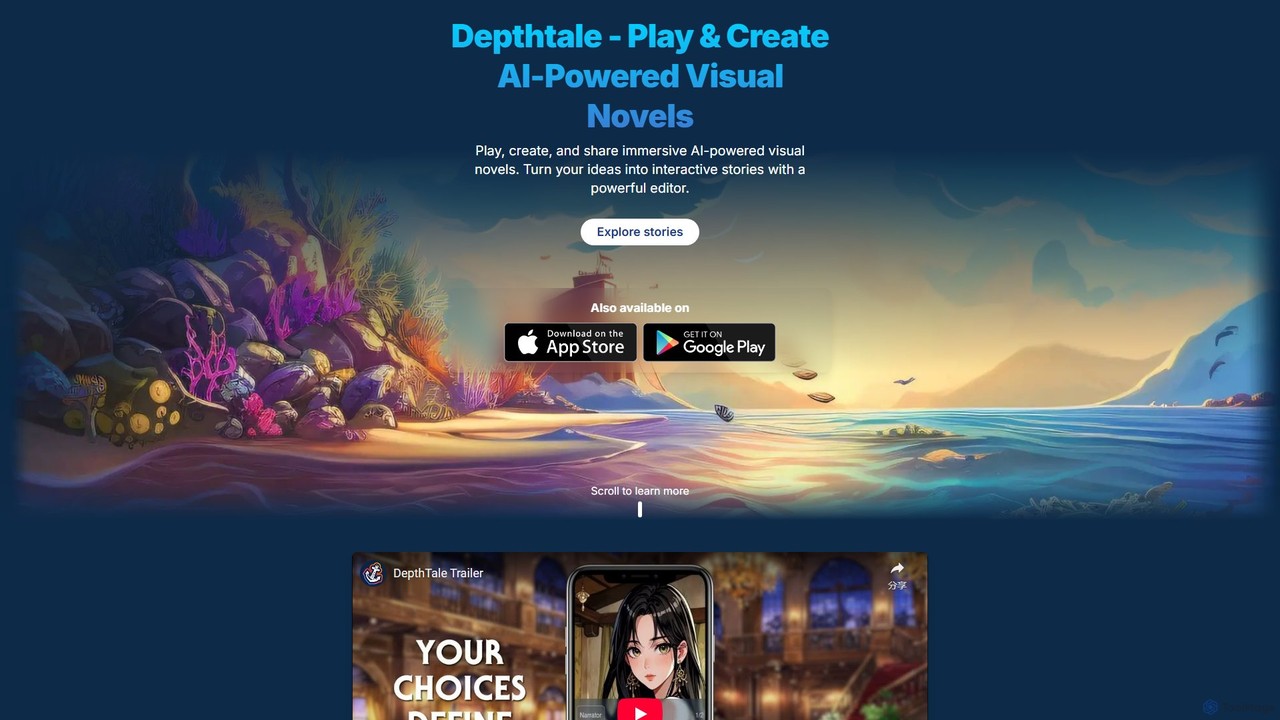
Depthtale
Depthtale is an AI-powered platform for creating and playing interactive visual novels. It combines traditional storytelling with point-and-click …
Depthtale is an AI-powered platform for creating and playing interactive visual novels. It combines traditional storytelling with point-and-click adventure elements, allowing creators to build immersive worlds with AI-generated art and readers to experience narratives shaped by their choices.
About Storytelling
Storytelling AI tools are a specialized category within gaming that utilize artificial intelligence to enhance and automate narrative creation. These tools leverage advanced natural language processing and generation to craft dynamic plots, character backstories, and dialogue. They empower game developers to build more immersive, branching storylines and personalized player experiences, moving beyond static narratives. This innovation allows for emergent gameplay and richer interactive worlds within the broader gaming landscape.
Core Features
- Dynamic Plot Generation: Automatically creates branching storylines and quests based on player choices and game state.
- Character & Dialogue AI: Generates unique character personalities, backstories, and context-aware dialogue.
- World Lore Creation: Assists in building detailed histories, cultures, and geographical elements for game worlds.
- Narrative Adaptation: Modifies story elements in real-time to respond to player actions and emergent events.
- Emotional Resonance: Analyzes and generates text to evoke specific emotional responses from players.
Applicable Scenarios
Game designers use these tools to rapidly prototype narrative ideas and explore different story paths. Indie developers can leverage AI to generate extensive lore and dialogue without large writing teams. Large studios integrate AI storytelling to create highly replayable games with personalized player journeys, enhancing player engagement across various genres.
How to Choose
Evaluate the tool's narrative complexity capabilities, its integration with existing game engines, the level of control offered over generated content, and its ability to maintain thematic consistency. Consider the specific genre and desired player agency, as well as the tool's scalability for your project size and the quality of its language generation models.
StorytellingUse Cases
Generate Dynamic NPC Dialogue
Game writers use AI storytelling tools to create context-aware and varied dialogue for non-player characters (NPCs). By inputting character traits, current game state, and plot points, the AI generates dialogue that feels natural and responsive, enhancing player immersion and reducing manual writing effort for thousands of lines, leading to more believable interactions.
Prototype Branching Storylines
Narrative designers leverage these tools to rapidly prototype complex branching narratives. They define key choices and outcomes, allowing the AI to explore numerous story paths and identify potential plot holes or inconsistencies early in development. This significantly accelerates the iteration process and ensures a cohesive narrative structure for player agency.
Create Extensive Game Lore
World builders and lore masters utilize AI to expand game universes with rich, detailed backstories, historical events, and cultural nuances. The AI can generate interconnected lore elements, ensuring consistency across vast game worlds and providing a deeper foundation for player exploration, making the game world feel more alive and authentic.
Personalize Player Quests
Developers integrate AI storytelling to offer players personalized quest lines. Based on a player's past actions, preferences, and in-game reputation, the AI dynamically generates unique missions and challenges, making each playthrough feel distinct and tailored to the individual, significantly boosting replayability and engagement.
Automate Procedural Content Narratives
For games with procedurally generated content (e.g., roguelikes, open-world exploration), AI storytelling can automatically weave narratives around generated environments, items, and events. This ensures that even random elements contribute to a cohesive and engaging story, rather than feeling disjointed, providing a richer, more consistent experience.
Develop Interactive Fiction & Visual Novels
Independent creators and interactive fiction authors use AI tools to assist in writing and expanding their stories. The AI can generate multiple narrative choices, character responses, and descriptive passages, streamlining the creation of complex interactive experiences and visual novels with diverse outcomes, making the creative process more efficient.