Promise
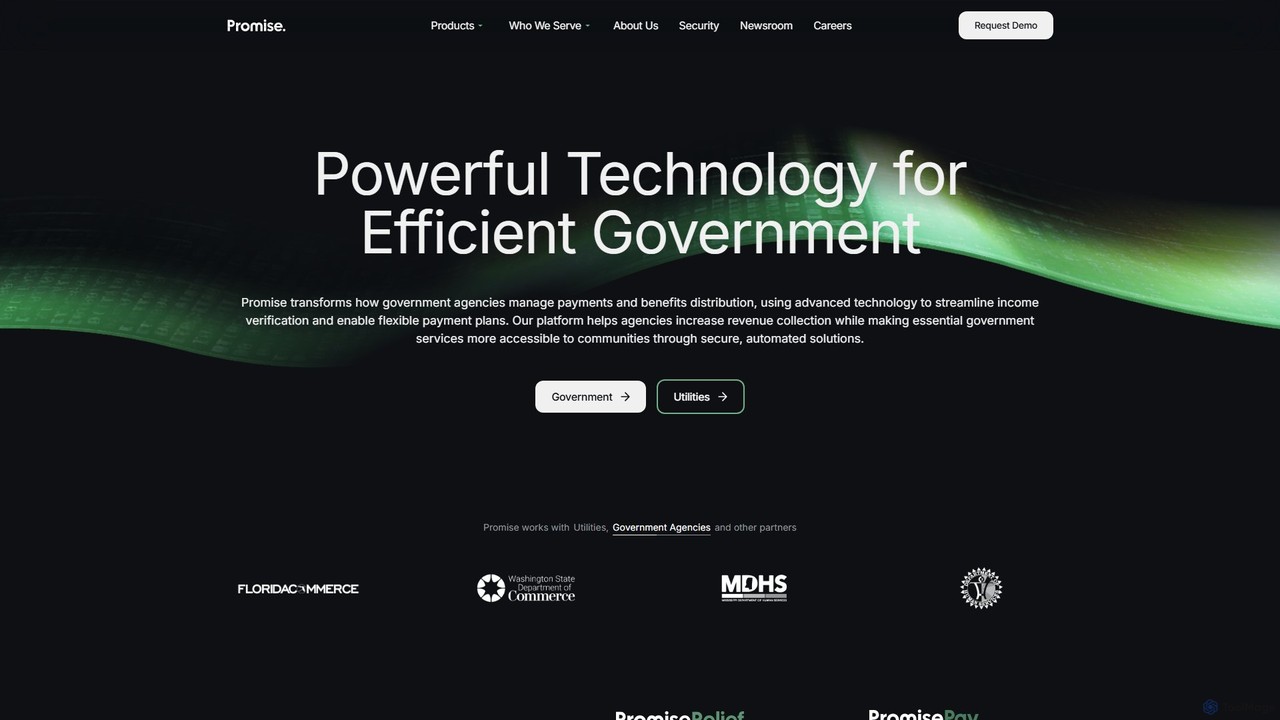
Promise is an AI-powered platform designed for government agencies and utilities to streamline payment management and benefits distribution. …
Promise is an AI-powered platform designed for government agencies and utilities to streamline payment management and benefits distribution. It uses advanced technology to automate income verification, create flexible payment plans, and manage relief programs, helping to recover more revenue while making essential services more accessible to communities.
About Public Sector Solutions
Public Sector Solutions are a class of AI tools specifically designed to meet the unique operational, regulatory, and security requirements of government agencies and public institutions. These tools leverage machine learning, natural language processing, and data analytics to automate processes, enhance citizen services, and support data-driven policymaking. Their primary value lies in modernizing public administration while adhering to strict standards of transparency, security, and compliance. They are engineered to handle sensitive citizen data and integrate with complex legacy government systems.
Core Features
- Regulatory Compliance & Security: Built-in adherence to government-specific data privacy standards and security protocols.
- Legacy System Integration: Specialized connectors and APIs to work seamlessly with existing government IT infrastructure.
- Public Data Analytics: Capabilities to analyze large-scale, diverse public datasets for policy insights and trend forecasting.
- Automated Citizen Services: AI-powered chatbots and workflow automation for handling inquiries, applications, and service requests.
- Ethical AI & Transparency: Features for auditability, bias detection, and explainability to ensure fair and accountable decision-making.
Use Cases
These solutions are widely used in public administration, urban planning, public health, law enforcement, and transportation management. For instance, a city might use AI to optimize traffic flow, while a federal agency could use it to detect fraud in benefits programs, both aiming to improve efficiency and public outcomes.
How to Choose
When selecting a Public Sector Solution, prioritize vendors with proven experience in the government sector. Verify their compliance with relevant security certifications (e.g., FedRAMP, GDPR). Assess the tool's interoperability with your existing systems and its scalability to serve a large population. Finally, scrutinize its data governance and ethical AI features to ensure public trust.

Public Sector SolutionsUse Cases
Automating Permit and License Applications
A municipal planning department uses an AI workflow tool to manage the influx of building permit applications. The system automatically scans submissions for completeness, cross-references information with zoning regulations and building codes, and flags any discrepancies for human review. This automation reduces the initial processing time from several weeks to just a few days, allowing staff to focus on complex cases and improving the experience for citizens and contractors.
Predicting Public Health Trends
A national health agency employs a predictive analytics platform to monitor and forecast disease outbreaks. The tool analyzes anonymized health records, environmental data, and global travel patterns to identify potential hotspots. This allows public health officials to proactively allocate resources, such as vaccines and medical staff, to high-risk areas and launch targeted public awareness campaigns, ultimately mitigating the impact of outbreaks.
Optimizing Public Transportation Routes
A city's transit authority uses an AI solution to analyze real-time data from GPS on buses, passenger counters, and traffic sensors. The system identifies patterns in passenger demand and traffic congestion to recommend dynamic adjustments to bus routes and schedules. This leads to more reliable service, reduced wait times for passengers, and more efficient fuel consumption, improving the overall quality and sustainability of public transport.
Detecting Fraud in Social Benefit Programs
A government social services agency employs an AI tool to ensure the integrity of its benefits distribution system. The platform analyzes vast datasets of claims, looking for anomalous patterns, duplicate applications, or inconsistencies that may indicate fraud. By flagging a small percentage of high-risk cases for human investigation, the agency can recover significant funds and ensure that resources are directed to citizens who genuinely need them, while minimizing disruption for legitimate applicants.
Enhancing Emergency Response Coordination
An emergency services agency uses an AI-powered command center platform to manage responses to large-scale incidents. The system integrates data from emergency calls, traffic cameras, weather forecasts, and GPS locations of first responders. It provides a unified operational picture, suggests optimal deployment routes to avoid congestion, and predicts resource needs. This enables commanders to make faster, more informed decisions, improving coordination and potentially saving lives.
Providing 24/7 Citizen Support with AI Chatbots
A city government deploys a multilingual AI chatbot on its official website to handle common citizen inquiries. The chatbot can answer questions about tax payments, waste collection schedules, and local event information around the clock. It can also guide users through simple application processes. This provides immediate assistance to citizens outside of office hours and frees up human customer service agents to handle more complex and sensitive issues, improving overall service efficiency.