Irisradgroup
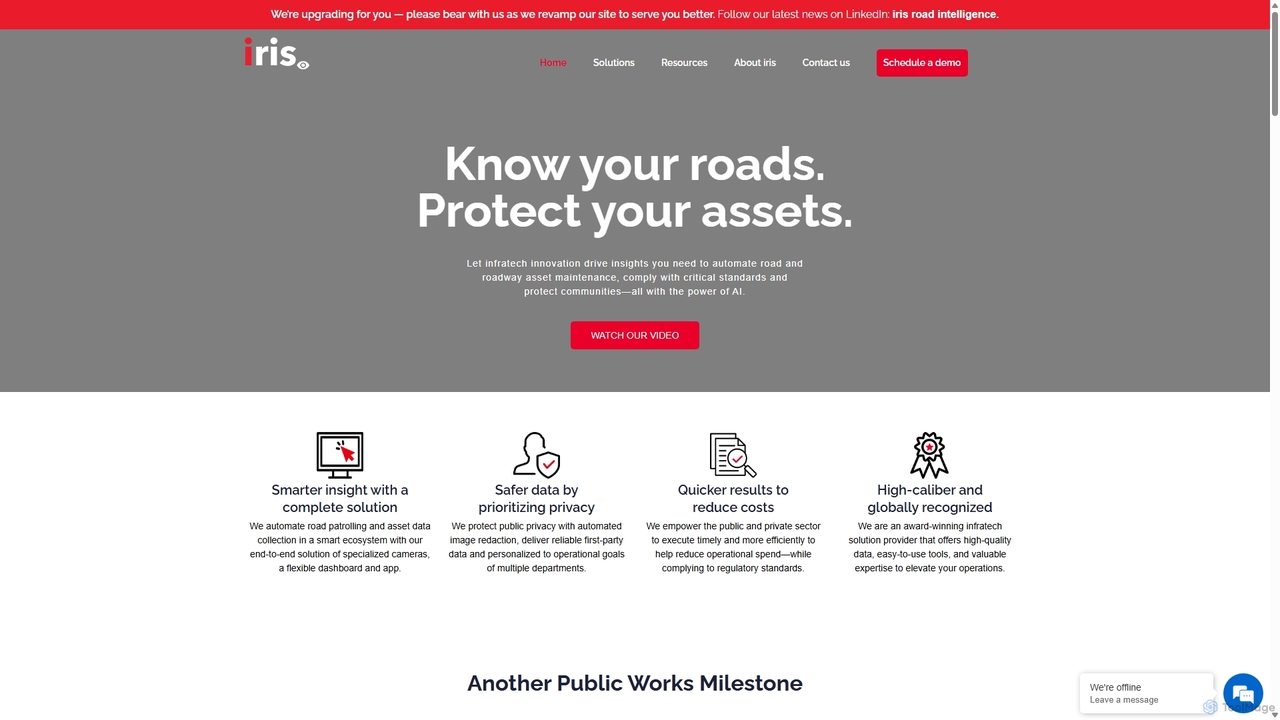
Irisradgroup is an AI-powered infratech solution that automates road and roadway asset maintenance. Using specialized cameras and an …
Irisradgroup is an AI-powered infratech solution that automates road and roadway asset maintenance. Using specialized cameras and an intelligent dashboard, it helps municipalities and infrastructure managers monitor road conditions, inventory assets, ensure compliance, and improve public safety efficiently.
About Public Sector
Public Sector AI tools are specialized applications designed to enhance the efficiency, transparency, and service delivery of government agencies and public organizations. These tools leverage machine learning, natural language processing, and data analytics to automate administrative tasks, analyze large-scale public data, and improve citizen engagement. They are crucial for modernizing government operations, enabling data-driven policy-making, and optimizing the allocation of public resources. Unlike general enterprise AI, these solutions are built with a strong emphasis on security, regulatory compliance, and public accountability.
Core Features
- Citizen Service Automation: Deploys chatbots and virtual assistants to handle common inquiries, process applications, and guide users through public services 24/7.
- Public Data Analytics: Processes and visualizes large datasets (e.g., census, traffic, health data) to identify trends, predict needs, and inform policy decisions.
- Regulatory Compliance Monitoring: Automatically tracks and flags activities to ensure adherence to government regulations, standards, and legal frameworks.
- Resource Allocation Optimization: Uses predictive models to forecast demand for public services, helping to optimize the deployment of personnel, equipment, and funds.
- Predictive Maintenance: Analyzes data from public infrastructure like transit systems and utilities to predict failures and schedule maintenance proactively.
Applicable Scenarios
These tools are essential for city managers, public health officials, urban planners, and administrative departments. Common applications include automating the processing of permits and licenses, optimizing public transportation routes based on real-time data, and analyzing public sentiment from social media to gauge policy impact. They are also used in emergency services to predict incident hotspots and improve response times.
Selection Criteria
When choosing a Public Sector AI tool, prioritize solutions with robust data security and privacy certifications (e.g., FedRAMP, GDPR). Evaluate its ability to integrate with existing legacy government systems and its scalability to serve a large population. Crucially, assess the tool's transparency and explainability (XAI) features, as decisions affecting the public require clear justification and auditability.

Public SectorUse Cases
Automating Citizen Inquiry Responses
A municipal government's citizen service department is overwhelmed with repetitive inquiries about tax payments, waste collection schedules, and park permits. By implementing an AI-powered chatbot on their official website, they can provide instant, 24/7 answers to these common questions. The chatbot uses natural language processing to understand user queries in various forms and provides accurate information from a knowledge base. This frees up human agents to handle more complex, sensitive cases, reducing wait times and improving overall citizen satisfaction.
Predictive Maintenance for Public Infrastructure
A metropolitan transit authority needs to manage the maintenance of hundreds of buses and trains efficiently. They use an AI tool that analyzes real-time sensor data from vehicles, historical maintenance records, and operational logs. The system predicts when a specific component, like a brake system or engine part, is likely to fail. This allows the maintenance team to perform proactive repairs before a breakdown occurs, reducing service disruptions, improving passenger safety, and lowering long-term repair costs by addressing issues early.
Optimizing Emergency Service Dispatch
An emergency response agency for a large city uses an AI-powered dispatch system to improve response times. The system analyzes real-time traffic data, weather conditions, incident locations, and the current status of all emergency vehicles. When a new call comes in, the AI instantly recommends the optimal vehicle and route, accounting for potential delays like traffic jams or road closures. This data-driven approach ensures the fastest possible response, which can be critical in life-threatening situations, and helps manage the fleet of emergency vehicles more effectively.
Analyzing Public Feedback for Policy Making
A city planning department launches a public consultation for a new urban development project and receives thousands of emails, survey responses, and social media comments. Manually analyzing this volume of feedback is impractical. They use an AI tool with Natural Language Processing (NLP) capabilities to automatically categorize comments by topic (e.g., traffic, green space, housing) and analyze sentiment (positive, negative, neutral). This provides planners with a clear, data-backed summary of public opinion, helping them identify key concerns and make more informed, citizen-centric policy decisions.
Fraud Detection in Social Benefit Programs
A national welfare agency manages millions of applications for social benefits, making it a target for fraudulent claims. They deploy an AI system that analyzes application data, cross-references it with other government databases, and identifies patterns indicative of fraud. The model can flag suspicious applications, such as multiple claims from the same address with different names or inconsistencies in income reporting. This allows human investigators to focus their efforts on high-risk cases, protecting public funds and ensuring that benefits reach those who genuinely need them.
Streamlining Permit and License Applications
A local government's department for business licensing is bogged down by a manual, paper-based application process. They adopt an AI-powered platform that digitizes the entire workflow. Applicants submit their documents online, and an AI tool performs an initial review, using optical character recognition (OCR) to extract data and checking for completeness and basic compliance. The system flags missing information or inconsistencies for the applicant to correct, reducing the number of incomplete submissions. This automation significantly speeds up the review cycle, allowing businesses to get licensed and operational faster.