
ToolMage
Sign in

Best 1 Training AI tools for Hr

Popular Training AI tools in Hr include Bunch, helping you work more efficiently.

Bunch
Freemium

Bunch

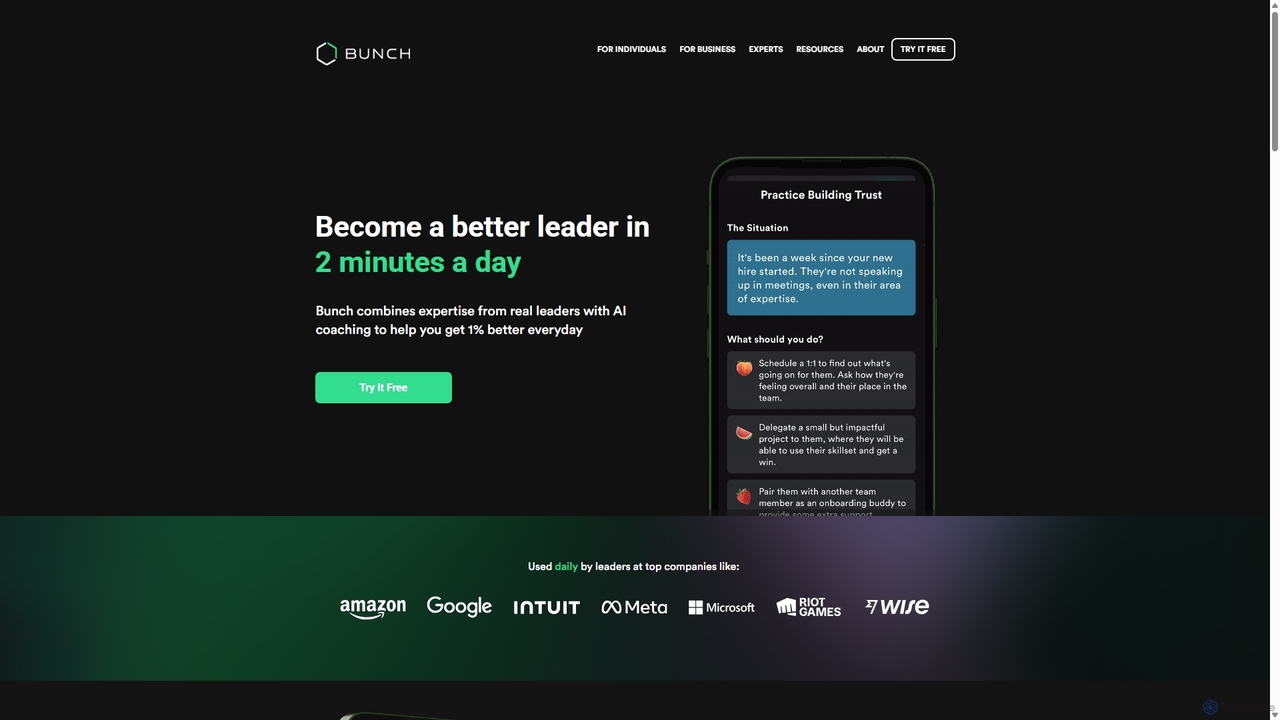
Bunch is an AI-powered leadership coach designed for managers and aspiring leaders. It delivers personalized, bite-sized daily tips and 24/7 AI coaching to help you improve your leadership skills in just 2 minutes a day, fostering continuous professional growth.

Professional Development
Visits 20KFavorites 151Likes 159

About Training

Training tools are AI-powered solutions designed to enhance, automate, and personalize employee learning and development within organizations. These tools leverage advanced algorithms to deliver adaptive content, intelligent assessments, and data-driven insights. Their primary value lies in optimizing skill acquisition, improving onboarding processes, ensuring compliance, and boosting overall workforce productivity.

Core Features

  • Personalized Learning Paths: Tailors educational content and progression to individual employee needs and learning styles.
  • AI-powered Content Creation: Generates or curates relevant training materials, quizzes, and interactive simulations efficiently.
  • Performance Tracking & Analytics: Monitors learner progress, identifies skill gaps, and provides actionable insights for program optimization.
  • Adaptive Assessments: Adjusts the difficulty of evaluations based on real-time performance to ensure effective knowledge retention.
  • Virtual Coaching & Feedback: Offers real-time guidance and constructive feedback to learners, simulating a human mentor.

Applicable Scenarios

AI training tools are indispensable for corporate HR departments managing new employee onboarding, facilitating continuous professional development for existing staff, and ensuring mandatory compliance training. They are also highly effective for specialized team training, such as product knowledge enhancement for sales teams or leadership development programs.

How to Choose

When selecting an AI training tool, prioritize its customization capabilities to align with your company's specific learning objectives and culture. Evaluate its content integration and creation features, robust analytics and reporting for measuring ROI, and overall scalability to accommodate future growth. User experience for both learners and administrators is also a critical factor.

Training use cases

1

Streamlined New Employee Onboarding

HR managers and department heads utilize AI training tools to automate and personalize the onboarding process for new hires across various departments. The tools deliver tailored modules on company culture, policies, and initial job-specific skills, tracking completion and understanding. This approach significantly reduces manual HR effort, ensures consistent foundational knowledge, and accelerates new hire productivity, allowing them to contribute effectively sooner.

2

Personalized Skill Development for Existing Staff

Employees and team leaders leverage AI platforms to identify and address individual skill gaps, fostering continuous professional growth. These tools assess current competencies, recommend relevant courses or modules, and adapt content based on learning pace and performance. This results in boosted employee engagement, improved specific job competencies, and prepares staff for future roles, contributing to a more agile and skilled workforce.

3

Automated Compliance and Regulatory Training

Compliance officers and legal departments utilize AI tools to ensure all employees complete mandatory training on legal, safety, or industry-specific regulations. AI platforms deploy, track, and report on compliance modules, automatically reminding non-compliant individuals and updating content as regulations change. This minimizes legal risks, maintains regulatory adherence, and provides auditable training records efficiently, saving significant administrative time.

4

Sales Team Product Knowledge Enhancement

Sales managers and representatives utilize AI training platforms to rapidly educate sales teams on new product features, benefits, and competitive positioning. These platforms offer interactive simulations, micro-learning modules, and AI-powered Q&A to quickly disseminate product information and test understanding. This equips sales teams with up-to-date knowledge, leading to more effective pitches, improved customer interactions, and ultimately, increased sales performance.

5

Leadership and Management Development Programs

Senior management and aspiring leaders benefit from AI tools to cultivate leadership skills and strategic thinking within the organization. AI platforms provide virtual coaching, scenario-based training, and personalized feedback on leadership styles and decision-making, often through interactive simulations. This approach develops a strong internal leadership pipeline, improves managerial effectiveness, and fosters a culture of continuous improvement and innovation.

6

Global Workforce Language and Cultural Training

Multinational companies and HR departments utilize AI-powered tools to facilitate effective communication and cultural understanding across diverse global teams. These tools offer adaptive language learning modules and cultural sensitivity training, tailored to specific regions and employee needs. This enhances cross-cultural collaboration, reduces misunderstandings, and strengthens global team cohesion, leading to more harmonious and productive international operations.

Training FAQ

What are AI Training Tools?

AI Training Tools are software solutions that leverage artificial intelligence to enhance, automate, and personalize the learning and development process within organizations. They go beyond traditional e-learning by offering adaptive content, intelligent assessments, and data-driven insights to optimize employee skill acquisition and knowledge retention. These tools are crucial for modern HR departments looking to scale their training efforts and ensure a highly skilled workforce.

How do AI Training Tools differ from traditional e-learning platforms?

While traditional e-learning platforms typically deliver static content, AI Training Tools offer dynamic and personalized learning experiences. AI tools can adapt content difficulty, recommend relevant modules based on performance, and provide real-time feedback, much like a human tutor. They also use analytics to identify skill gaps and predict future training needs, making the learning process more efficient, engaging, and tailored to individual learners.

What are the key benefits of using AI for employee training?

The primary benefits of using AI for employee training include personalization, scalability, and efficiency. AI tools can create customized learning paths for each employee, ensuring relevant skill development. They allow organizations to train a large workforce consistently without significant manual overhead. Additionally, AI-driven analytics provide valuable insights into learning effectiveness, helping HR optimize programs, reduce training costs, and improve overall employee performance and retention.

What features should I look for when choosing an AI Training Tool?

When selecting an AI Training Tool, prioritize features like adaptive learning paths, AI-powered content generation or curation, robust performance analytics, and seamless integration with existing HRIS or LMS. Also, consider the tool's ability to support various content formats (video, simulations), its user-friendliness for both learners and administrators, and the level of customization it offers to align with your company's specific training objectives and culture.

Can AI Training Tools help with compliance training?

Yes, AI Training Tools are highly effective for compliance training. They can automate the deployment of mandatory modules, track completion rates, and provide detailed audit trails, ensuring all employees meet regulatory requirements. AI can also adapt content to different regional regulations and automatically update modules as laws change, significantly reducing the administrative burden and risk associated with compliance management.