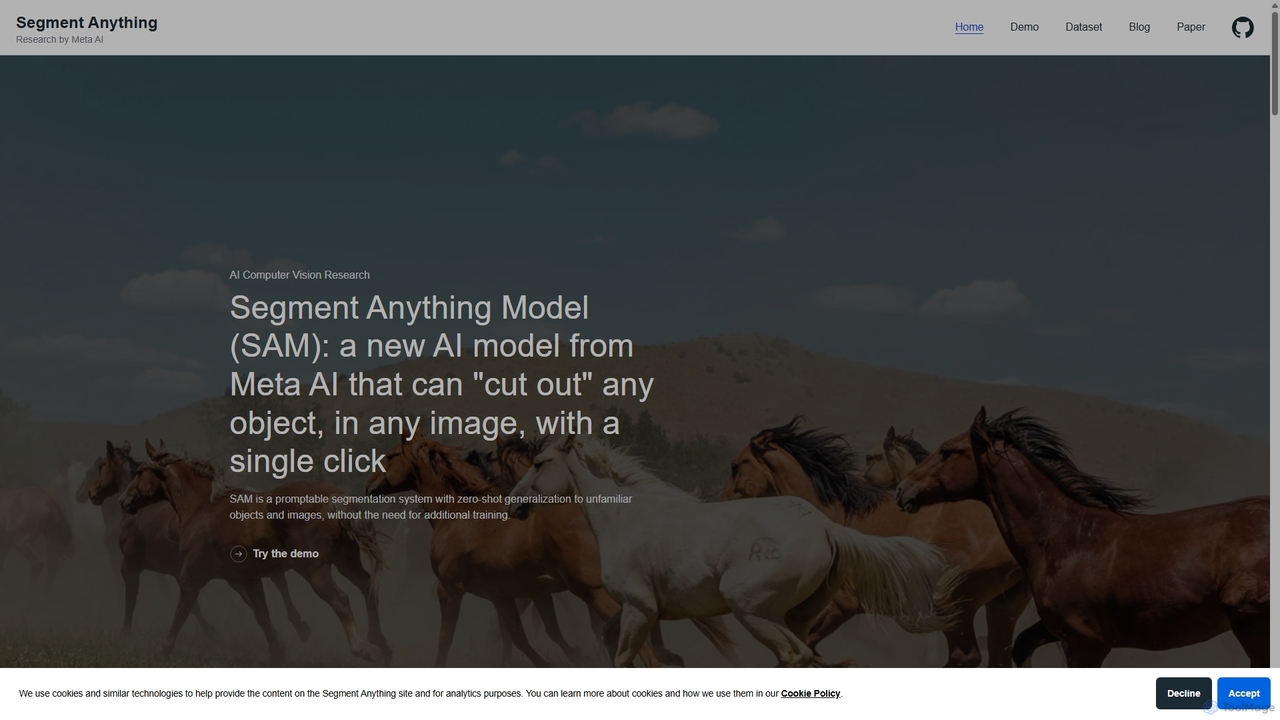
Segment Anything
Segment Anything (SAM) is a groundbreaking AI model from Meta AI for image segmentation. It can identify and …
Segment Anything (SAM) is a groundbreaking AI model from Meta AI for image segmentation. It can identify and "cut out" any object in any image with a single click or prompt. Featuring zero-shot generalization, SAM understands objects without prior specific training, making it incredibly versatile for researchers, developers, and creators in computer vision, image editing, and data annotation.
About Image Segmentation
Image Segmentation tools are a specialized class of AI software that partition a digital image into multiple segments or pixel sets, corresponding to different objects or regions. These tools operate by assigning a specific label to every pixel, creating a detailed, pixel-level map where pixels with the same label share common attributes. This granular analysis is crucial for tasks requiring precise object delineation, such as medical image analysis, autonomous vehicle navigation, and satellite imagery interpretation. Unlike object detection which draws a simple box, image segmentation provides the exact contour of each object, offering superior spatial detail.
Core Features
- Semantic Segmentation: Classifies each pixel into a predefined category (e.g., 'road', 'sky', 'building') without distinguishing between individual instances.
- Instance Segmentation: Identifies and outlines each distinct object instance, even if they belong to the same class (e.g., 'car_1', 'car_2').
- Panoptic Segmentation: Combines semantic and instance segmentation to provide a comprehensive scene understanding of both 'things' (countable objects) and 'stuff' (amorphous regions).
- Pixel-level Masking: Generates precise masks for each identified segment, enabling targeted extraction, editing, or analysis.
- Custom Model Training: Allows users to train models on specific datasets to recognize unique or domain-specific objects and patterns.
Use Cases
Image Segmentation is widely used in fields requiring high precision. In medicine, it helps delineate tumors in MRI scans. In the automotive industry, it enables self-driving cars to understand road scenes by identifying pedestrians, vehicles, and lane markings. It is also applied in agriculture for crop monitoring from satellite images and in e-commerce for creating clean product cutouts.
How to Choose
When selecting an Image Segmentation tool, first identify the required segmentation type (semantic, instance, or panoptic) for your task. Evaluate the model's accuracy using metrics like Intersection over Union (IoU) on relevant data. For real-time applications, consider the processing speed and latency. Finally, assess the availability of an API for integration with your existing workflows and the tool's capacity for custom model training.
Image SegmentationUse Cases
Medical Image Analysis for Tumor Detection
A radiologist or medical researcher uses an image segmentation tool to analyze hundreds of MRI or CT scans. The primary task is to identify and precisely measure the boundaries of tumors or other tissue abnormalities. The AI automatically segments the scan, highlighting suspicious regions with pixel-perfect accuracy. This process significantly reduces manual annotation time, improves diagnostic consistency across different practitioners, and enables precise, quantitative tracking of tumor volume changes over the course of treatment.
Autonomous Vehicle Scene Understanding
A robotics engineer developing autonomous driving systems relies on image segmentation to enable a vehicle to perceive its environment. The model processes real-time camera feeds, classifying every pixel as 'road', 'sidewalk', 'pedestrian', 'vehicle', or 'obstacle'. This detailed, pixel-level map provides the vehicle's navigation system with a comprehensive understanding of its surroundings, which is critical for safe path planning, lane keeping, and collision avoidance in complex urban environments.
Precision Agriculture via Satellite Imagery
An agronomist or agricultural data scientist uses image segmentation on satellite or drone imagery to monitor crop health. The tool segments the images to differentiate between healthy crops, stressed vegetation, weeds, and bare soil. This allows for the creation of detailed field maps that guide precision farming practices. As a result, farmers can apply water, fertilizers, or pesticides in a targeted manner, optimizing resource use, reducing environmental impact, and ultimately increasing crop yield.
E-commerce Product Photo Enhancement
An e-commerce manager or graphic designer needs to create clean, professional product listings. Using an instance segmentation tool, they can precisely outline a product and generate a perfect mask to remove or replace its background. This is especially useful for complex items like clothing, furniture, or jewelry. The process automates what was once a tedious manual task, ensuring a consistent and high-quality visual style across an entire product catalog, which can lead to improved customer engagement and higher conversion rates.
Infrastructure Inspection with Drone Footage
A civil engineer or infrastructure inspector analyzes high-resolution drone footage to assess the structural integrity of bridges, power lines, or buildings. An AI segmentation tool processes the video frames to identify and delineate specific components (e.g., bolts, beams, insulators) and automatically detect defects like cracks, rust, or corrosion. This improves inspection safety by reducing the need for manual access to hazardous areas and provides objective, quantifiable data on defect size and location for maintenance planning.
Interactive Video Editing and VFX
A video editor or VFX artist needs to isolate a character or object from a video scene for tasks like color grading, background replacement, or adding special effects. This process, known as rotoscoping, is traditionally highly manual and time-consuming. An image segmentation tool can process each frame of the video to automatically generate a precise moving mask (matte) for the desired subject. This significantly accelerates the workflow, freeing up artists to focus on more creative aspects of post-production rather than tedious frame-by-frame masking.