Segment Anything
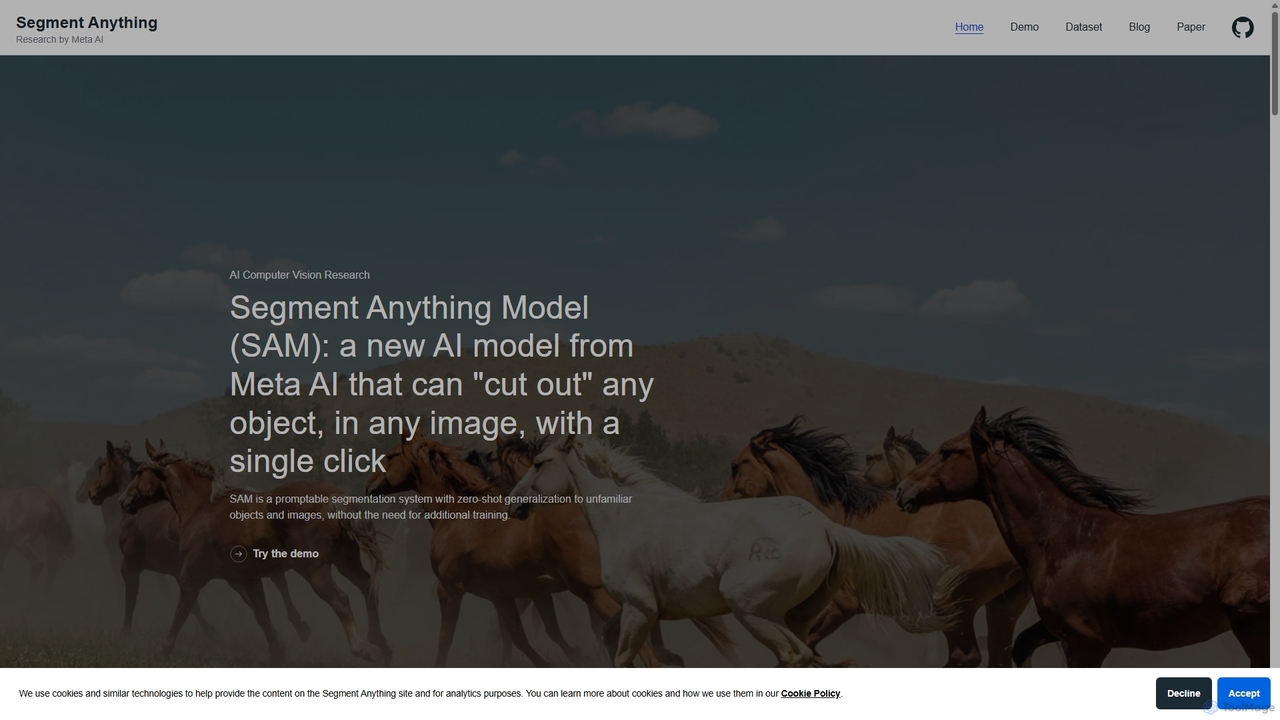
Segment Anything (SAM) is a groundbreaking AI model from Meta AI for image segmentation. It can identify and …
Segment Anything (SAM) is a groundbreaking AI model from Meta AI for image segmentation. It can identify and "cut out" any object in any image with a single click or prompt. Featuring zero-shot generalization, SAM understands objects without prior specific training, making it incredibly versatile for researchers, developers, and creators in computer vision, image editing, and data annotation.
Prolific
Prolific is a leading platform for collecting high-quality data from a global pool of over 200,000 vetted and …
Prolific is a leading platform for collecting high-quality data from a global pool of over 200,000 vetted and engaged human participants. It enables AI developers and researchers to quickly launch studies, train models, and gather reliable human feedback for tasks like data annotation, RLHF, and surveys.
Your Personal AI
Your Personal AI provides bespoke, enterprise-grade AI and machine learning solutions. They specialize in custom AI development, intelligent …
Your Personal AI provides bespoke, enterprise-grade AI and machine learning solutions. They specialize in custom AI development, intelligent automation, predictive analytics, and comprehensive data services, including collection, annotation, and validation. With a strong focus on data security and industry-specific applications (like healthcare, finance, and automotive), they help businesses integrate and scale AI to drive efficiency, gain strategic insights, and achieve measurable ROI.
gts.ai
GTS.ai is a leading AI data solutions provider with over 25 years of experience. They offer high-quality, customized …
GTS.ai is a leading AI data solutions provider with over 25 years of experience. They offer high-quality, customized datasets for machine learning, including image, video, speech, and text data. Leveraging a global workforce of over 4.5 million, GTS provides comprehensive services from data collection and annotation to transcription and data management. They ensure data accuracy, security (ISO, GDPR, HIPAA compliant), and scalability for AI projects across various industries, helping businesses propel their AI initiatives forward with reliable data.
Oda Studio
Oda Studio provides bespoke AI solutions to transform complex, unstructured data into actionable insights. Specializing in Vision-Language Models …
Oda Studio provides bespoke AI solutions to transform complex, unstructured data into actionable insights. Specializing in Vision-Language Models (VLMs) and custom data pipelines, they serve industries like construction, finance, and media. Their expert team delivers end-to-end services from data annotation to model deployment, enabling businesses to make smarter, faster decisions.
clickworker
clickworker is a leading crowdsourcing platform that provides high-quality, diverse, and scalable data for training AI and machine …
clickworker is a leading crowdsourcing platform that provides high-quality, diverse, and scalable data for training AI and machine learning models. It leverages a global community of over 7 million freelancers to generate, validate, and label data, including images, videos, audio, and text, tailored to specific project needs.
Defined.ai
Defined.ai is a leading marketplace and platform for high-quality AI training data. It provides off-the-shelf datasets and custom …
Defined.ai is a leading marketplace and platform for high-quality AI training data. It provides off-the-shelf datasets and custom data collection/annotation services for computer vision, NLP, and speech recognition. By leveraging a global crowd and a robust platform, Defined.ai helps businesses accelerate the development of accurate and ethical AI models.
About Data Annotation
Data Annotation tools are AI-powered platforms designed to systematically label raw data, such as images, text, audio, and video. These tools enable the precise tagging and categorization of data points, making them suitable for training robust machine learning models. They are crucial for developing accurate and unbiased AI systems across various domains, transforming unstructured information into valuable, structured datasets.
Core Features
- Image & Video Annotation: Tools for drawing bounding boxes, polygons, keypoints, and semantic segmentation masks on visual data.
- Text Annotation: Capabilities for Named Entity Recognition (NER), sentiment analysis, text classification, and relation extraction.
- Audio Annotation: Features for transcribing speech, identifying speakers (diarization), and detecting specific sound events.
- Workflow Management: Tools for project setup, task distribution, progress tracking, and team collaboration.
- Quality Assurance: Mechanisms for reviewer feedback, consensus-based labeling, and automated quality checks to ensure high data accuracy.
Applicable Scenarios
Data annotation is indispensable for industries building AI applications. It's used by autonomous vehicle companies to label road objects, by healthcare providers to annotate medical images for diagnostic AI, and by e-commerce platforms to categorize products from descriptions and images. Content moderation teams also rely on it to classify harmful content for automated filtering systems.
How to Choose
When selecting a data annotation tool, consider the types of data you need to annotate (images, text, audio, video) and the specific annotation techniques required (e.g., bounding boxes vs. semantic segmentation). Evaluate its scalability for large datasets, the efficiency of its workflow management features, and the robustness of its quality assurance processes. Also, assess its integration capabilities with existing data pipelines and its pricing model.
Data AnnotationUse Cases
Autonomous Driving Object Detection
Automotive engineers and AI researchers use data annotation tools to label millions of video frames and images captured by self-driving cars. They meticulously draw bounding boxes around vehicles, pedestrians, traffic signs, and lane markers, and perform semantic segmentation to delineate road surfaces and obstacles. This annotated data is then fed into deep learning models to train the car's perception system, enabling it to accurately identify and react to its environment, which is critical for safety and navigation.
Medical Image AI Diagnosis
Radiologists and medical AI developers utilize annotation platforms to precisely mark anomalies, tumors, or specific anatomical structures within X-rays, MRIs, and CT scans. Using tools like polygons and segmentation masks, they highlight areas of interest, providing ground truth for AI models. These models are then trained to assist in early disease detection, automate diagnostic processes, and improve the accuracy of medical imaging analysis, ultimately aiding clinicians in making more informed decisions.
E-commerce Product Categorization
E-commerce businesses employ data annotators to tag product images and descriptions with relevant attributes, categories, and keywords. For instance, an image of a "red leather handbag" would be annotated with "color: red," "material: leather," "type: handbag," and "style: fashion." This structured data is vital for training recommendation engines, improving search relevance, and automating product catalog management, ensuring customers can easily find desired items and enhancing the overall shopping experience.
Chatbot & Virtual Assistant Training
NLP engineers and customer service teams use data annotation to prepare conversational data for training AI chatbots and virtual assistants. They annotate user queries with their corresponding intents (e.g., "check order status," "reset password") and extract entities (e.g., "order number," "product name"). This labeled data allows the AI to understand natural language, accurately interpret user requests, and provide relevant responses, significantly improving customer interaction and reducing the need for human intervention.
Speech Recognition System Enhancement
AI audio specialists and linguists leverage data annotation tools to transcribe vast amounts of audio recordings, converting spoken words into text. They also perform speaker diarization (identifying who spoke when) and emotion detection. This meticulously labeled audio data is essential for training and refining automatic speech recognition (ASR) systems, voice assistants, and call center analytics, leading to higher accuracy in transcription and better understanding of spoken language.
Agricultural Crop Disease Detection
Agricultural technologists and researchers use data annotation to label images of crops, identifying signs of diseases, pest infestations, or nutrient deficiencies. They might draw bounding boxes around affected leaves or segment diseased areas. This annotated visual data trains AI models to automatically monitor crop health from drone imagery or field sensors, enabling early detection and targeted intervention. This helps farmers optimize resource use, minimize crop loss, and improve overall yield.