Chainrel
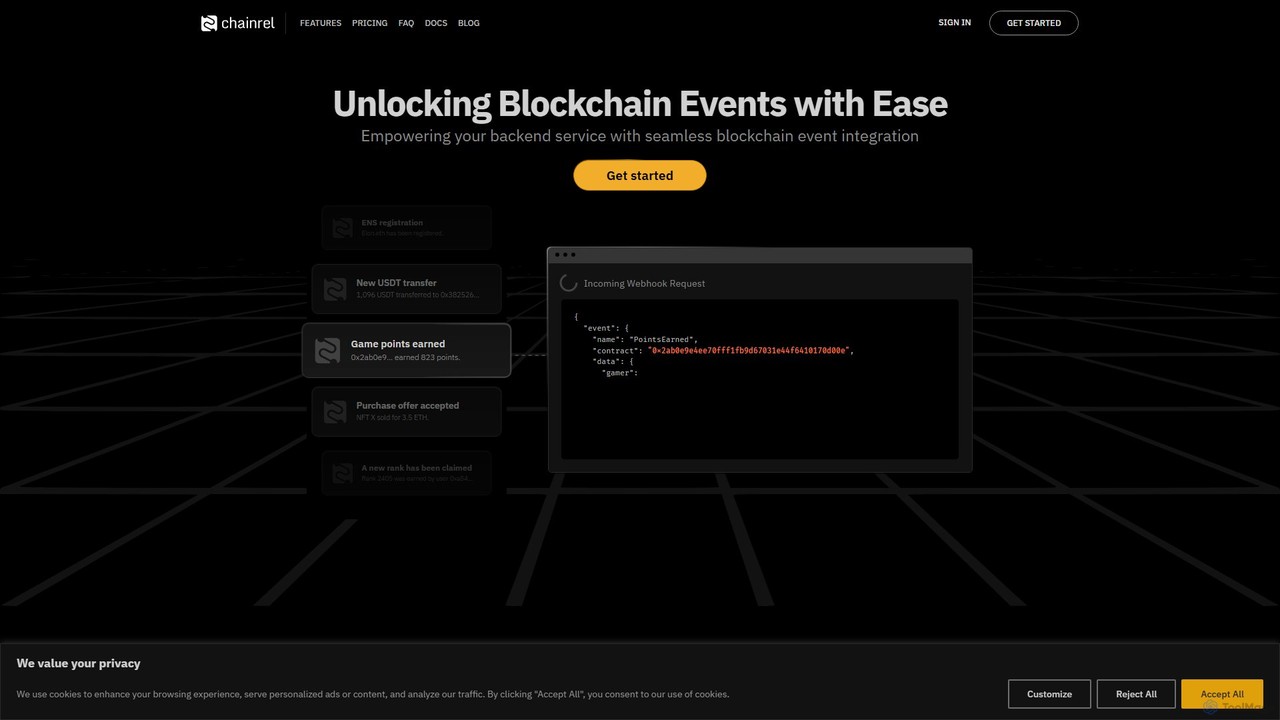
Chainrel is a developer-focused platform that simplifies blockchain integration by providing real-time event notifications via webhooks. It allows …
Chainrel is a developer-focused platform that simplifies blockchain integration by providing real-time event notifications via webhooks. It allows developers to monitor smart contract events, wallet transfers, and NFT activities across multiple blockchains like Ethereum and Polygon, and deliver this data directly to their backend services, Slack, or Discord without managing complex blockchain infrastructure.
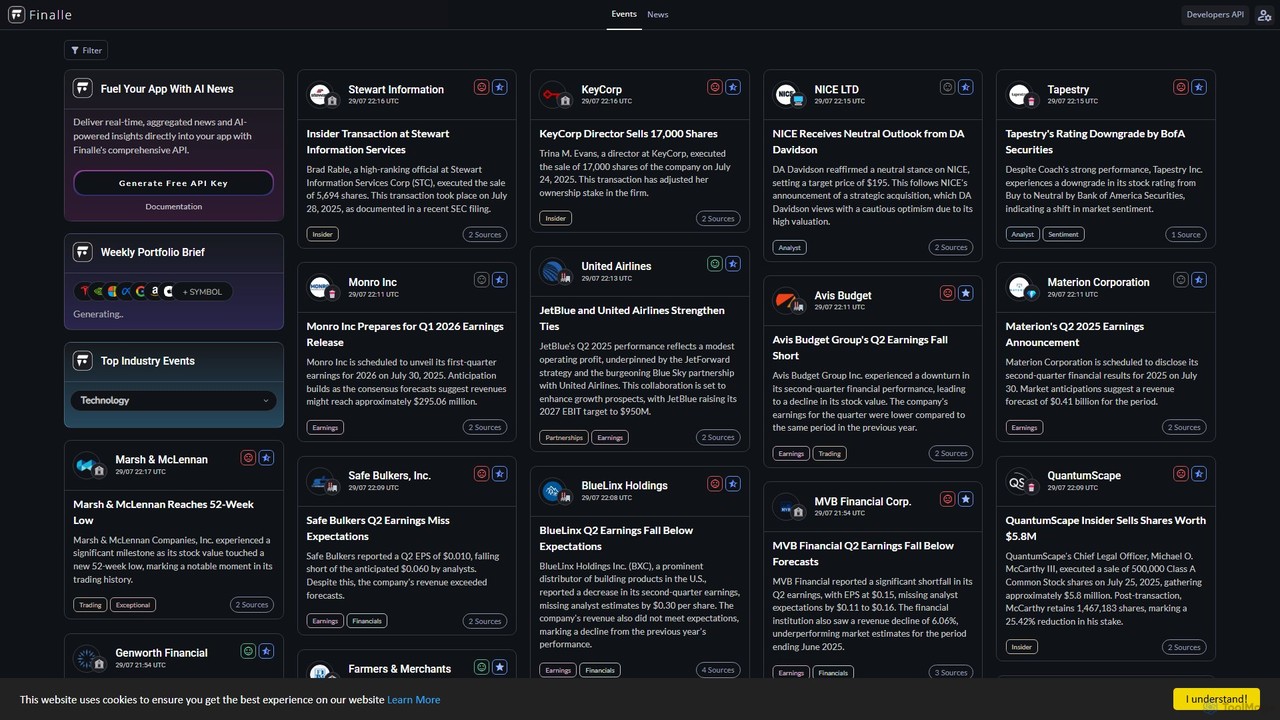
Finalle
Finalle is an AI-powered news API for developers and businesses. It delivers real-time, aggregated financial and business news, …
Finalle is an AI-powered news API for developers and businesses. It delivers real-time, aggregated financial and business news, enriched with AI-driven insights like sentiment analysis, entity recognition, and event categorization. Integrate this comprehensive data stream directly into your applications to provide users with up-to-the-minute market intelligence.
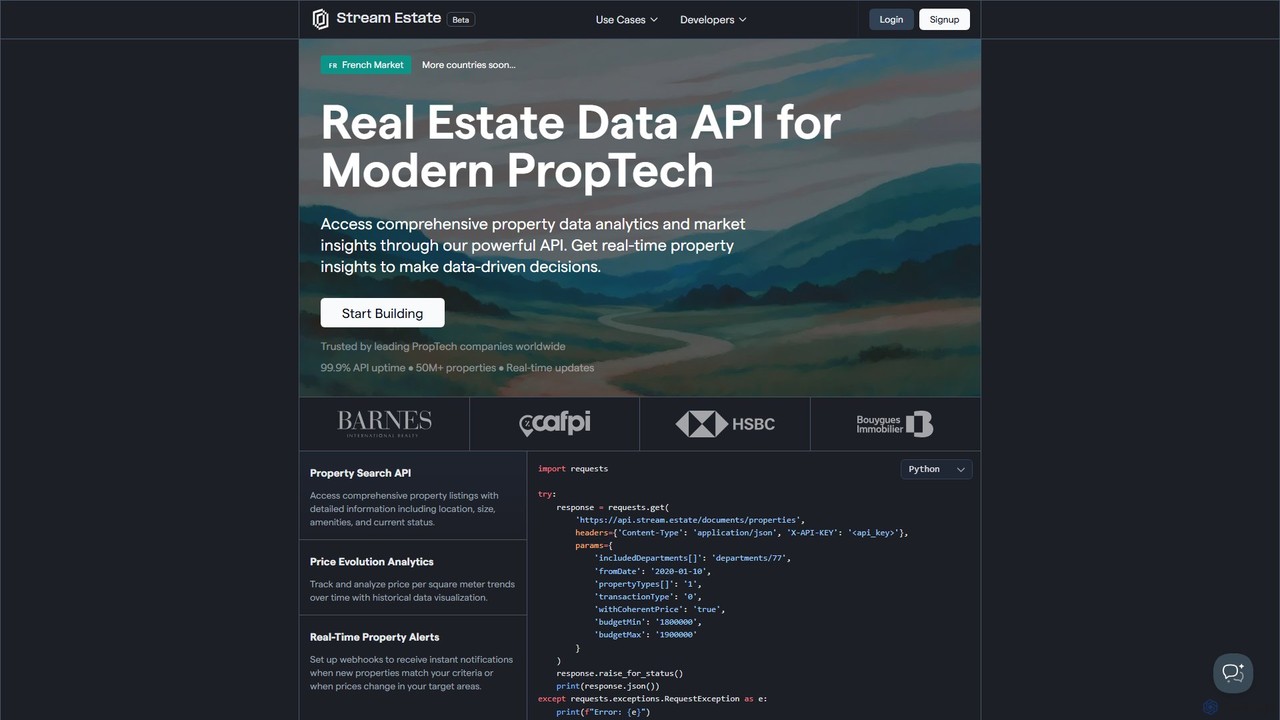
Stream.Estate
A powerful Real Estate Data API designed for modern PropTech companies. It provides comprehensive, real-time property data, market …
A powerful Real Estate Data API designed for modern PropTech companies. It provides comprehensive, real-time property data, market analytics, and AI-powered insights to facilitate data-driven decisions. Access over 50 million properties, primarily in the European market, with high uptime and developer-friendly tools.
About Api
AI API tools provide programmatic access to powerful, pre-trained artificial intelligence models. These tools function as a bridge, allowing developers to integrate advanced capabilities like natural language processing, computer vision, or data analysis directly into their own applications without needing to build or train models from scratch. By making simple HTTP requests, applications can leverage sophisticated AI to perform complex tasks, significantly accelerating development cycles and reducing infrastructure costs. This approach democratizes access to cutting-edge AI, enabling businesses of all sizes to build intelligent features and services.
Core Features
- Pre-trained Model Access: Offers immediate access to state-of-the-art models for tasks like text generation, image recognition, and translation.
- Scalable Endpoints: Provides managed, auto-scaling infrastructure that handles fluctuating request volumes reliably.
- Usage-Based Pricing: Features flexible pay-per-call or pay-per-token pricing models, making it cost-effective for projects of any scale.
- Developer SDKs & Documentation: Includes comprehensive guides, code samples, and software development kits (SDKs) for easy integration.
- Specialized Functionality: Offers dedicated endpoints for specific tasks, such as sentiment analysis, object detection, or speech-to-text conversion.
Use Cases
AI APIs are primarily used by software developers, product teams, and data scientists to build AI-powered features. Common applications include embedding intelligent chatbots in customer service platforms, automating content moderation on social media, adding voice command capabilities to applications, or creating personalized recommendation engines for e-commerce sites.
How to Choose
When selecting an AI API, consider the model's accuracy and performance for your specific task. Evaluate the quality of the documentation and the availability of SDKs for your programming language. Analyze the pricing structure to ensure it aligns with your expected usage. Finally, check the API's latency, uptime guarantees (SLA), and data privacy policies to ensure it meets your application's reliability and security requirements.
ApiUse Cases
Build an Intelligent Customer Support Chatbot
A developer for an e-commerce company is tasked with reducing customer support tickets. By integrating a conversational AI API, they can build a chatbot for their website. This bot uses the API's natural language understanding (NLU) to interpret user queries about order status, return policies, and product information. The API processes the request, retrieves the necessary information from the company's database, and generates a human-like response. This automates responses to over 60% of common inquiries, freeing up human agents to handle more complex issues.
Automate Content Moderation on a Platform
A product manager for a social media platform needs to ensure a safe user environment. They use a content moderation API to automatically scan user-generated text and images. When a user uploads content, it is sent to the API, which uses computer vision and text analysis models to detect hate speech, violence, or other policy violations. If a violation is found, the content is automatically flagged for review or removed, reducing the manual workload for the moderation team and enabling faster response to harmful content.
Extract Data from Invoices and Receipts
An accounting firm processes thousands of invoices and receipts monthly. A developer integrates a document intelligence API into their internal software. Employees can now upload a scanned document, and the API uses Optical Character Recognition (OCR) and entity recognition models to automatically identify and extract key information like vendor name, invoice number, date, and total amount. This data is then structured into a JSON format and populated directly into their accounting system, eliminating manual data entry and reducing errors by over 95%.
Add Real-Time Translation to a Mobile App
A startup is developing a travel application and wants to include a real-time translation feature. Instead of building a complex translation system, their mobile developer integrates a translation API. When a user speaks or types a phrase, the app sends the text to the API endpoint along with the target language. The API processes the request using its advanced neural machine translation models and returns the translated text in milliseconds. This allows the app to offer accurate, real-time translation in over 100 languages, significantly enhancing its value proposition with minimal development effort.
Enable Visual Search in E-commerce
An online fashion retailer wants to improve product discovery. A developer implements a visual search feature using an image recognition API. A user can now upload a photo of an item they like. The app sends this image to the API, which analyzes it to identify attributes like clothing type (e.g., 'dress'), color ('red'), and pattern ('floral'). The API returns these tags, which are then used to query the retailer's product catalog and display visually similar items to the user, creating a more intuitive and engaging shopping experience.
Generate Personalized Marketing Copy
A marketing agency needs to create diverse ad copy for multiple client campaigns. A marketer uses a text generation API integrated into a custom dashboard. They input key product features, target audience (e.g., 'young professionals'), and desired tone ('witty'). The API generates dozens of variations of headlines, body text, and calls-to-action. This allows the team to A/B test different messages at scale, optimizing campaign performance without spending hours on manual copywriting, and increasing ad engagement by up to 30%.