ToolMage
Sign in

Best 1 Model Repository AI tools for Image

Popular Model Repository AI tools in Image include Civitai, helping you work more efficiently.

Civitai
Freemium

Civitai

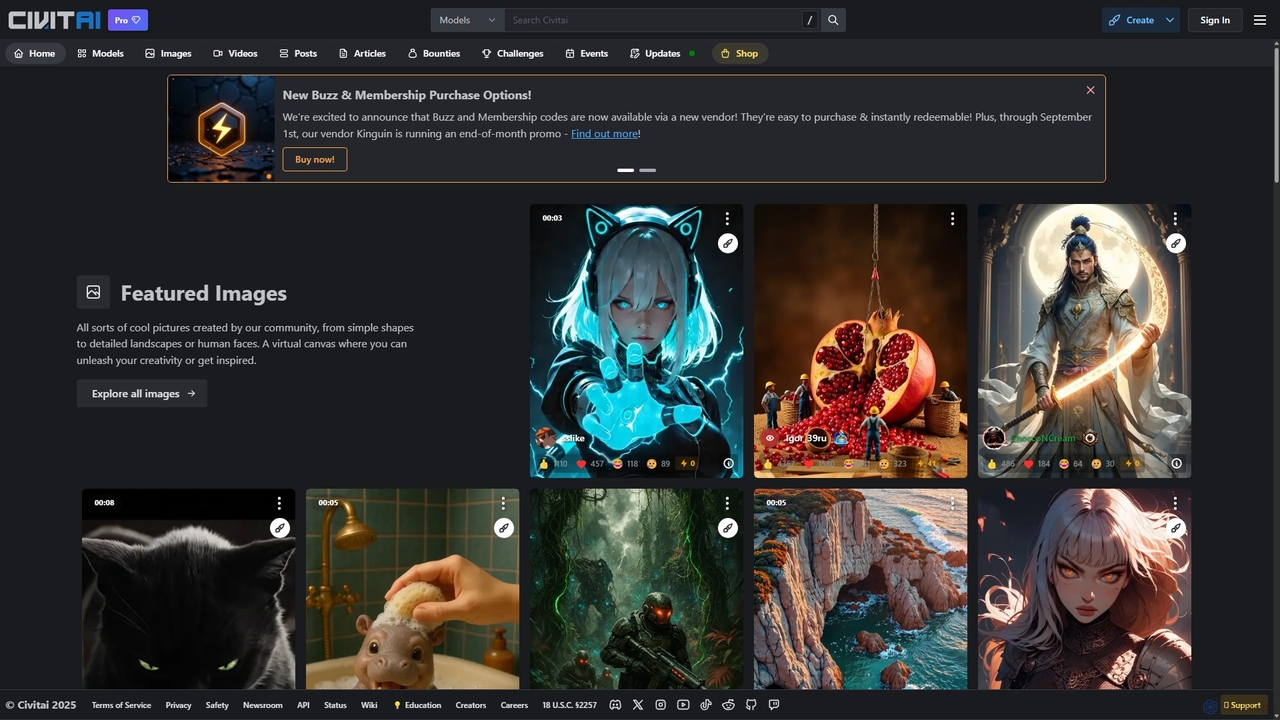
Civitai is the leading hub for the open-source generative AI community. It serves as a massive repository for discovering, sharing, and downloading AI models like Stable Diffusion checkpoints and LoRAs. The platform also features an integrated AI image and video generator, allowing users to create content directly on the site, fostering a vibrant ecosystem for AI artists, developers, and enthusiasts.

Creative Communities
Visits 7.6MFavorites 115Likes 120

About Model Repository

A Model Repository is a specialized platform for storing, managing, and sharing pre-trained or custom AI models, particularly those used in image processing and generation. These repositories provide version control, metadata management, and often deployment capabilities, enabling developers and researchers to efficiently discover, reuse, and collaborate on image-related AI assets. They streamline the lifecycle of AI models, from development to deployment, significantly accelerating innovation in computer vision and generative AI applications.

Core Features

  • Model Versioning: Tracks changes and manages different iterations of AI models, ensuring reproducibility and easy rollback.
  • Metadata Management: Stores crucial information about each model, including architecture, training data, performance metrics, and licensing.
  • Model Discovery: Offers search and filtering capabilities to easily find relevant pre-trained or custom image models for specific tasks.
  • Access Control: Manages permissions for who can view, download, or contribute models, facilitating secure collaboration.
  • Deployment Integration: Often provides APIs or direct integrations for deploying models into various applications or cloud environments.

Use Cases

Model repositories are essential for teams developing AI solutions for image analysis, generation, and manipulation. They serve as a central hub for machine learning engineers to store and retrieve image classification models, for data scientists to share generative adversarial networks (GANs), and for researchers to publish their latest computer vision breakthroughs, ensuring consistency and accessibility across projects.

How to Choose

When selecting a Model Repository, consider its compatibility with your existing MLOps pipeline, the types of image models it supports (e.g., TensorFlow, PyTorch), its scalability for large model collections, security features for sensitive data, and the ease of integration with deployment tools. Evaluate its community support for pre-trained models and its cost-effectiveness for your team's needs.

Featured tool rankings

Model Repository use cases

1

Sharing Custom Image Generation Models

AI artists and developers can upload their unique image generation models (e.g., Stable Diffusion fine-tunes, custom GANs) to a repository. This allows them to share their creations with a community, collaborate on improvements, or make them available for commercial use, fostering innovation in generative AI art and design.

2

Accessing Pre-trained Computer Vision Models

Machine learning engineers working on object detection or image classification projects can quickly browse and download pre-trained models from a repository. This saves significant time and computational resources compared to training models from scratch, enabling rapid prototyping and deployment of vision-based AI applications.

3

Versioning AI Models for Image Style Transfer

Researchers experimenting with different image style transfer algorithms can use a model repository to manage various versions of their models. This ensures that each iteration, along with its performance metrics and associated code, is meticulously tracked, allowing for easy comparison, reproducibility, and rollback to previous successful versions.

4

Collaborating on Image Segmentation Model Development

Data science teams can leverage a model repository to collaboratively develop and refine image segmentation models for medical imaging or autonomous driving. Team members can upload their trained model components, review others' contributions, and integrate them into a unified solution, accelerating complex model development cycles.

5

Deploying Optimized Image Recognition Models

Enterprises can store their production-ready image recognition models, optimized for specific tasks like quality control in manufacturing or facial recognition, in a repository. This facilitates seamless integration with deployment pipelines, ensuring that the latest, most performant models are consistently used in live applications.

6

Benchmarking Different Image Enhancement Models

Developers seeking to improve image quality can use a model repository to host and compare various image enhancement or super-resolution models. By standardizing the storage and access, they can systematically benchmark different approaches on common datasets, identifying the most effective models for their specific visual applications.

Model Repository FAQ

What is an AI Model Repository for images?

An AI Model Repository for images is a centralized platform designed to store, manage, and distribute artificial intelligence models specifically trained for computer vision and image processing tasks. It provides tools for version control, metadata tracking, and often facilitates the discovery and deployment of models like image classifiers, object detectors, and generative models. This helps streamline the development and application of AI in visual domains.

How do I choose the right Model Repository for my image AI projects?

When selecting a Model Repository for image AI, consider its support for popular deep learning frameworks (e.g., PyTorch, TensorFlow), its scalability for large model files, and its integration capabilities with MLOps tools. Evaluate its security features, access control mechanisms, and whether it offers robust metadata management for tracking model performance and lineage. Community support and pricing models are also crucial factors.

What are the key benefits of using a Model Repository for image-related AI?

Using a Model Repository for image AI offers several benefits: it ensures model reproducibility through version control, simplifies collaboration among teams by centralizing assets, and accelerates deployment by providing standardized access. It also enhances model discovery, reduces redundant training efforts, and improves governance by tracking model lineage and performance metrics, leading to more efficient and reliable AI development.

How does a Model Repository differ from a general code repository for image AI projects?

While a general code repository (like Git) stores code, a Model Repository is specifically optimized for large, binary AI model files and their associated metadata. It provides specialized features like model versioning, performance metric tracking, framework compatibility, and deployment integration, which are not typically found in standard code repositories. It focuses on the model artifact itself, rather than just the code that generates it.

Who typically uses Model Repositories for image AI models?

Model Repositories for image AI models are primarily used by machine learning engineers, data scientists, AI researchers, and MLOps teams. These professionals leverage repositories to manage the lifecycle of image classification, object detection, segmentation, and generative models. They use them for sharing, versioning, deploying, and collaborating on AI models across various visual computing applications, from academic research to industrial solutions.