Infrastructure Best in category 2 results Machine Learning AI Tool

Popular AI tools in the Machine Learning field of Infrastructure include DigitalOcean、Inception Labs, etc., helping you quickly improve efficiency.

DigitalOcean

DigitalOcean

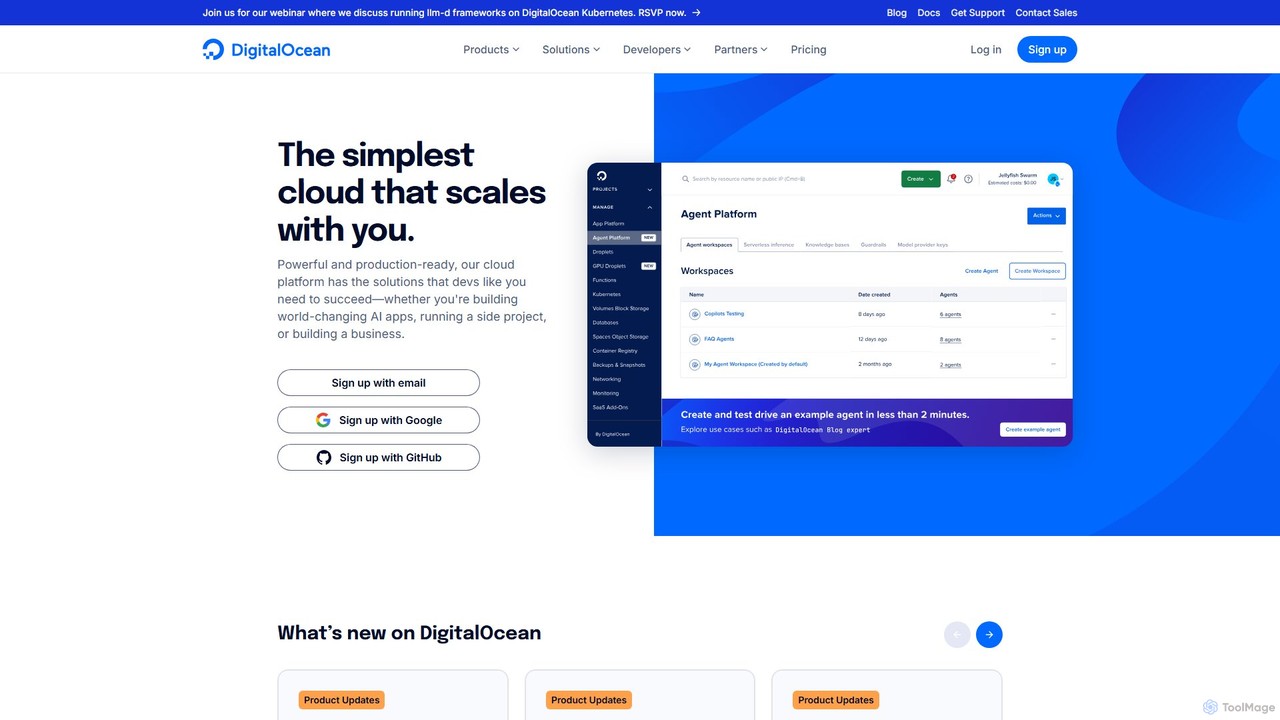
DigitalOcean is a developer-focused cloud infrastructure platform that simplifies building, deploying, and scaling applications. It offers a comprehensive …

4.7M
Inception Labs

Inception Labs

Inception Labs introduces a new generation of Diffusion Large Language Models (dLLMs) that are up to 10x faster …

243.7K

About Machine Learning

Machine Learning tools are platforms and frameworks designed to build, train, and deploy predictive models. As a core component of AI infrastructure, these tools enable systems to learn from data, identify patterns, and make decisions with minimal human intervention. Their primary value lies in creating intelligent applications that can forecast trends, classify information, and automate complex processes. Many platforms integrate the entire MLOps (Machine Learning Operations) lifecycle, from data preparation to model monitoring in production.

Core Features

  • Model Training & Tuning: Provides environments and algorithms for training models on datasets and optimizing their performance through hyperparameter tuning.
  • Data Preprocessing: Includes functionalities for cleaning, transforming, normalizing, and labeling raw data to make it suitable for model training.
  • Model Deployment & Serving: Offers infrastructure to deploy trained models as scalable APIs, allowing them to be integrated into other applications.
  • Experiment Tracking: Allows users to log, compare, and manage different model versions, parameters, and results to ensure reproducibility.
  • Algorithm Libraries: Contains pre-built and optimized algorithms for various tasks like classification, regression, and clustering.

Applicable Scenarios

Machine Learning tools are essential for data scientists, ML engineers, and AI researchers across various industries. In finance, they are used for fraud detection and algorithmic trading. E-commerce companies leverage them for building product recommendation engines and predicting customer churn. In healthcare, these tools assist in medical image analysis and disease prediction.

Selection Criteria

When choosing a Machine Learning tool, consider the supported frameworks (e.g., TensorFlow, PyTorch, Scikit-learn) and their compatibility with your existing stack. Evaluate the platform's scalability for handling large datasets and complex computations. Assess its MLOps capabilities for end-to-end model lifecycle management. Finally, consider the user interface and required technical expertise, distinguishing between code-first platforms for engineers and low-code solutions for analysts.

Machine LearningUse Cases

1

Building an E-commerce Product Recommendation Engine

A data scientist at an online retail company uses a machine learning platform to develop a personalized recommendation system. They begin by using the platform's data preprocessing tools to clean and format historical user purchase and browsing data. Next, they experiment with various collaborative filtering algorithms from the built-in library, tracking each experiment's performance. After selecting the best-performing model, they use the platform's deployment features to serve it as a real-time API on the website, increasing user engagement and sales by over 15%.

2

Developing a Real-Time Fraud Detection System

A machine learning engineer at a fintech company is tasked with reducing fraudulent transactions. Using an ML platform, they access and prepare a massive dataset of labeled transactions. They train a classification model (like a gradient boosting tree) to distinguish between legitimate and fraudulent activities in real-time. The platform's experiment tracking helps them compare dozens of model variations. The final model is deployed as a low-latency microservice that analyzes transactions as they occur, successfully blocking over 98% of fraudulent attempts without impacting legitimate user experience.

3

Predictive Maintenance for Industrial Machinery

An operations manager in a manufacturing plant aims to prevent costly equipment failures. They use an ML platform to analyze sensor data (temperature, vibration, pressure) from their machinery. A time-series forecasting model is trained to predict the probability of a component failure in the next 100 hours. The platform automates the data ingestion and model retraining pipeline. When the model predicts a high failure risk, it automatically creates a maintenance ticket, allowing technicians to perform proactive repairs and reducing unplanned downtime by 40%.

4

Analyzing Customer Sentiment from Reviews

A product manager wants to understand public perception of a new product. They use an ML platform with Natural Language Processing (NLP) capabilities to analyze thousands of online reviews. They fine-tune a pre-trained sentiment analysis model on a small set of their own labeled data to improve its accuracy for their specific domain. The platform processes the reviews and visualizes the results, showing that while 'features' are rated positively, 'customer support' is a major point of negative sentiment. This insight directly informs their next product roadmap and support team training.

5

Optimizing Logistics and Delivery Routes

A logistics company aims to reduce fuel costs and delivery times. A data scientist uses an ML platform to build a route optimization model. The model is trained on historical traffic data, delivery locations, vehicle capacity, and weather patterns. They use a reinforcement learning algorithm to find the most efficient multi-stop routes for their fleet of drivers. The platform allows for easy integration with their existing GPS and dispatch systems. After deployment, the company achieves a 12% reduction in fuel consumption and improves on-time delivery rates significantly.

6

Automating Medical Image Diagnosis

A team of AI researchers in a hospital is developing a system to assist radiologists. They use a specialized machine learning platform for medical imaging to train a deep learning model (a Convolutional Neural Network) on thousands of anonymized X-ray images. The model learns to identify potential signs of specific diseases. The platform provides tools for precise image annotation and ensures compliance with healthcare data privacy regulations. The resulting model, when deployed, acts as a second opinion for radiologists, highlighting areas of concern and improving diagnostic accuracy by over 10%.

Machine LearningFrequently Asked Questions