Chord ai
Chord ai is an AI-powered mobile app that instantly analyzes any song to provide accurate chords, tempo, and …
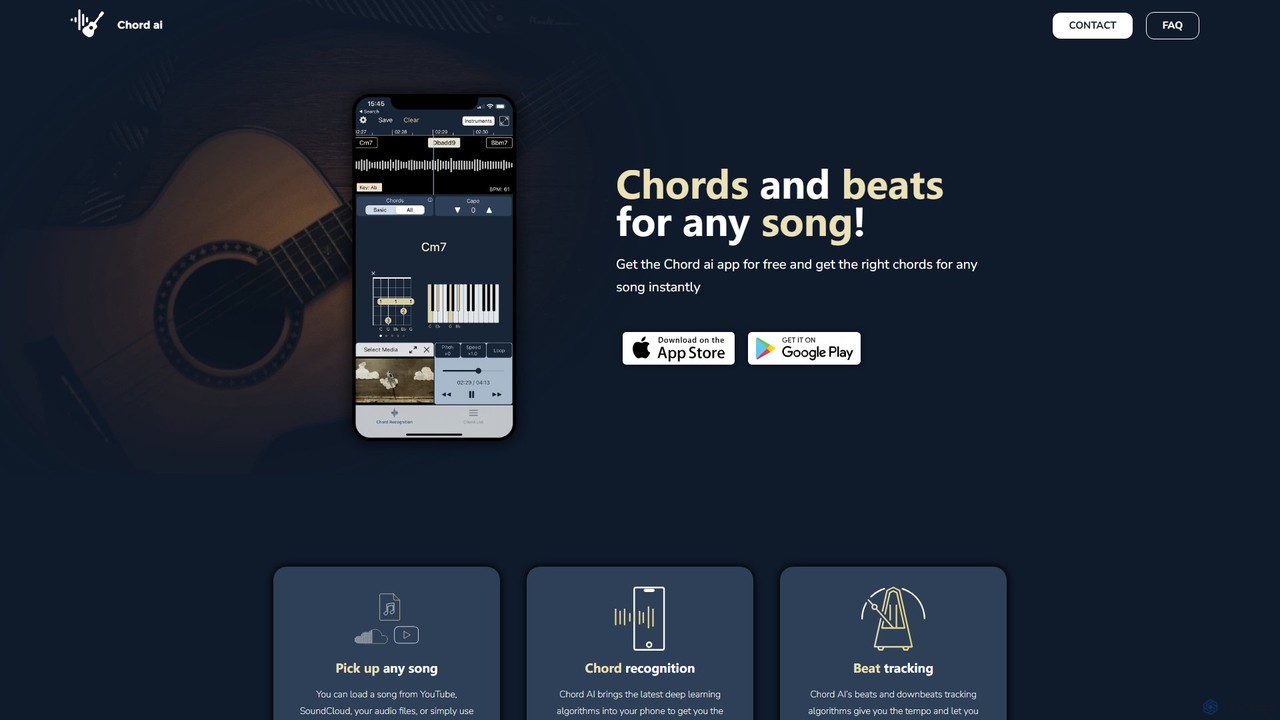
Chord ai is an AI-powered mobile app that instantly analyzes any song to provide accurate chords, tempo, and beats. Using deep learning, it transcribes music from YouTube, SoundCloud, audio files, or live input, making it an essential tool for musicians to learn, practice, and analyze songs.
About Transcription
Transcription tools are AI-powered solutions that convert audio into written text or musical notation. Leveraging advanced speech recognition and music information retrieval, these tools accurately process complex sound patterns from various sources, including spoken dialogue, instrumental performances, and full songs. They are invaluable for musicians, researchers, and content creators needing to document or analyze audio content efficiently, streamlining the creation of sheet music, lyrics, or textual records. This technology significantly enhances accessibility, analytical capabilities, and creative workflows for audio-based content across various domains.
Core Features
- Automatic Speech Recognition (ASR): Converts spoken words from audio into accurate, editable text, making it ideal for transcribing song lyrics, spoken introductions, or dialogue within musical pieces.
- Music Notation Generation: Automatically transcribes melodies, harmonies, and rhythms into standard musical notation, including staves, notes, rests, and time signatures, facilitating sheet music creation.
- Instrument Separation: Utilizes advanced algorithms to isolate individual instrument tracks (e.g., vocals, drums, bass, guitar) from a mixed audio file, allowing for focused analysis or remixing.
- Chord Detection and Analysis: Automatically identifies and labels chord progressions played in a musical piece, providing valuable insights for musicians learning songs or analyzing compositions.
- Tempo and Key Analysis: Accurately determines the tempo (BPM) and musical key of an audio recording, which is crucial for musical analysis, performance, and arrangement.
Applicable Scenarios
Musicians extensively use these tools to learn new songs by generating sheet music or tablature from recordings, or to accurately document their own original compositions. Music educators can efficiently create teaching materials and examples by transcribing complex musical passages. Furthermore, content creators leverage these tools for generating precise subtitles or lyrics for music videos, podcasts, and interviews, significantly enhancing accessibility and improving search engine optimization.
Key Selection Points
When selecting an AI transcription tool, it's crucial to consider the primary output needed: whether it's text for lyrics and speech, or detailed musical notation. Evaluate the tool's accuracy for your specific audio types, such as complex instrumental pieces, clear vocals, or mixed audio. Look for support for various audio formats, robust instrument separation capabilities, and potential integration with other music production or editing software. User interface intuitiveness, processing speed, and the pricing model are also critical factors for a seamless and cost-effective workflow.
TranscriptionUse Cases
Generate Sheet Music for Song Learning
A guitarist wants to learn a new song but can't find the sheet music or tabs. Using an AI transcription tool, they upload the song's audio, and the tool generates accurate musical notation or tablature, including chords and rhythm. This saves hours of manual ear training and allows them to quickly practice and master the piece, accelerating their learning process significantly.
Transcribe Original Musical Ideas
A composer records a melody or a chord progression idea on their phone. Instead of manually writing it down, they use an AI transcription tool to convert the audio into standard musical notation. This ensures their creative ideas are accurately documented, making it easier to share with collaborators or develop further without losing intricate details, preserving their artistic vision.
Produce Accurate Lyrics for Music Videos
A music artist releases a new song and wants to add synchronized lyrics to their music video for accessibility and fan engagement. An AI transcription tool processes the vocal track, generating precise text lyrics that can then be easily integrated into video editing software, ensuring high accuracy even with complex vocal arrangements and enhancing viewer experience.
Analyze Music Structure and Harmony
A musicology student needs to analyze the harmonic structure and melodic patterns of a specific classical piece. They feed the audio into an AI transcription tool that provides detailed musical notation, chord progressions, and even tempo maps. This allows for in-depth study and identification of musical themes and variations more efficiently than manual transcription, supporting academic research.
Separate Instruments for Remixing
A DJ or music producer wants to remix a song but needs individual instrument stems (e.g., just the drums or bassline). An AI transcription tool with instrument separation capabilities can isolate these tracks from the original mix. This provides clean audio for each instrument, enabling creative remixing, focused practice on specific parts, or sampling for new productions.
Create Subtitles for Spoken Word Content
A podcaster or spoken word artist wants to make their content accessible to a wider audience, including those with hearing impairments or non-native speakers. They use an AI transcription tool to convert their audio recordings into accurate text subtitles. This not only improves accessibility but also boosts SEO for their content on platforms like YouTube, expanding their reach.