ToolMage
Sign in

Best 1 Information Aggregation AI tools for News

Popular Information Aggregation AI tools in News include Summate.it, helping you work more efficiently.

Summate.it
Freemium

Summate.it

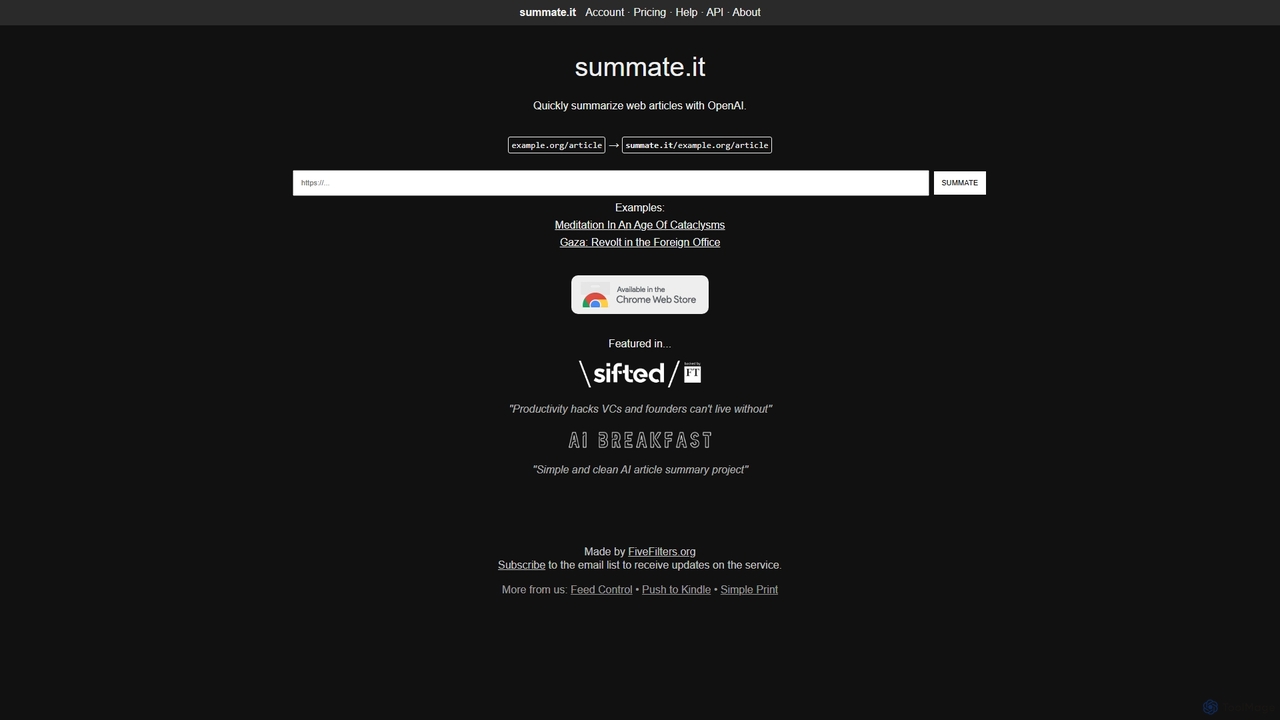
Summate.it is an AI-powered tool that quickly summarizes web articles. Simply provide a URL, and it uses OpenAI to generate concise, easy-to-understand summaries, helping you absorb key information in a fraction of the time. It also offers a Chrome extension, API access, and summary translation.

Research
Visits 5.8KFavorites 129Likes 122

About Information Aggregation

Information Aggregation tools are AI-powered platforms designed to systematically collect, process, and present data from diverse sources into a unified, digestible format. Leveraging advanced AI algorithms, these tools excel at filtering noise, identifying key trends, and summarizing vast amounts of information, enabling users to stay informed and make data-driven decisions efficiently, particularly within the dynamic landscape of news and media analysis.

Core Features

  • Automated Data Collection: Gathers information from a wide array of sources including news sites, social media, blogs, forums, and databases.
  • Intelligent Filtering & Curation: Uses AI to filter content based on relevance, sentiment, topic, and user-defined criteria, reducing information overload.
  • Content Summarization: Automatically extracts key points and generates concise summaries or abstracts from lengthy articles and reports.
  • Real-time Monitoring & Alerts: Provides instant notifications for breaking news, trending topics, or specific keyword mentions across monitored sources.
  • Personalized Feeds & Dashboards: Offers customizable interfaces and feeds tailored to individual user interests, roles, or organizational needs.

Applicable Scenarios

Information Aggregation tools are invaluable for professionals across various sectors. Journalists use them to track breaking stories and competitor coverage, while marketing teams leverage them for competitive intelligence and brand monitoring. Researchers and analysts utilize these tools to gather comprehensive data for market trends and academic studies, ensuring they have a holistic view of their respective fields.

How to Choose

When selecting an AI Information Aggregation tool, consider the breadth and depth of its source coverage, the accuracy and sophistication of its AI filtering and summarization capabilities, and its customization options for feeds and alerts. Evaluate its real-time processing speed, integration potential with existing workflows, and overall user-friendliness to ensure it meets your specific information needs.

Information Aggregation use cases

1

Competitive Intelligence & Brand Monitoring

Marketing and PR teams utilize AI information aggregation tools to continuously monitor news outlets, social media, and industry blogs for mentions of their brand, competitors, and relevant industry keywords. This enables them to quickly identify emerging threats, track sentiment, analyze competitor strategies, and respond proactively to maintain brand reputation and competitive edge.

2

Industry Trend Spotting & Market Research

Market researchers and business analysts leverage these tools to aggregate reports, news articles, and academic papers from various sources, identifying emerging industry trends, shifts in consumer behavior, and technological advancements. By synthesizing vast amounts of data, they gain comprehensive insights to inform strategic planning and investment decisions, saving significant time compared to manual research.

3

Personalized News & Content Curation

Individuals and professionals can configure AI aggregation tools to deliver highly personalized news feeds and content digests based on their specific interests, job roles, or learning objectives. This eliminates the need to visit multiple websites, ensuring they receive only the most relevant and high-priority information directly to their preferred dashboard or email, significantly reducing information overload.

4

Crisis Communication & Reputation Management

PR and corporate communications teams deploy AI aggregation tools for real-time monitoring of news, social media, and online forums for any negative mentions or emerging crises. The tools provide instant alerts and sentiment analysis, allowing teams to detect potential issues early, assess their impact, and formulate rapid, informed responses to protect the organization's reputation.

5

Content Idea Generation for Publishers

Content creators, journalists, and publishers utilize AI aggregation tools to identify trending topics, popular articles, and audience engagement patterns across various news and social platforms. By analyzing what content resonates most, they can generate fresh, relevant content ideas, optimize their editorial calendar, and produce stories that are more likely to capture audience interest and drive traffic.

6

Academic Research & Literature Review

Academics and researchers employ AI information aggregation tools to efficiently gather and synthesize new publications, patents, and research news relevant to their specific fields. These tools can automatically identify and summarize key findings from vast scientific databases and journals, significantly accelerating the literature review process and ensuring researchers stay abreast of the latest advancements without manual, time-consuming searches.

Information Aggregation FAQ

What are AI Information Aggregation tools?

AI Information Aggregation tools are platforms that use artificial intelligence to automatically gather, process, and organize data from various online sources like news sites, social media, and blogs. They go beyond simple collection by employing AI for intelligent filtering, summarization, and trend detection, providing users with curated, relevant, and digestible information to make informed decisions.

How do AI Information Aggregation tools differ from standard news readers?

While standard news readers typically display content from a pre-selected set of sources, AI Information Aggregation tools actively *process* and *synthesize* information from a much broader, often dynamic, range of sources. They use AI to filter for relevance, summarize content, detect trends, and personalize feeds, offering deeper insights and reducing information overload compared to a simple display of articles.

What are the main benefits of using AI for Information Aggregation?

The primary benefits include significant time savings by automating data collection and processing, comprehensive insights from diverse sources, and reduced information overload through intelligent filtering and summarization. AI also enables real-time trend detection, personalized content delivery, and enhanced decision-making by providing a curated, holistic view of relevant information, making it indispensable for staying competitive and informed.

Who can benefit most from AI Information Aggregation tools?

A wide range of professionals can benefit, including journalists and media analysts for breaking news and trend spotting; marketing and PR teams for competitive intelligence and brand monitoring; business analysts and market researchers for industry insights; and academic researchers for literature reviews. Essentially, anyone who needs to efficiently consume, analyze, and act upon large volumes of diverse information will find these tools invaluable.

How to choose the right AI Information Aggregation tool?

To select the best tool, evaluate its source coverage (breadth and depth), the accuracy and sophistication of its AI for filtering, summarization, and sentiment analysis, and its customization options for dashboards and alerts. Consider its real-time processing capabilities, ease of integration with your existing workflows, scalability for future needs, and overall user interface. A free trial can also help assess its suitability for your specific requirements.