ToolMage
Sign in

Best 1 Data Control AI tools for Privacy

Popular Data Control AI tools in Privacy include BYOKList, helping you work more efficiently.

BYOKList
Free

BYOKList

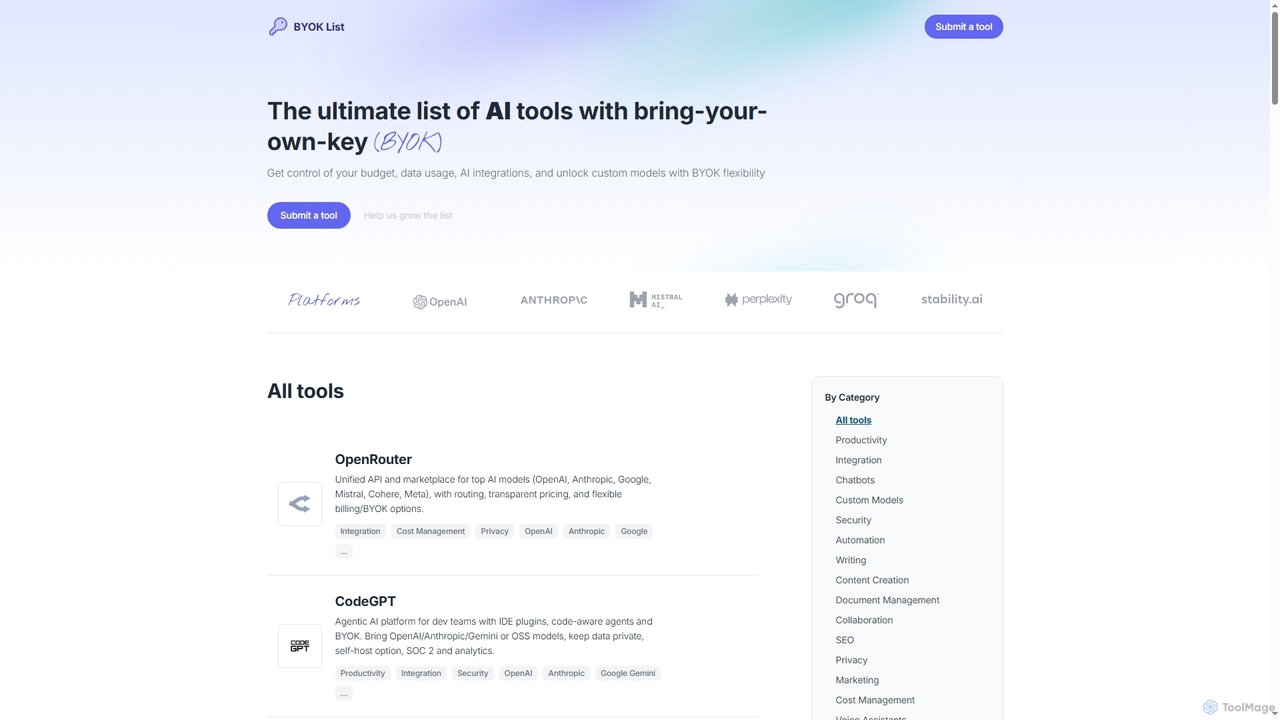
BYOKList is the ultimate directory for discovering AI tools that support Bring-Your-Own-Key (BYOK) functionality. It empowers users to manage their budget, data usage, and AI integrations, while also enabling access to custom models with enhanced flexibility.

Ai Resource
Visits 10.7KFavorites 96Likes 92

About Data Control

Data Control AI tools are specialized solutions designed to manage, monitor, and enforce policies over data, particularly sensitive or personal information, within AI systems and applications. These tools are crucial for ensuring data privacy, regulatory compliance, and building user trust by providing granular control over how data is collected, processed, and utilized. They act as a vital component within the broader privacy framework, empowering organizations to actively govern their data assets.

Core Features

  • Consent Management: Track, manage, and enforce user consent for data collection and processing across AI applications.
  • Access Control: Define and manage granular permissions for who can access, modify, or delete specific datasets used by AI models.
  • Data Anonymization & Pseudonymization: Apply techniques to mask or de-identify sensitive data, allowing AI training while protecting individual privacy.
  • Usage Monitoring & Auditing: Log and monitor how AI models and users interact with data, providing transparency and audit trails for compliance.
  • Data Erasure & Portability: Facilitate the fulfillment of data subject rights, such as the right to be forgotten or to data portability.

Applicable Scenarios

Organizations across various sectors leverage Data Control tools to navigate complex data landscapes. This includes companies needing to comply with regulations like GDPR or CCPA, AI developers training models with sensitive user data, and enterprises aiming to establish robust data governance frameworks for their AI initiatives.

How to Choose

When selecting a Data Control AI tool, prioritize solutions with strong compliance features tailored to relevant regulations, robust integration capabilities with existing data infrastructure and AI platforms, and granular control mechanisms for data access and usage. Additionally, evaluate the quality of reporting and auditing functionalities to ensure transparency and accountability in data handling.

Featured tool rankings

Data Control use cases

1

Ensuring GDPR Compliance for Customer Data

A Data Protection Officer (DPO) at an e-commerce company uses Data Control AI tools to manage customer consent preferences, automate responses to data access requests (DSARs), and ensure timely data deletion. By centralizing these processes, the DPO can efficiently demonstrate compliance with GDPR, reducing legal risks and building stronger trust with customers regarding their personal data handling.

2

Anonymizing Datasets for AI Model Training

An AI/ML engineer needs to train a new recommendation engine using sensitive customer purchase history. They employ Data Control tools to apply advanced anonymization and pseudonymization techniques to the dataset before feeding it to the AI model. This ensures that individual customer identities are protected, allowing for ethical model development while maintaining the utility and statistical integrity of the data for training purposes.

3

Managing Access to Sensitive Healthcare Records

A healthcare IT administrator utilizes Data Control AI tools to implement granular access policies for patient medical records. This ensures that only authorized medical staff can view or modify specific parts of a patient's file, based on their role and need-to-know basis. The system also logs all access attempts and modifications, providing a comprehensive audit trail essential for HIPAA compliance and maintaining patient confidentiality.

4

Monitoring AI Model Data Usage in Financial Services

A Risk & Compliance Analyst at a financial institution employs Data Control AI tools to continuously monitor how AI models, such as those used for fraud detection or credit scoring, access and process customer financial data. This allows them to detect any unauthorized data access patterns or deviations from established data usage policies, ensuring regulatory compliance (e.g., PCI DSS) and preventing potential misuse of sensitive financial information.

5

Facilitating Data Portability Requests for Users

A customer support team at a social media platform uses Data Control AI tools to efficiently handle user requests for data portability. When a user wants to download all their personal data in a structured, commonly used, and machine-readable format, the tool automates the extraction and packaging process. This streamlines compliance with regulations like GDPR Article 20, empowering users with greater control over their digital footprint and improving operational efficiency.

6

Enforcing Data Minimization Policies for New AI Applications

A product development team launching a new AI-powered application uses Data Control tools to enforce data minimization principles from the design phase. The tool helps identify and restrict the collection of only essential data points required for the AI's functionality, preventing over-collection of sensitive information. This proactive approach reduces the overall data footprint, lowers privacy risks, and simplifies future compliance efforts, ensuring the application is privacy-by-design.

Data Control FAQ

What are Data Control AI tools?

Data Control AI tools are specialized software solutions that enable organizations to manage, monitor, and enforce policies over data used by AI systems. They typically feature functionalities like consent management, access control, data anonymization, and usage auditing. Their primary purpose is to ensure data privacy, regulatory compliance (e.g., GDPR, CCPA), and ethical AI development by giving users and organizations granular control over data lifecycle within AI applications.

Why is Data Control important for AI systems?

Data Control is crucial for AI systems because it addresses fundamental concerns around privacy, ethics, and compliance. Without robust data control, AI models could inadvertently expose sensitive information, be trained on biased or non-consented data, or operate in ways that violate data protection laws. Implementing data control ensures that AI systems are developed and deployed responsibly, fostering user trust and mitigating legal and reputational risks for organizations.

How do Data Control tools differ from general Privacy Management tools?

While both Data Control and Privacy Management tools aim to protect data, Data Control tools focus specifically on the *active mechanisms and technical enforcement* of data policies within AI systems. Privacy Management is a broader concept encompassing policies, legal frameworks, and ethical guidelines. Data Control tools provide the granular, operational capabilities (e.g., access rules, anonymization features, audit trails) that *implement* the strategic goals set by a comprehensive privacy management framework, making them a crucial, hands-on component of overall privacy strategy.

What key features should I look for in a Data Control tool?

When evaluating Data Control tools, prioritize features such as comprehensive consent management (tracking, revocation), robust access control (role-based, attribute-based), and advanced data anonymization/pseudonymization capabilities. Look for strong auditing and reporting functionalities to demonstrate compliance, seamless integration with your existing AI and data infrastructure, and support for relevant global and local data protection regulations. Scalability and ease of use are also important considerations for long-term effectiveness.

Who benefits most from implementing Data Control AI tools?

Organizations that handle large volumes of sensitive or personal data, such as those in healthcare, finance, e-commerce, and social media, benefit most from Data Control AI tools. Data Protection Officers (DPOs), legal and compliance teams, AI/ML engineers, and product managers also gain significant advantages. These tools help them navigate complex regulatory landscapes, build ethical AI systems, reduce legal and reputational risks, and ultimately foster greater trust with their users and customers.