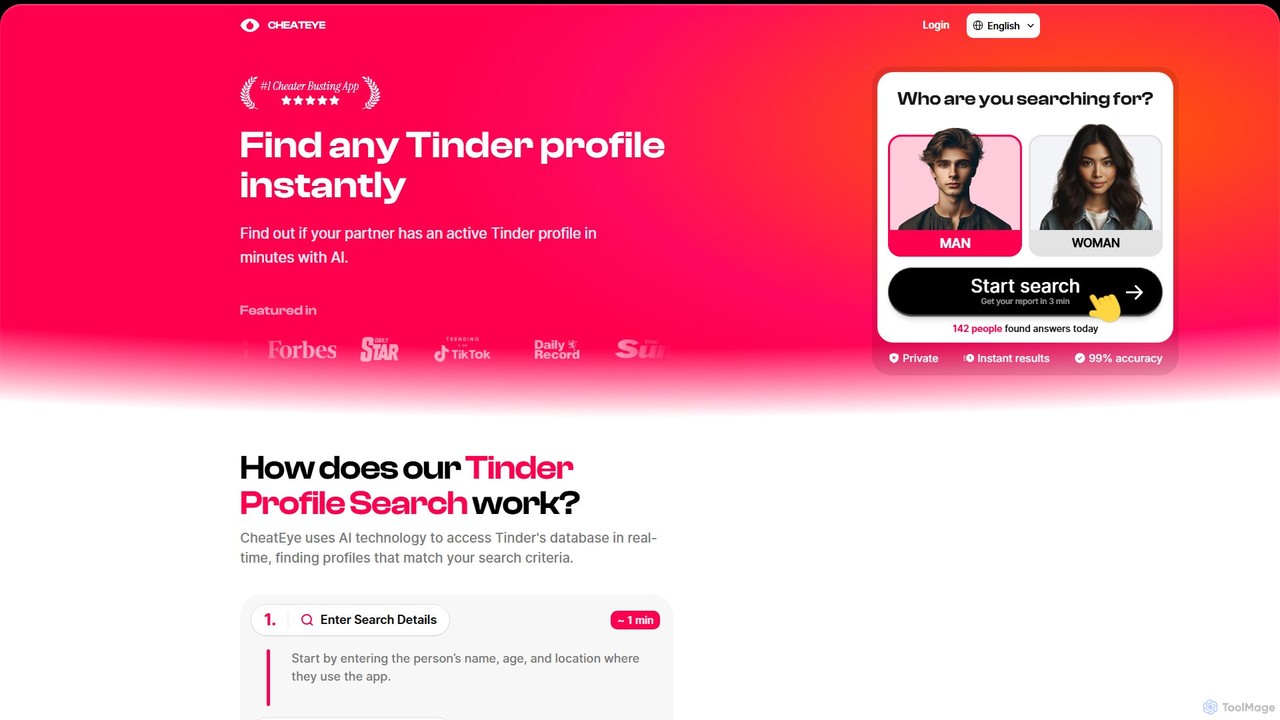
CheatEye
CheatEye is an AI-powered search engine designed to instantly and discreetly find anyone's Tinder profile. It helps users …
CheatEye is an AI-powered search engine designed to instantly and discreetly find anyone's Tinder profile. It helps users uncover potential infidelity or verify a partner's dating app activity, providing detailed reports with 99% accuracy to ease relationship doubts and anxiety.
About Search Engine
AI Search Engines are advanced tools that leverage artificial intelligence to understand user intent and deliver highly relevant, contextual search results. They utilize natural language processing (NLP) and machine learning algorithms to go beyond simple keyword matching, providing more accurate and personalized information. These tools enhance the discovery of information across vast datasets, making them a powerful component within the broader category of Utilities.
Core Features
- Semantic Understanding: Interprets the meaning and context of queries, not just keywords, for more accurate results.
- Personalized Results: Adapts search outcomes based on user history, preferences, and behavior.
- Conversational Search: Allows users to interact with the search engine using natural language questions and receive direct answers.
- Knowledge Graph Integration: Connects related entities and concepts to provide comprehensive, structured information.
- Information Summarization: Generates concise summaries of search results or documents, saving time.
Applicable Scenarios
AI Search Engines are invaluable for researchers needing to synthesize complex information, content creators seeking nuanced topic insights, and businesses managing extensive internal knowledge bases. They streamline the process of finding specific data points within large document repositories and help users explore topics in a more intuitive, conversational manner.
How to Choose
When selecting an AI Search Engine, consider its ability to understand complex queries, the breadth and depth of its data sources, and its customization options for specific domains. Evaluate its integration capabilities with existing systems, the level of personalization offered, and its privacy and data security policies. Finally, assess the cost-effectiveness and scalability to match your organizational needs.
Search EngineUse Cases
Enhanced Academic Research
Researchers use AI search engines to quickly sift through vast academic databases, identifying key papers, summarizing findings, and discovering connections between disparate studies, significantly accelerating literature reviews and knowledge synthesis.
Personalized Product Discovery
E-commerce platforms integrate AI search to understand customer preferences and search intent, offering highly personalized product recommendations and direct answers to complex product queries, improving conversion rates and user satisfaction.
Internal Knowledge Management
Large enterprises deploy AI search to enable employees to rapidly find specific documents, policies, or expert contacts within internal wikis, shared drives, and communication archives, boosting productivity and reducing support requests.
Content Idea Generation & Curation
Content creators leverage AI search to explore trending topics, identify audience questions, and gather comprehensive background information for articles, videos, or social media posts, ensuring content relevance and depth while saving research time.
Customer Support & FAQ Automation
Businesses use AI search to power intelligent chatbots and self-service portals, allowing customers to ask natural language questions and receive instant, accurate answers from a comprehensive knowledge base, reducing agent workload and improving response times.
Competitive Intelligence Gathering
Marketing and business intelligence teams utilize AI search to monitor industry trends, analyze competitor strategies, and identify emerging market opportunities by processing vast amounts of public web data and news feeds, providing actionable insights.